
UNO is one of the easiest card games to learn and one of the hardest to stop playing. The idea fits in a single sentence: match the top card of the discard pile by colour, number or symbol, and be the first player to empty your hand. Yet almost every table has its own version of the rules, and arguments about stacking, drawing and Wild Draw Fours are nearly as much a part of the game as the cards themselves.
This page brings the official UNO rules together in one place. You will find what is in the deck, how to set up and deal, how a turn works, what every action card does, when to call “UNO”, how scoring works, and where the popular house rules part ways with Mattel’s official instructions. Each section gives you the essentials and then points you to an in-depth guide on unorules.ca if you want the full detail.
Whether you are teaching UNO to kids at the cottage, settling a dispute at a family game night in Toronto, or trying out a new edition like UNO Flip or UNO No Mercy, start here and follow the links to the topic you need.
What is UNO?
UNO is a “shedding” card game: the goal of each round is to get rid of all your cards before anyone else. It is played with a special deck of coloured number cards, action cards and Wild cards, and it works for anywhere from 2 to 10 players aged 7 and up. A round usually takes a few minutes, and a full game is played over several rounds until someone reaches 500 points.
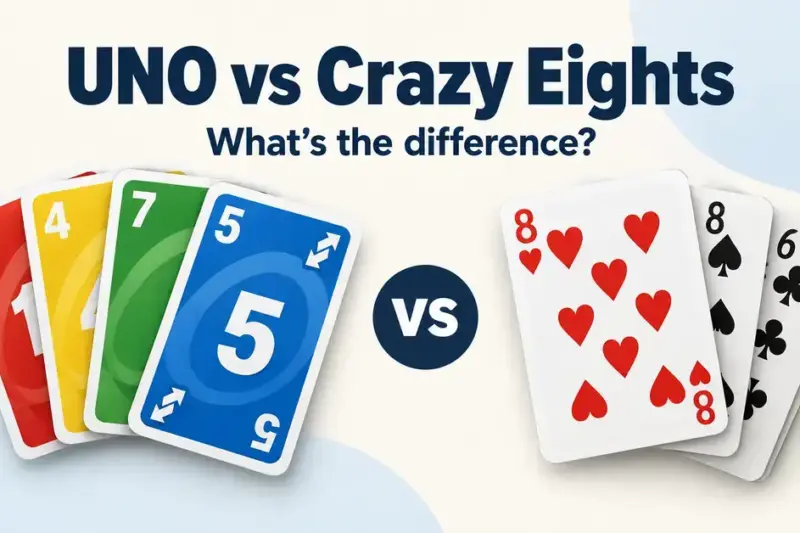
The game belongs to the same family as Crazy Eights, the traditional card game where you match the previous card by suit or rank. UNO took that simple idea, gave it its own colourful deck and added action cards that skip players, reverse the direction of play and force opponents to draw. The name is Spanish and Italian for “one”, a nod to the moment you are down to your final card and must announce it to the table.
UNO is published by Mattel and has grown into a whole family of games, from the classic deck to spin-offs such as UNO Flip, UNO Attack and UNO Show ’em No Mercy. The core rules described on this page apply to the standard game; the UNO versions guide covers how the different editions change things.
UNO at a glance
Before going into detail, here is the whole game in summary form. If you only need a quick reminder at the table, this table covers the essentials.
| Rule | Official answer |
|---|---|
| Number of players | 2 to 10 |
| Recommended age | 7 and up |
| Cards in the deck | 108 (112 in many newer boxes) |
| Cards dealt | 7 per player |
| Who goes first | The player to the dealer’s left |
| Direction of play | Clockwise, until a Reverse is played |
| A legal play | Match the top discard by colour, number or symbol, or play a Wild |
| If you can’t play | Draw one card; you may play it if it fits |
| Calling UNO | Required when you’re down to one card; caught = draw 2 |
| Stacking draw cards | Not allowed in the official rules |
| Winning a round | First player to empty their hand |
| Winning the game | First player to reach 500 points |
For a full walkthrough of these rules with examples, read our pillar guide on how to play UNO. If you want something to keep in the game box, there is also a printable version of the UNO rules.
What’s in an UNO deck?
A classic UNO deck contains 108 cards split into four colours (red, yellow, green and blue) plus a set of black Wild cards that belong to no colour. Knowing the deck makes the rest of the rules easier to follow, and it also helps you check whether a second-hand set is complete. Our guide on how many cards are in an UNO deck has the full card-by-card breakdown.
Number cards
There are 76 number cards, 19 in each colour. Each colour has a single 0 and two copies of every number from 1 to 9. Because there is only one 0 per colour, zeros are the rarest number cards in the deck. Number cards are the backbone of the game: most of your turns will be spent matching colours and numbers.
Action cards
There are 24 coloured action cards: two Skip, two Reverse and two Draw Two cards in each colour. These cards follow the same matching rules as number cards, so a green Skip can be played on any green card or on any other Skip. Their job is to change the flow of play, which is where most of UNO’s drama comes from. The UNO action cards guide explains each one in depth.
Wild cards
The standard deck has 8 Wild cards: four plain Wilds and four Wild Draw Fours. Wild cards can be played on top of almost anything, and the person who plays one chooses the colour that play continues in. The Wild Draw Four also forces the next player to draw four cards and lose their turn, but it comes with a restriction that we cover below.
108 vs 112 cards
Since 2015, many retail UNO boxes have contained 112 cards instead of 108. The extra four cards are a Wild Shuffle Hands card (earlier printings had Wild Swap Hands instead) and three blank customizable Wild cards that you can write your own rule on. All 108 classic cards are still there, so both decks play the standard game in exactly the same way. The extra cards are optional variety rather than a different rulebook.
| Card group | 108-card deck | 112-card deck |
|---|---|---|
| Number cards (0–9) | 76 | 76 |
| Skip, Reverse, Draw Two | 24 | 24 |
| Wild | 4 | 4 |
| Wild Draw Four | 4 | 4 |
| Wild Shuffle/Swap Hands | 0 | 1 |
| Customizable blank Wilds | 0 | 3 |
| Total | 108 | 112 |
How to set up a game of UNO
Setting up UNO takes less than a minute. The official instructions follow a simple order, and getting it right avoids arguments before the first card is even played.
- Choose a dealer. Each player draws one card; the highest number deals. Cards with symbols count as zero for this draw.
- Shuffle and deal. The dealer shuffles the whole deck and deals seven cards face down to each player, one at a time.
- Make the draw pile. The remaining cards go face down in the middle of the table.
- Start the discard pile. Turn over the top card of the draw pile and place it face up beside it.
- Begin play. The player to the dealer’s left goes first, and play moves clockwise.
Seven cards per player is fixed no matter how many people are playing, which is why very large groups need some adjustments. Our guide to playing UNO with large groups covers how to handle eight, nine or ten players, and when it makes sense to combine two decks.
What if the first card is an action card?
If the card turned over to start the discard pile is an action or Wild card, its effect applies to the opening turn. This is one of the most commonly forgotten official rules.
| First card turned over | What happens |
|---|---|
| Skip | The player to the dealer’s left is skipped |
| Reverse | Direction reverses; the player to the dealer’s right goes first |
| Draw Two | The first player draws two cards and loses their turn |
| Wild | The first player chooses the starting colour, then plays |
| Wild Draw Four | Return it to the deck, reshuffle, and turn over a new card |
How a turn works in UNO
Every turn follows the same pattern. Look at the top card of the discard pile, then either play a matching card or draw.
A card is playable if it matches the top discard by colour, number or symbol. If the top card is a blue 6, you may play any blue card, any 6 of another colour, or a Wild. If the top card is a red Skip, you may play any red card or any Skip of another colour. You play one card per turn, placing it face up on the discard pile.
Under the official rules you can only play a single card at a time, even if you hold two identical cards. Playing doubles is a popular house rule, explained in our article on whether you can play two cards at once in UNO.
What happens when you can’t play?
If you have no playable card, you draw one card from the draw pile. If that card can be played, you may play it immediately on the same turn. If it can’t, your turn ends and play passes to the next person.
This is where many tables drift away from the rulebook. Lots of players believe you must keep drawing until you find a card you can play, but that is a house rule rather than an official one. Our guide on whether you have to keep drawing until you can play compares both approaches and how they change the length of a game.
You are also allowed to draw instead of playing, even when you hold a playable card, as a tactical choice. In that case, you still draw only one card and may only play that drawn card if it fits.
What if the draw pile runs out?
Long rounds sometimes exhaust the draw pile. When that happens, set aside the top card of the discard pile, shuffle the rest of the discards, and place them face down as a new draw pile. Play continues as normal. Our guide on what happens when the UNO draw pile runs out explains the step-by-step reset.
UNO action cards explained
Action cards are what turn UNO from a matching exercise into a game of timing and nerve. Each card has a specific effect, and most rule disputes start here.
Skip
When you play a Skip, the next player in turn order loses their turn completely. Play moves to the player after them. A Skip can be played on a card of the same colour or on another Skip.
Reverse
A Reverse flips the direction of play, so clockwise becomes counterclockwise and vice versa. With three or more players this changes who goes next and can rescue you from an opponent who is about to win. With two players, a Reverse works like a Skip, because reversing direction hands the turn straight back to you. The full detail is in our UNO Reverse card rules guide.
Draw Two
A Draw Two forces the next player to draw two cards and miss their turn. Officially, they cannot respond by playing their own Draw Two to pass the penalty along. They simply take the cards and their turn is over.
Wild
A Wild card can be played on top of any card, and you choose the colour that play continues in. You may even name the colour that is already in play. Under the official rules a plain Wild can be played at any time, even when you hold other playable cards. Our UNO Wild card rules guide covers the edge cases, such as playing a Wild as your final card.
Wild Draw Four
The Wild Draw Four is the most powerful card in the deck and the most misunderstood. When you play it, you choose the next colour, and the next player draws four cards and loses their turn. However, it comes with a condition: you may only play it if you have no card in your hand that matches the colour of the top discard. Holding a card of the same number or symbol is fine; holding a card of the same colour is not.
Because opponents cannot see your hand, the rules include a challenge. If the player who must draw suspects the Wild Draw Four was played illegally, they can challenge. The player who played it must show their hand to the challenger:
- If the play was illegal, the person who played the card draws four cards instead.
- If the play was legal, the challenger draws the four cards plus two more, for six in total.
The challenge rule is what keeps the card fair. Our dedicated guide to UNO Wild Draw Four rules walks through how to challenge and when it is worth the risk.
When do you call “UNO”?
You must call “UNO” when you play your second-to-last card, leaving one card in your hand. It warns the table that you are about to go out.
If you forget and another player catches you before the next player begins their turn, you must draw two cards as a penalty. If nobody notices in time, you escape the penalty and the game continues. That small window is why sharp-eyed players watch hand sizes so closely. The calling UNO rule guide explains the timing in more detail, including what happens when two players call out at the same moment.
How to win and how UNO scoring works
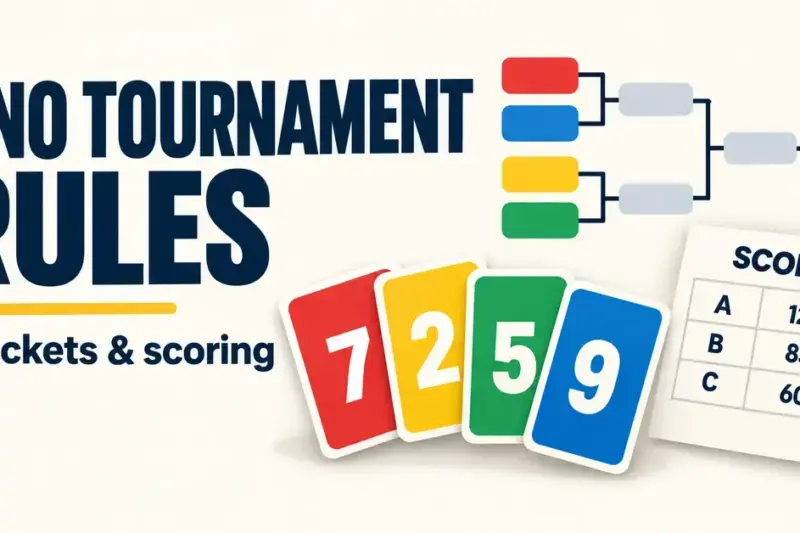
A round ends when one player plays their last card. That player wins the round and scores points for every card still held by their opponents. Points are added up round after round, and the first player to reach 500 points wins the game.
| Card | Points |
|---|---|
| Number cards (0–9) | Face value |
| Skip, Reverse, Draw Two | 20 each |
| Wild, Wild Draw Four | 50 each |
| Wild Shuffle Hands (112-card decks) | 40 |
| Customizable Wild (112-card decks) | 40 |
You may finish a round on any card, including an action card. If your final card is a Draw Two or Wild Draw Four, the next player still has to draw those cards, and they are counted in your score. Our UNO finishing rules guide covers what is and isn’t allowed as a last card.
Mattel’s instructions also describe an alternative scoring method in which each player keeps a running total of the points left in their own hand at the end of each round. When someone passes 500, the player with the lowest total wins. Many families also skip scoring entirely and simply play single rounds. The UNO scoring rules guide explains both systems, with worked examples and a simple tally sheet approach.
Common UNO rule myths
UNO is so widely played that many house rules have become “common knowledge”, even though they aren’t in Mattel’s instructions. Here are the most frequent misunderstandings and what the official rules actually say.
- “You can stack Draw Twos and Draw Fours.” You can’t, officially. Mattel’s UNO account publicly confirmed in 2019 that stacking is not part of the game. If someone plays a Draw Two on you, you draw two cards and your turn ends. See our UNO stacking rules guide for the full story and how to play it as a house rule.
- “You have to keep drawing until you can play.” Not officially. You draw one card, and if it can’t be played, your turn ends.
- “You can’t finish on an action card.” You can. Any card, including a Wild Draw Four, is a valid final card.
- “A Wild Draw Four can be played any time.” Only when you have no card matching the current colour; otherwise you risk a challenge.
- “You need to call UNO before playing your second-to-last card.” The call is linked to playing that card. Most groups accept a call as you lay it down, and the penalty only applies if you are caught before the next turn begins.
- “Reverse does nothing in a two-player game.” It acts as a Skip, giving you another turn.
Our UNO FAQ gathers the most-asked questions about disputed rules in one place, which is useful when you need a quick ruling mid-game.
Official optional rules and popular house rules
House rules are part of UNO’s charm, and Mattel’s own instructions acknowledge this by suggesting optional variants. The key is to agree on any changes before the first card is dealt. Our main guide to UNO house rules covers the full list; here are the ones you’ll meet most often.
Seven-O
In the Seven-O variant, playing a 7 lets you swap hands with another player of your choice, and playing a 0 makes every player pass their hand to the next player in the direction of play. It shakes up the game constantly and stops anyone from feeling safe. Read the UNO 7-0 rule guide for how to handle swaps when someone has just called UNO.
Jump-In
Jump-In lets a player play a card out of turn if it is an exact match (same colour and same number or symbol) for the top discard. Play then continues from the person who jumped in. It keeps everyone alert even when it isn’t their turn. The UNO Jump-In rule guide explains the timing and common disputes.
Stacking
Stacking allows a player hit by a Draw Two to play another Draw Two, passing a growing penalty to the next player. Some groups also allow stacking Wild Draw Fours, or mixing the two. It is the most popular unofficial rule in UNO, and also the one that makes games longest and most punishing.
Other popular variations
- Draw until you can play, which makes hands grow faster and rounds more chaotic.
- Doubles, where you can play two identical cards at once.
- Zero-point or no-scoring games, popular with younger players.
- Party and drinking-game variants for adult gatherings, covered in our UNO party rules and UNO drinking game rules guides. Please play those responsibly and only where you are of legal drinking age in your province or territory.
For even more ideas, browse our collection of fun UNO variations or the full House Rules category.
Playing UNO with different groups
The same rules work for almost any group, but a few adjustments make the game better depending on who is at the table.
Two players
UNO works surprisingly well as a head-to-head game. The deal and matching rules stay the same, but action cards change character: Skip and Reverse both give you an extra turn, and a Draw Two lets you play again after your opponent draws. That makes chaining action cards a strong tactic. Our guide to playing UNO with two players covers the tactics and a few optional tweaks.
Large groups
With eight or more players, seven cards each uses a large share of a single deck, and the draw pile empties quickly. Many groups shuffle two decks together for nine or ten players. Waiting time between turns also gets longer, which is why Jump-In works especially well with bigger groups. See UNO for large groups for setups that keep things moving.
Kids and families
UNO is a great first “real” card game for children because it teaches colour and number recognition, turn-taking and following rules. For younger kids, many families drop scoring, remove the Wild Draw Four challenge, and play with open hands until everyone is comfortable. Our UNO for kids guide has age-by-age suggestions, and the UNO Junior rules cover Mattel’s simplified edition for preschoolers.
UNO versions and spin-offs
Mattel has released dozens of UNO editions, and while many are simply themed artwork on the classic deck, others change the rules significantly. Our UNO versions pillar page compares the main editions, and the UNO Versions category collects every rules guide we have published.
Editions with new mechanics
- UNO Flip uses double-sided cards with a Light Side and a harsher Dark Side, switched by the Flip card. See UNO Flip rules.
- UNO Show ’em No Mercy is a deliberately brutal version with bigger draw cards, official stacking and a mercy rule that knocks out players with too many cards. See UNO No Mercy rules.
- UNO Attack replaces the draw pile with a card launcher that randomly fires out cards. See UNO Attack rules.
- UNO Showdown adds an electronic device that triggers head-to-head draw contests. See UNO Showdown rules.
- UNO All Wild makes every card a Wild, so the game is purely about action effects. See UNO All Wild rules.
- UNO Triple Play uses an electronic unit with three discard piles. See UNO Triple Play rules.
- UNO Battle Royale is a fan-driven variant that has taken off online. See UNO Battle Royale rules.
Collector and themed editions
Beyond rule-changing versions, there are themed decks, deluxe tins, braille editions and limited releases with special cards. Our guide to UNO special editions explains which ones play exactly like the classic game and which add extra cards you need to know about.
Related games from the UNO family
If you enjoy UNO, you might also like its relatives. DOS is a Mattel game that uses two discard rows and lets you match by sum, explained in our DOS rules. Skip-Bo is a sequencing game from the same publisher, covered in our Skip-Bo rules. For more alternatives, read our comparison of card games like UNO.
UNO strategy basics
UNO involves a lot of luck, but good players win more often over a full game to 500 points. The difference usually comes down to card management and paying attention to opponents.
- Hold onto Wild cards when you can. A Wild is your escape route when you run out of matching colours, so playing it too early can leave you stuck later.
- Shed high-value cards early in a round. If someone else goes out, the 20- and 50-point cards in your hand count against you.
- Watch hand sizes. When an opponent drops to two cards, save Skips, Reverses and Draw Twos to stop them.
- Track colours. If a player draws instead of playing on red, they probably have no red; switching to that colour can force them to keep drawing.
- Use your Wild Draw Four legally. Being caught by a challenge costs you four cards and gives away information about your hand.
- Change colour to your strongest suit. When you play a Wild, name the colour you hold the most of, not just the one you happen to like.
Our UNO tips for beginners build on these basics, and the advanced UNO strategy guide goes deeper into card counting, timing action cards and reading opponents. The how to win at UNO pillar page combines both, and every article on tactics is collected in our Strategy & Tips category.
A short history of UNO
UNO was created in 1971 by Merle Robbins, a barber from Reading, Ohio, who developed the game around his family’s kitchen table after an argument about the rules of Crazy Eights. He and his family printed and sold the first decks themselves, including from his barbershop and local businesses.
In 1972 Robbins sold the rights to a group of investors who formed International Games, Inc., which grew UNO into a national success through the 1970s and 1980s. Mattel acquired International Games in 1992, and UNO has since become one of the best-selling card games in the world, with editions printed in many languages and countless themed decks.
The rules have stayed remarkably stable over the decades. The biggest changes have been the addition of the Wild Shuffle Hands and customizable Wild cards to the standard deck, and Mattel’s increasingly public stance on house rules through its social media accounts. Our full guide to the history of UNO covers the story in detail, from homemade decks to global brand.
Playing UNO in Canada
UNO is a staple of Canadian game cupboards, from family cottages and school classrooms to camping trips and holiday gatherings. The rules are the same as everywhere else, since Canadian stores sell the standard Mattel editions. One practical difference is the packaging: boxes sold in Canada typically carry bilingual English and French text, and the rules sheet usually includes both languages, so French-speaking and English-speaking players can read the same official instructions.
The name doesn’t change in French, and neither do the core rules. The card names are translated (for example, a Draw Two is usually printed as a “+2” symbol on the card itself), but the symbols on the cards are universal, so a mixed-language group can play together without any confusion.
unorules.ca writes all of its guides in Canadian English, and every rules explanation is checked against Mattel’s official instruction sheets. You can read more about how we research and update our content in our editorial policy, or learn more about unorules.ca.
Where to start on unorules.ca
Not sure where to go next? Here is how the site is organized:
- New to UNO? Start with how to play UNO, then try the UNO tips for beginners.
- Settling a dispute? Check the Official Rules category or the UNO FAQ.
- Want to mix things up? Browse UNO house rules and fun UNO variations.
- Bought a new edition? Find its rules in our UNO versions guide.
- Want to win more? Head to how to win at UNO.
- Need a quick answer? Our Guides & FAQ category collects short explainers on common questions.
Reference sources
Frequently Asked Questions
What are the basic rules of UNO?
Each player is dealt seven cards. On your turn, you match the top card of the discard pile by colour, number or symbol, or play a Wild card. If you can’t play, you draw one card. Call “UNO” when you have one card left. The first player to empty their hand wins the round, and the first to 500 points wins the game.
How many cards do you get in UNO?
Every player starts with seven cards, regardless of how many people are playing. A standard deck has 108 cards, while many newer boxes have 112 cards because they include a Wild Shuffle Hands card and three customizable Wilds.
Can you stack Draw Two cards in UNO?
Not under the official rules. If a Draw Two is played on you, you draw two cards and lose your turn. Stacking is a very popular house rule, but Mattel has confirmed it is not part of the official game, so agree on it before you start.
What happens if you forget to say UNO?
If you play your second-to-last card without calling “UNO” and another player catches you before the next player starts their turn, you must draw two cards. If no one notices in time, there is no penalty.
When can you play a Wild Draw Four?
You can only play a Wild Draw Four when you have no card in your hand matching the colour of the top discard. The next player can challenge you. If you played it illegally, you draw four cards; if it was legal, the challenger draws six.
Can you win UNO with an action card?
Yes. Any card can be your last card, including a Skip, Reverse, Draw Two, Wild or Wild Draw Four. If you finish on a Draw Two or Wild Draw Four, the next player still draws those cards, and they count toward your points.
How many players can play UNO?
UNO is designed for 2 to 10 players. With two players, Skip and Reverse cards both give you another turn. For groups larger than ten, many players shuffle two decks together.