

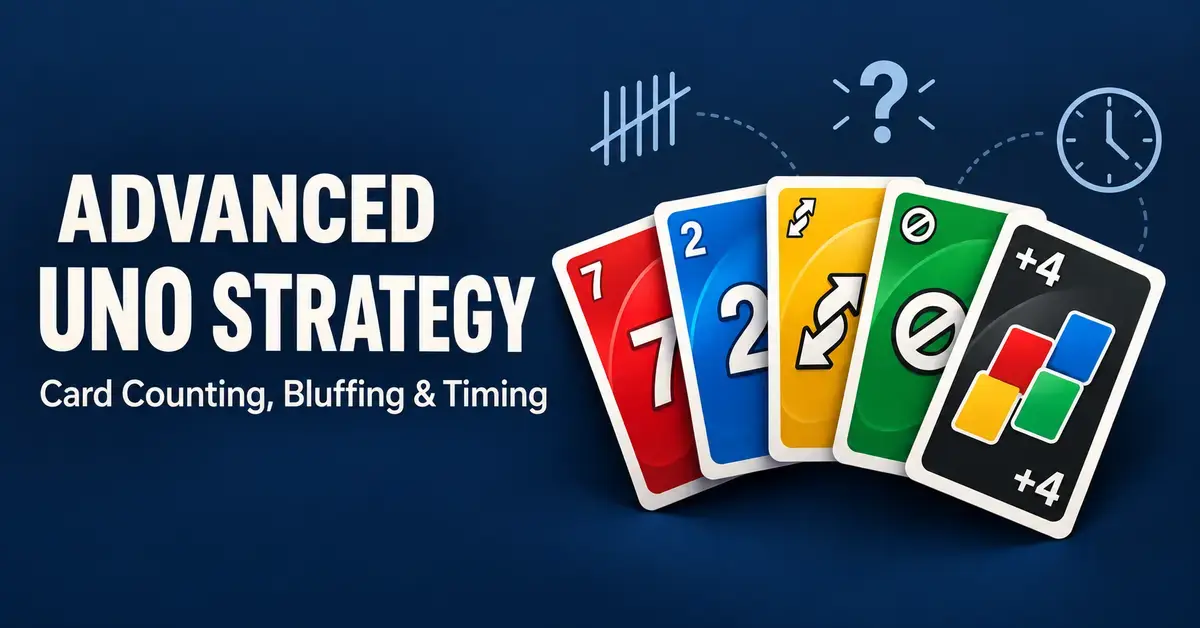
Advanced UNO strategy is about the decisions casual players never think about: tracking which colours and high-value cards are gone, timing a Wild Draw Four so opponents misjudge whether you are bluffing, knowing the exact moment to challenge, and aiming your attacks at the player closest to winning rather than the one sitting next to you. If you already know the basics and want to beat opponents who also know them, this guide covers the counting, bluffing, timing and team-play techniques that separate a strong player from a lucky one. For the wider fundamentals, start with our guide on how to win at UNO and treat this article as the next level up.
What “advanced” UNO strategy actually means
Advanced UNO strategy means playing the information and the table, not just your hand. Beginners react to the top card; advanced players build a running picture of what has been played, what opponents are likely holding, and who is the real threat, then choose the move that shapes the next several turns. None of it involves cheating — every technique here uses public information (the discard pile, how many cards each player holds, what they draw) and legal plays under the official rules of UNO.
Three ideas underpin everything that follows. First, cards are a limited resource: a standard deck has 108 cards, so once you see enough of a colour or an action card leave, you can estimate what is left. Second, tempo matters more than raw card count late in a round — a well-timed Skip or Draw Two can be worth more than emptying two number cards. Third, the winner of a round scores the points still in everyone else’s hands, so who wins and how much they leave behind both matter across a game to 500.
Key Strategies at a Glance
- Count colours and big cards: track which colours opponents draw on and how many Skips, Draw Twos and Wilds are already gone.
- Save your Wilds: keep at least one Wild and any Wild Draw Four for the endgame, not for minor jams.
- Bluff the Wild Draw Four with intent: play it against a player near UNO who is unlikely to risk a challenge.
- Challenge on evidence: lose a challenge and you draw six cards and miss your turn, so only challenge when you saw the colour in their hand.
- Attack the real threat: aim action cards at whoever can win the round or game, not automatically the next player.
- Play as a team: steer colours toward your partner and sacrifice turns for the teammate closest to going out.
Tracking cards: colour and card counting in UNO
Card counting in UNO is simply tracking what has already been played so you can predict what opponents hold and what the deck can still deal you. You do not need a perfect memory — even a rough count of colours and high-value cards gives you a real edge.
How to track colours
Watch which colour opponents are forced to draw on. If a player draws instead of playing when the pile is green, they probably hold few or no green cards. Store that fact: later, when you play a Wild or Wild Draw Four, switch the colour to the one they are weakest in, so your change of colour also traps them. Conversely, if you notice a colour has appeared far less than the others, the remaining cards of that colour are still in hands or the deck — useful when you decide which colour to steer the round toward.
Counting high-value cards
Keep a loose tally of the big cards, because they decide both the round and the score. A standard deck contains eight Skips, eight Reverses, eight Draw Twos, four Wilds and four Wild Draw Fours. If most of the Draw Twos and Wild Draw Fours have already been played, the risk of getting hit with a big draw late in the round drops sharply, so you can afford to sit on a low hand and wait. If almost none have appeared, assume opponents are holding them for the endgame and keep your own escape cards ready.
Reading what opponents draw
Every forced draw is information. A player who draws several times in a row is short on options and probably holding a hand full of one or two colours — press that weakness by keeping the active colour on their weak side. A player who suddenly stops drawing and starts dumping cards fast is trying to reach UNO; that is your cue to shift from building your own hand to slowing them down.
Wild Draw Four: bluffing and timing
The Wild Draw Four is the most powerful — and most misplayed — card in UNO, and using it well is the clearest sign of an advanced player. It forces the next player to draw four cards and skips their turn, and it lets you choose the next colour, all for a card worth 50 points if you are caught holding it.
When a Wild Draw Four is legal
Officially, you may play a Wild Draw Four only when you have no card matching the current colour. You are allowed to hold matching numbers, action cards or ordinary Wild cards — only a matching colour makes the play illegal. This rule is exactly why bluffing exists: no one else can see your hand, so you can play a Wild Draw Four even when you do hold a matching colour, betting that the next player will not challenge you.
How to bluff with a Wild Draw Four
Bluff when the reward is high and the reader is unlikely to challenge. The strongest moment is when the next player is close to winning: forcing four cards on someone at UNO can undo their whole round, and many players will not risk a challenge because losing one costs them even more. A slight, deliberate hesitation before you play can also nudge an opponent into a wrong read. Bluff sparingly, though — if you are caught and challenged successfully, you take the four cards yourself and hand the initiative back.
When to challenge a Wild Draw Four
Challenge only when the odds are on your side, because the penalty for a wrong challenge is steep. If you challenge and the play was illegal, the player who bluffed draws the four cards instead of you. But if the play was legal, you must draw six cards — the original four plus two more — and still miss your turn. Challenge when you have watched that player put down the current colour on a recent turn (so they likely still hold it), or when you are going to lose the round anyway and the swing is worth the gamble. Against a careful opponent who rarely bluffs, let it go.
Timing your action cards
Advanced players treat Skip, Reverse and Draw Two as tempo tools, not just cards to discard. The value of an action card depends entirely on when you play it. Dumping a Skip early to get rid of it wastes its best use: stopping a specific opponent at a specific moment.
- Skip: Save it to deny a turn to whoever is closest to UNO, or to give yourself back-to-back turns when a colour switch would help you.
- Reverse: In a three-or-more-player game, use it to skip back over a dangerous player or to hand the Draw Two coming your way back to the person who sent it. In a two-player game a Reverse acts as a Skip, letting you play again.
- Draw Two: Hold it for the leader’s turn so the four extra cards (if you chain your own turn) land on the threat, not on a player who is already buried.
- Wild: Keep at least one Wild for the endgame; it guarantees you can always play and lets you set a colour that strands an opponent.
Note that under official rules you cannot “stack” a Draw Two or Wild Draw Four to pass the penalty along — that popular twist is a house rule, not part of standard play. If your group uses it, plan for it, but do not assume it at an unfamiliar table. See our guide to UNO house rules for how stacking and other variants change the maths.
Targeting the point leader
In a game played to 500 points, you should aim your attacks at the player most likely to win the round or the game, not simply the next player in turn. Because the round winner scores every card left in the losers’ hands, letting a strong player go out while others hold heavy cards can swing the whole game. That makes card values a strategic input, not just a scoring detail.
Two habits help. First, know what the dangerous cards are worth so you can decide whose hand to attack and which cards to shed first — the cheat sheet below lists every value. Second, watch hand sizes: the player with the fewest cards is the immediate threat, but the player with the highest running score is the long-game threat. When those are different people, use your Skips, Draw Twos and Wild Draw Fours on whichever one can actually win from here, and offload your own 50-point Wilds before a round ends so you are not caught holding them.
UNO Card Points Cheat Sheet
| Card type | In a standard 108-card deck | Point value |
|---|---|---|
| Number cards 0–9 | 76 | Face value (0–9) |
| Skip | 8 | 20 |
| Reverse | 8 | 20 |
| Draw Two | 8 | 20 |
| Wild | 4 | 50 |
| Wild Draw Four | 4 | 50 |
Team play and reading the table
When UNO is played in teams — a common format in larger groups — the goal shifts from your own hand to getting one teammate out first. Coordinate colours: steer the active colour toward one your partner is strong in and away from your opponents’ strengths. Sacrifice for the teammate closest to UNO by using your action cards to skip opponents on their behalf, and change colours with your Wilds to set them up rather than yourself.
Reading the table matters even in a free-for-all. Track the mood of the game: who is frustrated and dumping cards, who is quietly holding a Wild Draw Four for a finish, and who keeps steering to one colour. The more players at the table, the more turns pass between yours, so the value of a Skip or Reverse that buys you tempo goes up. If your group enjoys team formats, several official editions are built around larger groups and partner play — see our overview of UNO versions and editions.
Common advanced mistakes
Even experienced players lose rounds to avoidable errors. The most common ones come from focusing on your own hand instead of the table.
- Playing Wilds too early. A Wild used to escape a minor jam is a Wild you do not have for the endgame — and 50 points in your hand if the round ends suddenly.
- Challenging on instinct. A failed challenge costs six cards and your turn. Challenge on evidence (you saw them hold the colour), not on suspicion alone.
- Attacking the next player by default. The next player is not always the threat. Aim Draw Twos and Skips at whoever is closest to winning the round or the game.
- Ignoring what opponents draw. Every forced draw tells you a colour they lack. Failing to log it wastes the best information the game gives you.
- Announcing your plan. Playing a colour you clearly need, or hesitating only when you are strong, teaches opponents to read you. Vary your tempo.
- Forgetting to call UNO. All the strategy in the world is undone by a missed “UNO” call and the penalty draw that follows.
Sources
Frequently Asked Questions (FAQ)
Is card counting allowed in UNO?
Yes. Counting cards in UNO simply means remembering what has already been played — the discard pile and every player’s forced draws are public information, so tracking them breaks no rule. It is a legitimate skill, unlike hiding cards or peeking at hands, which are cheating.
Can you play a Wild Draw Four if you have a matching colour?
Officially, no — a Wild Draw Four is legal only when you hold no card matching the current colour. You may still hold matching numbers, action cards or ordinary Wilds. Playing it with a matching colour is a bluff, and it is legal to attempt only in the sense that opponents can catch it by challenging.
What happens if you challenge a Wild Draw Four and lose?
If the play was legal, the challenger draws six cards — the four they were already required to take plus two more — and misses their turn. That steep penalty is why you should only challenge when you have real evidence the card was played illegally.
Should you save Wild cards for the end of the round?
Usually yes. Holding a Wild or Wild Draw Four guarantees you can always make a legal play and lets you switch to a colour that strands an opponent when it matters most. The trade-off is that each is worth 50 points if you are still holding it when someone else goes out, so shed them before a round ends if a win is out of reach.
Does bluffing actually work in UNO?
Yes, because opponents cannot see your hand. Playing a Wild Draw Four when you hold a matching colour, or hesitating to disguise a strong turn, can push opponents into wrong reads and costly challenges. Bluff sparingly and vary your timing, or observant players will learn your tells.
