
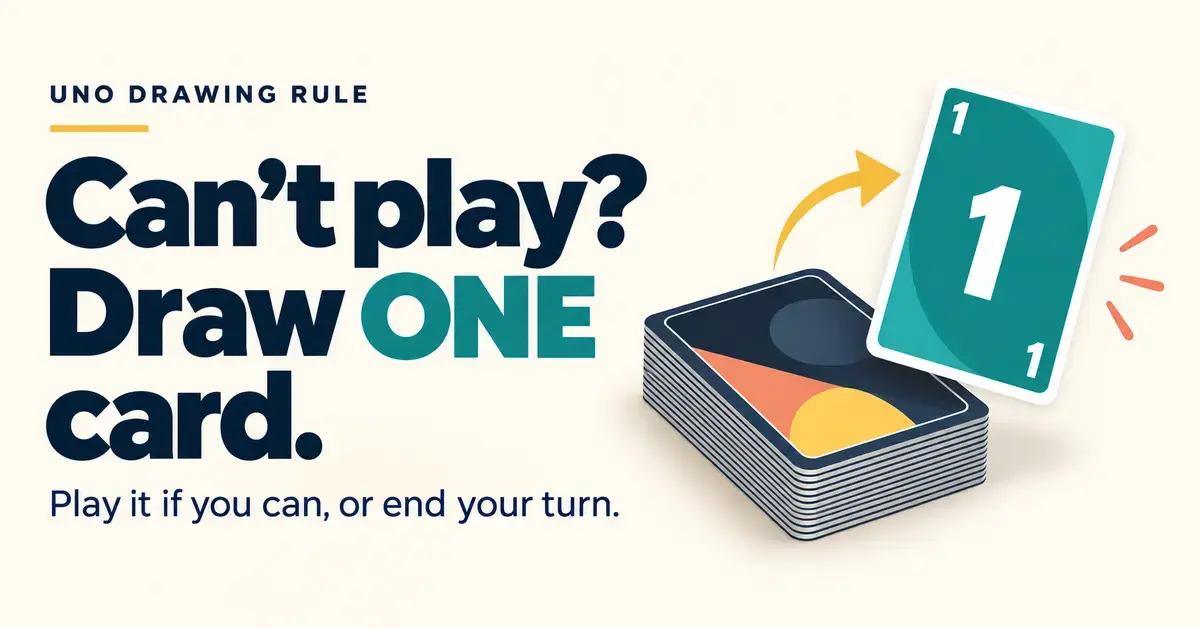
No — in official UNO you do not keep drawing until you can play. When it is your turn and you have no card that matches the top of the discard pile, you draw exactly one card from the draw pile. If that card can be played, you may play it right away; if it cannot, your turn simply ends and play moves to the next person. The popular habit of drawing again and again until you finally get a match is a house rule, not the real rule. This guide explains the official drawing rule step by step, where the “draw until you can play” version comes from, and the edge cases that trip players up.
Key Points
- Official rule: when you can’t play, you draw exactly one card — not until you get a match.
- If the drawn card is playable you may play it that turn; if not, your turn ends and you keep it.
- Playing the card you drew is optional, and you may draw voluntarily even when you hold a playable card.
- “Keep drawing until you can play” is a popular house rule, not the official rule.
- UNO No Mercy is the official edition that forces you to draw until you can play.
- UNO’s official account publicly confirmed the one-card rule in 2019.
The short answer: one card, then your turn ends
You draw a single card when you cannot play, and that is the whole rule. The official Mattel instructions say that if you do not have a card matching the colour, number or symbol on the discard pile, you take one card from the draw pile. If it is playable you are free to put it down in the same turn; if it is not, play passes to the next player and you keep the card you drew. There is no obligation — and no permission — to keep pulling cards until a match appears.
This surprises a lot of people, because “draw until you can play” is one of the most common ways the game is taught at home. It is worth knowing the official version, especially if you play with new groups, in tournaments, or alongside the other official UNO rules.
What the official Mattel rule says, step by step
The drawing rule has three simple stages. Walking through them removes almost every argument about how a turn should end.
Step 1 — Check whether you can play
On your turn you first look for a card that matches the top of the discard pile by colour, by number, or by symbol (Skip, Reverse, Draw Two). A Wild card can always be played. If you have a legal play, you may make it — see the next section on whether you are forced to.
Step 2 — If you can’t play, draw one card
When nothing in your hand matches, you take one card from the draw pile. Just one. This is the moment players most often get wrong by continuing to draw.
Step 3 — Play the drawn card or end your turn
If the card you just drew is playable, you may play it immediately in the same turn. If it is not playable, you keep it and your turn is over — play passes to the next person. You do not draw a second card, and you are never required to play a card you drew if you would rather hold it.
Can you play the card you just drew?
Yes — playing the card you drew is allowed but optional. If the single card you pick up happens to match the discard pile, you may put it down straight away, or you may choose to keep it in your hand and end your turn. Holding a useful card (for example, a Wild or a Draw Two you want to save) is a legitimate strategic choice, not a rule break.
Can you draw even when you have a playable card?
Yes. Under the standard rules you are allowed to draw a card from the pile on your turn even if you already hold a card you could legally play. You might do this to keep a strong card in reserve or to disguise your hand. As with the card you drew after being stuck, you then either play the newly drawn card (if it is playable) or end your turn. Some casual groups ban this, but the official rules permit it.
Why so many people play “draw until you can play”
“Draw until you can play” spread because it feels intuitive and keeps a turn going until something happens. For decades families taught it as the normal way to handle a dead hand, so a huge number of players genuinely believe it is the rule. The confusion became so widespread that UNO’s official account publicly clarified it in 2019, reminding everyone that you only draw one card and then skip your turn if you still cannot play — a post that went viral precisely because so many people were doing it the other way.
Both ways of playing are fine as long as everyone at the table agrees before the game starts. The table below shows exactly how the official rule and the house rule differ so you can pick one deliberately.
Official vs House Rule
| Aspect | Official Mattel rule | “Draw until you can play” house rule |
|---|---|---|
| Cards drawn when stuck | One | As many as needed until one is playable |
| After an unplayable draw | Turn ends, play passes on | You keep drawing |
| Must you play the drawn card | No — optional | Usually yes, play it once you can |
| Effect on hand size | Stays small | Can grow quickly |
| Draw pile use | Slow; reshuffle rarely | Fast; reshuffle often |
| Where it’s standard | Classic UNO and most editions | House rule; built into UNO No Mercy |
If you enjoy tinkering with the rules, the draw-until-you-can-play version sits alongside other popular tweaks — see our round-ups of fun UNO variations and the full catalogue of UNO house rules for ideas, all clearly labelled as unofficial.
UNO editions that make you draw until you can play
One official product does build draw-until-you-can-play into the box: UNO No Mercy. In UNO No Mercy (also sold as Show ‘Em No Mercy), if you cannot match the discard pile you must keep drawing until you get a card you can play — which is a big reason hands balloon and the game earns its brutal reputation. So the next time someone insists you have to keep drawing, they may simply be remembering No Mercy or a house-ruled table. In classic UNO and in most other editions, the one-card rule applies.
What happens when the draw pile runs out
If the draw pile empties, you do not stop the game — you rebuild it. Take the discard pile, leave the current top card in place, shuffle the rest, and turn it over to form a fresh draw pile. Play then continues normally. This matters for the drawing question because, under the official one-card rule, the pile is used up slowly; under draw-until-you-can-play it can run dry quickly, so expect to reshuffle more often. For more quick rulings like this, see our UNO FAQ.
Common mistakes with the UNO drawing rule
Most disputes over drawing come down to a handful of recurring errors. Knowing them keeps the game moving.
- Drawing more than one card when stuck. The single most common mistake — official UNO is one card, then your turn ends.
- Thinking you must play the card you drew. You may play it if it is legal, but you are allowed to keep it and pass.
- Believing you cannot draw if you hold a playable card. Voluntary drawing is allowed under the standard rules.
- Mixing up editions. Draw-until-you-can-play is correct in UNO No Mercy but not in classic UNO.
- Not agreeing the rule up front. Because the house rule is so common, decide before you deal which version you are using to avoid mid-game arguments.
- Forgetting to reshuffle. When the draw pile runs out, rebuild it from the discard pile rather than ending the round.
Sources
Frequently Asked Questions (FAQ)
Do you have to keep drawing until you can play in UNO?
No. In official UNO you draw one card when you cannot play. If it is playable you may play it; if not, your turn ends. Continuous drawing is a house rule.
How many cards do you draw in UNO if you can’t play?
Exactly one. You take a single card from the draw pile, then either play it (if it matches) or keep it and pass your turn to the next player.
Do you have to play the card you draw in UNO?
No. Playing the drawn card is optional even when it is a legal play. You can choose to keep it in your hand and end your turn instead.
Which UNO game makes you draw until you can play?
UNO No Mercy (Show ‘Em No Mercy) builds draw-until-you-can-play into its rules, so you keep drawing until you get a playable card. Classic UNO does not.
Can you draw a card in UNO even if you have a playable card?
Yes. The standard rules let you draw on your turn even when you already hold a card you could play, then play the drawn card or end your turn.
