
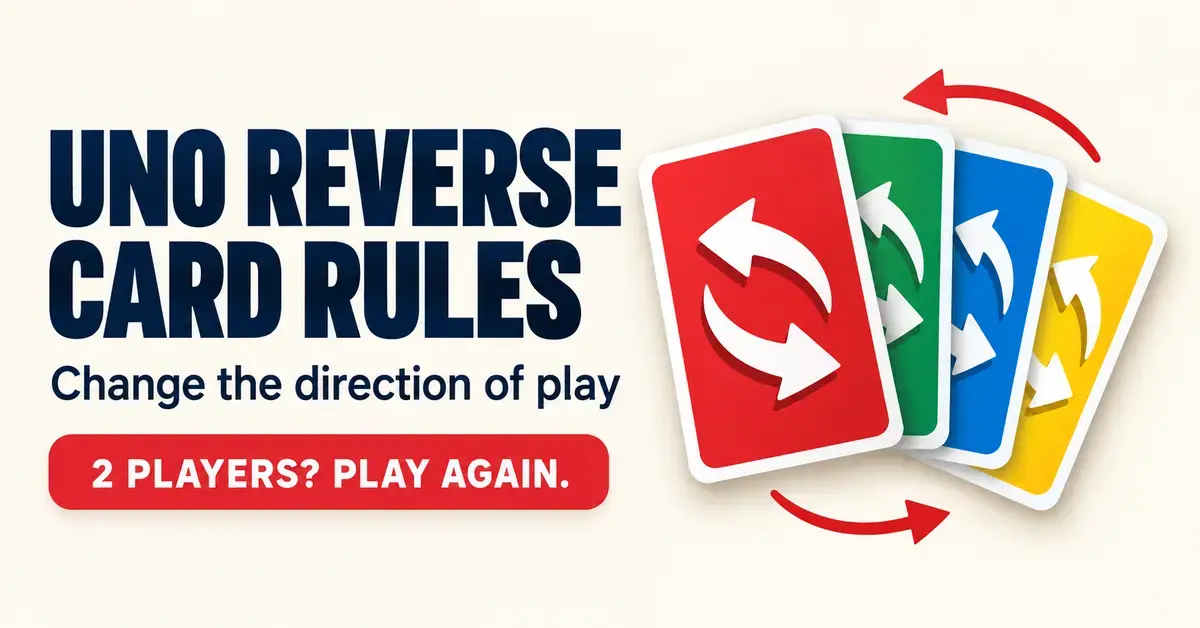
The UNO Reverse card changes the direction of play: when it is played, the order of turns flips from one direction to the other. It is one of UNO’s three coloured action cards, and in a two-player game it behaves very differently from a game with three or more players. This guide explains exactly what the Reverse card does, how it works at every player count, what it is worth when you score, the start-of-game edge case, and the most common mistakes people make with it — all based on the official Mattel rules.
Reverse Card Quick Facts
- What it does: reverses the direction of play (turns switch from left to right, or right to left)
- Cards per deck: 8 — two each in red, green, blue and yellow
- Point value: 20 points
- In a 2-player game: works like a Skip — you immediately play again
- You can play it on: a matching colour, or any other Reverse card
- As the first card flipped: the dealer plays first and play goes to the right
What does the UNO Reverse card do?
The Reverse card reverses the direction of play. If turns are passing to the left (clockwise), playing a Reverse makes them pass to the right (counter-clockwise), and vice versa. The card itself does not skip anyone or force a draw — it simply turns the table’s order of play around, so the player who went immediately before you is now the next to play.
There is one Reverse card in each of UNO’s four colours, printed with two curved arrows pointing in opposite directions. It is a coloured card, so it still has to follow the normal matching rule: you can play a Reverse on any card of the same colour, or on any other Reverse card regardless of colour. Reversing direction is the card’s only effect; the next player must still match the Reverse’s colour (or play another Reverse, a Wild, or a Wild Draw Four). For a full breakdown of how it sits alongside Skip, Draw Two and the Wild cards, see our guide to UNO action cards.
How does the Reverse card work with three or more players?
With three or more players, the Reverse flips the order of turns around the table. Say four players — A, B, C, D — are taking turns to the left in that order. If player B plays a Reverse, the direction switches: instead of C going next, play passes back to A, then D, then C, and so on in the new direction. Another Reverse later in the hand flips it back again.
Because it sends play back the way it came, the Reverse is most powerful when used to stop the player on your “downstream” side from going — or to hand the turn back to a player who has just been forced to draw. It never skips anyone outright in a multi-player game; everyone still gets a turn, just in the opposite order.
Reverse Card by Player Count
| Situation | What the Reverse card does |
|---|---|
| 2 players | Acts like a Skip — your opponent loses their turn and you play again immediately |
| 3 players | Flips the direction, so the player who went just before you is next |
| 4 or more players | Reverses the turn order around the table (clockwise becomes counter-clockwise, or vice versa) |
| Turned up to start the game | The dealer plays first and play passes to the right instead of the left |
How does the Reverse card work in a 2-player game?
In a two-player game, the Reverse card works like a Skip card: you immediately take another turn. This is an official rule printed in Mattel’s UNO instructions, not a house rule. With only two people at the table, reversing the direction of play would just hand the turn straight back to you — so the rules formalise that by letting you play again right away while your opponent loses their turn.
In practice that means you can chain cards. If you play a Reverse and then have another playable card, you can lay it down on the same turn. You can even play a second Reverse to go a third time, as long as each card matches. This makes the Reverse a genuinely useful tempo card in head-to-head UNO rather than a near-dead card. For the complete set of adjustments that apply when only two people play — including how Skip, Draw Two and Wild Draw Four behave — see our dedicated guide to playing UNO with 2 players.
What happens if a Reverse card is the first card flipped?
If a Reverse card is turned up to start the discard pile, the dealer plays first and play then goes to the right instead of to the left. Normally the player to the dealer’s left starts and play passes left; the opening Reverse flips that before anyone has even taken a turn, so the dealer effectively “gets” the first play and the order runs the other way.
This is different from the other action cards that can start the game. If a Skip is flipped first, the player to the dealer’s left is skipped; if a Draw Two is flipped first, that player must draw two and forfeit the turn. A Wild or Wild Draw Four turned up at the start is returned to the deck and a new card is drawn. Knowing the opening Reverse rule settles a surprising number of game-night arguments.
What can you play a Reverse card on, and what can you play after it?
You can play a Reverse card on any card that matches its colour, or on any other Reverse card of any colour. For example, a blue Reverse can go on any blue card or on a red, green or yellow Reverse. You cannot play a Reverse on a Skip or a Draw Two of a different colour just because they are both action cards — they are different symbols, so only the colour match counts.
After a Reverse is played, the next player must match its colour, play another Reverse, or play a Wild or Wild Draw Four. A Wild card changes the active colour but does not undo the direction change — once the order has flipped, it stays flipped until another Reverse is played.
How many Reverse cards are in a deck, and how many points is it worth?
A standard UNO deck contains eight Reverse cards — two each in red, green, blue and yellow. That is the same count as the Skip and Draw Two cards. Whether your deck is a 108-card classic set or a 112-card edition with extra Wilds, the Reverse count stays at eight.
Each Reverse card is worth 20 points when scoring. In standard UNO, the winner of a hand adds up the point value of the cards left in everyone else’s hands, so a Reverse caught in an opponent’s hand adds 20 points to your total. That is the same value as a Skip or a Draw Two, and more than most number cards, which score their face value. See how those numbers add up in our full guide to UNO scoring rules.
Can you stack Reverse cards or win the game on a Reverse?
Officially, there is no stacking of Reverse cards — the Reverse is not a draw card, so there is nothing to pass along the way players sometimes try to “stack” Draw Twos. Playing a Reverse on a Reverse simply flips the direction twice over the course of two turns. Some groups invent house rules around chaining cards, but these are not part of the official ruleset; our round-up of UNO house rules covers which extra rules people commonly add.
You can win the game by playing a Reverse as your last card. The official rules let you go out on an action card, and the Reverse’s effect still applies even as the final card of the hand — it flips the direction before the hand ends and scoring begins. A popular house rule bans finishing on action cards, but that is unofficial; we explain the official position in our guide to ending UNO on an action card.
Reverse card strategy: when to play it
Used well, the Reverse card controls who plays next and when. A few practical ideas:
- Protect your lead. If the player to your “downstream” side is close to winning or about to attack you, a Reverse sends the turn the other way and buys you time.
- Bounce a penalty back. After a player to one side has just drawn cards, a Reverse can keep the pressure on the players you want to target rather than letting the turn roll past them.
- Chain in two-player games. Because a Reverse lets you play again head-to-head, save one so you can offload a high-value card on the same turn, or combine it with a Skip for back-to-back plays.
- Hold it for colour control. Since a Reverse must match colour, keeping one of the active colour gives you a flexible card that also shifts the turn order in your favour.
Common mistakes with the Reverse card
The Reverse causes more table disputes than almost any other card. The mistakes to avoid:
- Treating it as a Skip with three or more players. With three or more players the Reverse only flips direction — it does not skip anyone. It acts like a Skip only in two-player games.
- Forgetting the two-player “play again” rule. In head-to-head UNO, a Reverse means you take another turn; it is not a wasted card and it does not simply pass back and forth for no reason.
- Playing it on the wrong card. A Reverse must match the colour on top or be played on another Reverse. It cannot be played on a Skip or Draw Two of a different colour.
- Getting the opening Reverse wrong. When a Reverse starts the discard pile, the dealer plays first and play goes to the right — not the player to the dealer’s left.
- Misreading the direction change. After a Reverse, the player who went immediately before the one who played it is next, which is easy to lose track of in a fast game.
What about the “UNO Reverse card” meme?
Beyond the game, the “UNO Reverse card” has become a popular internet meme used to describe turning a situation back onto whoever started it — the online equivalent of “no, you.” This cultural use has nothing to do with the official rules; in the actual card game the Reverse only changes the direction of play. The meme’s popularity has driven a lot of searches, but if you came here to settle a game-night rule, the sections above cover everything the card actually does. For the basics of a full game, start with our guide on how to play UNO.
Sources
Frequently Asked Questions (FAQ)
Does the UNO Reverse card skip a player?
Not in a game with three or more players — there it only reverses the direction of turns, and everyone still gets a turn. In a two-player game, however, the official rules say the Reverse works like a Skip: your opponent loses their turn and you immediately play again.
How many points is a Reverse card worth in UNO?
A Reverse card is worth 20 points. When you win a hand, you add up the point values of the cards left in your opponents’ hands, and each Reverse they are holding counts for 20 — the same as a Skip or a Draw Two.
Can you play a Reverse card on any colour?
You can play a Reverse on any card that matches its own colour, or on any other Reverse card of any colour. You cannot play it on a Skip or Draw Two of a different colour, because those are different symbols and only the colour match applies.
What happens if a Reverse is the first card at the start?
If a Reverse card is turned up to begin the discard pile, the dealer plays first and play then passes to the right instead of to the left. It is the only action card that changes who starts in this particular way.
How many Reverse cards are in an UNO deck?
There are eight Reverse cards in a standard UNO deck — two each in red, green, blue and yellow. That count is the same in both the 108-card classic deck and the 112-card editions.
