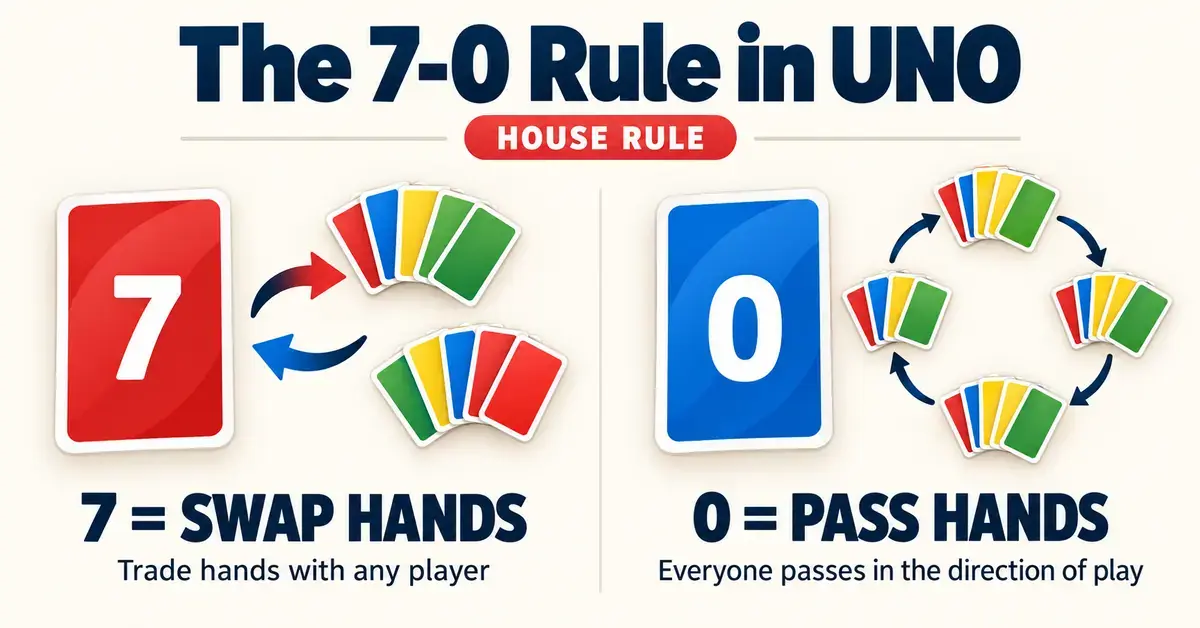
The 7-0 rule is one of the most popular unofficial UNO variations, and it can flip a game on its head in a single turn. Under this rule the humble number 7 and number 0 cards stop being plain point cards and become hand-swapping bombs: a 7 lets you trade your entire hand with someone else, and a 0 sends every player’s hand around the table. Below you’ll find exactly how each card behaves, whether it counts as official, a full worked example, and the strategy and mistakes that decide who benefits most.
What is the 7-0 rule in UNO?
The 7-0 rule is a house rule in which playing a 7 lets you swap your entire hand with another player of your choice, and playing a 0 forces every player to pass their whole hand to the next player in the current direction of play. The cards keep their normal color-and-number matching requirements — you can only play a 7 on a 7 or on a card of the same color, and the same goes for a 0 — but the moment one hits the discard pile, the special swap or pass happens.
The name simply comes from the two numbers involved: 7 triggers a chosen swap and 0 triggers a table-wide pass. It is sometimes written as the “seven-zero rule,” the “seven zero UNO rule,” or just the “swap hands rule.” Because it can rescue a player drowning in cards or punish someone who is about to win, it is one of the most chaotic and most-loved additions to a casual game.
Key Points
- 7 = swap: playing a 7 lets you swap your whole hand with a player of your choice.
- 0 = pass: playing a 0 makes everyone pass their whole hand in the current direction of play.
- House rule: not part of classic official UNO, but built into UNO Show ‘Em No Mercy (2023).
- Two players: both 7 and 0 simply swap hands with your single opponent.
- Matching still applies: a 7 or 0 must match the color or number of the top card before its effect triggers.
- Scoring unchanged: a 0 is still worth 0 points and a 7 is still worth 7 points.
Is the 7-0 rule official?
The 7-0 rule is not part of the classic, official UNO rulebook — it is a house rule — but Mattel made it official inside UNO Show ‘Em No Mercy (2023). In standard UNO, a 7 and a 0 are ordinary number cards worth 7 and 0 points with no special power. The swap-and-pass behavior only exists because players around the world adopted it and passed it on, which is the textbook definition of a house rule.
Mattel eventually embraced the idea. In UNO Show ‘Em No Mercy, the 7-swap and 0-pass mechanics are printed right into the official instructions, so they are no longer optional in that edition — they are simply how the game is played. If you own classic UNO, you and the other players just need to agree to switch the 7-0 rule on before the first card is dealt. To see where it sits among other optional tweaks, our guide to UNO house rules collects the most common ones in one place.
How the 7 card works: swapping hands
When you play a 7 under the 7-0 rule, you immediately swap your complete hand with one player of your choosing. You hand over every card you are holding and take everything that player was holding in return. You choose the target, which is what makes the 7 so powerful — you can dump a fat hand onto whoever is closest to winning, or grab a small hand from the player who is about to shout “UNO!”
A few details keep the swap fair and consistent:
- You must still play the 7 legally. It has to match the color or the number of the top discard, just like any other card.
- The swap is your whole hand, not a single card. Every card changes owner.
- You pick the target. You cannot be forced to swap; the choice belongs to the player who laid the 7.
- Play continues normally afterward. Once the swap is done, the turn passes to the next player in the current direction.
How the 0 card works: passing hands
When you play a 0, every player passes their entire hand to the next player in the current direction of play. Nobody chooses a target this time — the whole table shifts at once. If play is moving clockwise, each player hands their cards to the player on their left; if play is moving counter-clockwise, each hand goes to the player on the right.
Because a Reverse card changes the direction of play, the way a 0 rotates hands depends on which way the game is currently flowing when the 0 is played. That makes the 0 less precise than the 7 — you can’t aim it — but it is still a huge equalizer, because it can hand a bloated deck to someone who was comfortably ahead.
The 7-0 rule in a two-player game
In a two-player (1v1) game, the 7 and the 0 do exactly the same thing: you swap hands with your single opponent. With only two people at the table there is no “next player” to pass to other than the other person, and there is no one else to choose as a swap target, so both cards collapse into a straight hand exchange. That means the 7-0 rule stays fun in a duel, but it loses the targeting and rotation nuance that makes it so unpredictable with three or more players.
Worked example: the 7-0 rule in action
Imagine a four-player clockwise game with Ana, Ben, Cara, and Deepa sitting in that order. The card counts are:
- Ana – 2 cards
- Ben – 6 cards
- Cara – 5 cards
- Deepa – 8 cards
It is Deepa’s turn and she is losing badly with 8 cards. The top of the discard pile is a red 4. Deepa has a red 7, so she plays it. Because the 7-0 rule is on, she swaps her whole hand with Ana, who was about to win with just 2 cards. Now Deepa holds 2 cards and Ana holds 8 — a complete reversal in one move.
Play moves clockwise to Ana, who is now stuck. She plays a green 0 (it matches the green in a wild that was called earlier). Every player passes their hand one seat clockwise, to the player on their left:
- Ana’s 7 cards go to Ben
- Ben’s 6 cards go to Cara
- Cara’s 5 cards go to Deepa
- Deepa’s 2 cards go to Ana
After both special cards, Deepa — who started the round with the worst hand — is now sitting on 5 cards, while Ana, who was one card from victory, is down to 2 again but only after being dragged through the chaos. This is exactly why the 7-0 rule is loved and feared: two number cards completely rewrote the standings without a single Draw card being played.
How to add the 7-0 rule to your UNO game
Turning the 7-0 rule on takes nothing more than a group agreement before you deal. Follow these steps so nobody argues mid-game:
- Agree the rule is on before dealing. Confirm everyone understands that 7 = choose-a-player swap and 0 = pass all hands in the direction of play.
- Decide the pass direction wording. Agree that a 0 follows the current direction of play, and that Reverse cards can change which way hands move.
- Confirm the two-player exception. If only two of you are playing, both 7 and 0 mean “swap with the other player.”
- Keep scoring standard. A 0 is still worth 0 points and a 7 is still worth 7 points if you play to a points total; the rule changes what the cards do, not what they are worth.
If you enjoy this kind of twist, it pairs well with other options from our list of fun UNO variations, though stacking too many house rules at once can slow a game to a crawl.
7-0 rule vs standard UNO vs UNO No Mercy
The single biggest difference between the versions is whether the 7 and 0 have any special power at all, and whether that power is optional. In classic UNO they are plain number cards; with the 7-0 house rule switched on they gain swap and pass abilities; and in UNO Show ‘Em No Mercy those same abilities are printed into the official rules and can’t be turned off. The table below breaks down how the two cards behave in each version.
Comparison
| Version | What the 7 does | What the 0 does | Optional? |
|---|---|---|---|
| Classic / official UNO | Plain number card (worth 7 points) | Plain number card (worth 0 points) | No special effect |
| 7-0 house rule (added to classic UNO) | Swap your whole hand with a chosen player | Everyone passes their whole hand in the direction of play | Yes — must be agreed before dealing |
| UNO Show ‘Em No Mercy (2023) | Swap your whole hand with a chosen player | Everyone passes their whole hand in the direction of play | No — built into the official rules |
Because UNO Show ‘Em No Mercy bakes the 7-0 rule in permanently — alongside brutal extras like +6 and +10 draw cards and the 25-card knockout “mercy” rule — it is the fastest route to experiencing 7-0 without house-ruling a classic deck. Our full breakdown of the UNO No Mercy rules covers those other mechanics in detail.
Strategy tips for the 7-0 rule
The 7-0 rule rewards patience and timing more than any other house rule, because a swap is only powerful when the gap between hands is large. Keep these ideas in mind:
- Hold your 7 until you’re behind. Swapping when you already have few cards wastes the card; the 7 is at its best when you can offload a heavy hand onto a leader.
- Watch the whole table before playing a 0. A 0 rotates every hand, so make sure the pass benefits you — if the player receiving your cards is worse off than you, great; if not, hold the 0.
- Remember there are more 7s than 0s. A standard deck holds two 7s per color (eight total) but only one 0 per color (four total), so swaps come up roughly twice as often as full-table passes.
- Punish the caller. If someone is about to win with one or two cards, a well-timed 7 can steal their tiny hand and leave them with yours.
- Track the direction of play. Since a 0 follows the current direction and Reverse can flip it, playing a Reverse just before a 0 can redirect where the hands land.
Common mistakes with the 7-0 rule
The most common mistake is playing a 7 or 0 as soon as it is legal instead of waiting for the right moment. Because both cards can also be played as ordinary matches, new players often burn them early and lose the chance to reshape the game later. Other frequent errors include:
- Swapping into a worse hand. Playing a 7 without checking that your target actually has fewer cards can hand you a bigger deck than you started with.
- Forgetting the direction on a 0. Assuming hands always pass to the left ignores Reverse cards; the 0 always follows the current direction of play.
- Playing a 0 while you are winning. If you already have the smallest hand, a full-table pass usually gives your advantage away for free.
- Mixing up the two-player behavior. In a 1v1 game both cards simply swap with the opponent — there is no rotation and no choice of target.
- Assuming it is official everywhere. Outside of UNO No Mercy, the 7-0 rule only applies if every player agreed to it before the game, so confirm it is switched on first.
Who should play with the 7-0 rule?
The 7-0 rule suits groups that want more chaos, comebacks, and player interaction than standard UNO offers. It is ideal for casual game nights, families with mixed ages, and anyone who finds a normal game too predictable, because it keeps losing players in the fight until the very end. It is less suited to competitive players who prefer skill and card-counting to dominate, since a single lucky swap can erase a carefully built lead. If your table enjoys big swings and loud reactions, the 7-0 rule is one of the best house rules you can add.
Sources
Frequently asked questions (FAQ)
Is the 7-0 rule an official UNO rule?
No. In classic UNO the 7 and 0 are ordinary number cards, so the 7-0 rule is an unofficial house rule you must agree on before playing. The one exception is UNO Show ‘Em No Mercy, where the swap-and-pass mechanics are printed into the official rules.
What does the 7 do in the 7-0 rule?
Playing a 7 lets you swap your entire hand with any one player you choose. You give them all of your cards and take all of theirs, which makes the 7 ideal for offloading a large hand or stealing a small one.
What does the 0 do in the 7-0 rule?
Playing a 0 makes every player pass their whole hand to the next player in the current direction of play. Nobody picks a target; the entire table’s hands rotate one seat at once, following whichever way play is currently moving.
How does the 7-0 rule work with only two players?
In a two-player game both the 7 and the 0 do the same thing: you swap hands with your single opponent. There is no rotation and no choice of target because there is only one other person to exchange with.
Do 7 and 0 still have to match color or number?
Yes. The 7-0 rule does not change matching requirements. You can only play a 7 on a 7 or on a card of the matching color, and the same applies to a 0. The special effect happens only after the card is legally played.
