
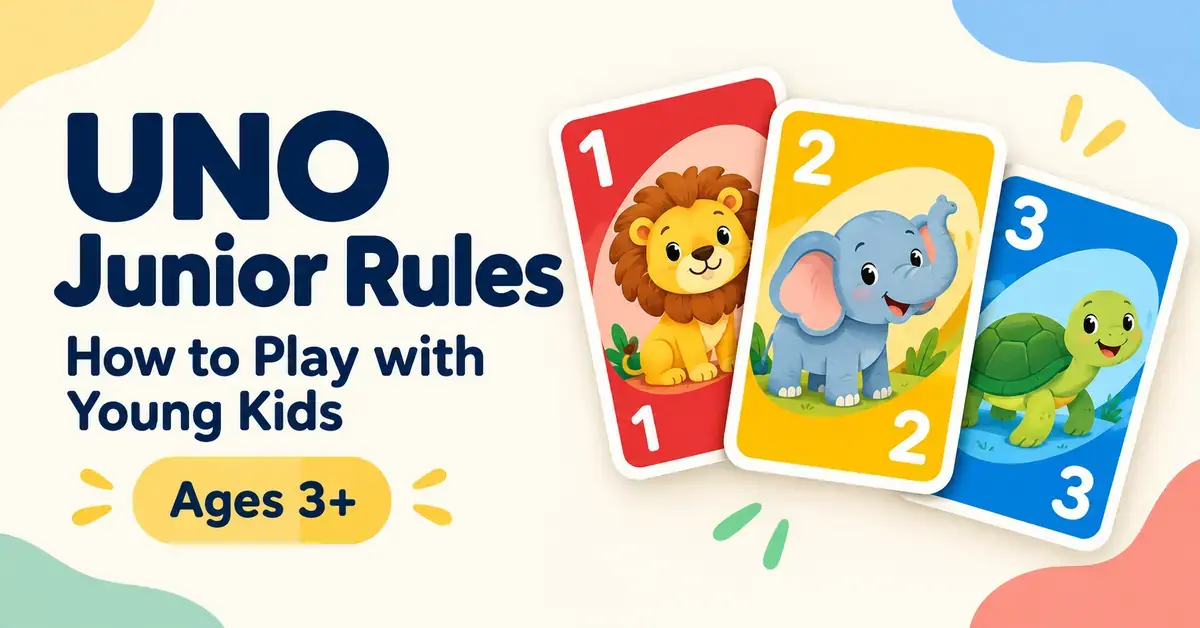
UNO Junior is Mattel’s simplified version of the classic card game, designed so children as young as three can join in. It keeps the familiar “match and shout UNO” idea but strips the rules down to their easiest form: fewer cards, fewer action cards, and picture animals on every number so a child who cannot yet read numbers can still play. This guide explains the UNO Junior rules from the box up — what is in the deck, how a turn works, how to win, the three difficulty levels that let the game grow with your child, and exactly how it differs from the grown-up game.
Quick Facts
| Publisher | Mattel |
|---|---|
| Players | 2–4 |
| Recommended age | 3+ |
| Game length | About 10–20 minutes |
| Deck size | Around 45 cards (older editions had 56) |
| Match by | Colour, number or animal |
| Action cards | Skip, Reverse, Draw One, Draw Two, Wild (no Wild Draw Four) |
| Goal | Be the first to play all your cards |
| Scoring | None — first to empty their hand wins the round |
What is UNO Junior?
UNO Junior is an official Mattel edition of UNO made for young children, recommended for ages 3 and up and for 2 to 4 players. A game usually takes about 10 to 20 minutes, which suits short attention spans.
The current edition is zoo-themed. Every numbered card shows a friendly animal alongside its colour and number, so a child can match on the picture alone before they know their numbers. That single change — matching by animal as well as by colour and number — is what makes the game work for pre-schoolers. If you already know the classic UNO rules, you will recognise the shape of the game immediately; UNO Junior is simply a gentler on-ramp to it.
What comes in the UNO Junior deck?
The UNO Junior deck is much smaller than a standard UNO deck. Card counts vary slightly between editions — the current retail edition is listed at around 45 cards, while older editions contained 56 — but the make-up is the same in spirit: mostly number cards plus a small handful of action cards.
The deck contains:
- Number cards in four colours — red, blue, green and yellow — each also showing a zoo animal (for example a blue panda or a red monkey).
- Skip cards, one per colour.
- Reverse cards, one per colour.
- Draw One cards, one per colour.
- Draw Two cards, one per colour.
- Wild cards, which can be played on any turn.
Crucially, there is no Wild Draw Four and no Draw Four card at all. The most punishing card in the adult game simply does not exist in UNO Junior, which keeps rounds friendly and short.
How do you set up UNO Junior?
Setting up takes less than a minute:
- Shuffle the cards and deal 5 cards to each player. With very young children you can deal the cards face up so an adult can help — there is no penalty for a visible hand.
- Place the rest of the deck face down in the middle as the draw pile.
- Turn the top card of the draw pile face up next to it to start the discard pile.
- The player to the dealer’s left goes first, and play moves clockwise.
How do you play UNO Junior?
On your turn you try to play one card that matches the top card of the discard pile. If you cannot match, you draw one card from the draw pile; if that drawn card matches, you may play it straight away, otherwise you keep it and your turn ends. The goal is to be the first player to get rid of every card in your hand.
Matching by colour, number or animal
A card matches the top of the discard pile if it shares the colour, the number, or the animal. For example, if the top card is a blue panda showing the number 5, you can play any of the following: any other blue card, any card showing the number 5, or any panda card of any colour. Three ways to match means young children almost always have a legal move, which keeps everyone in the game.
The action cards
UNO Junior uses only a few of UNO’s special cards, and each does exactly what its name suggests:
- Skip — the next player misses their turn.
- Reverse — the direction of play switches (clockwise to anti-clockwise and back).
- Draw One — the next player draws 1 card and misses their turn.
- Draw Two — the next player draws 2 cards and misses their turn.
- Wild — play it at any time on any card; you then call out the colour play must continue with.
Because there is no Wild Draw Four, no player can ever be forced to pick up four cards at once — a common source of tears at a young children’s table.
Calling “UNO!”
When you are down to your last card, you must shout “UNO!” before the next player takes their turn. If another player catches you before you call it, you draw 2 cards as a penalty. For very young children this rule is best treated as a fun ritual rather than strictly enforced.
How do you win UNO Junior?
You win a round by being the first player to play every card in your hand. UNO Junior has no point-scoring system — you do not add up card values as you do in the classic game’s race to 500 points. Most families simply play a fresh round each time and celebrate each winner, which is ideal for keeping small children happy.
The three levels of play
The clever part of UNO Junior is that it is designed to grow with your child through three levels of difficulty. You control the difficulty simply by deciding which cards go into the deck.
- Level 1 — matching only. Play with the number cards alone. Children practise matching by colour, number and animal with no special cards to remember. This is the ideal starting point for a three-year-old.
- Level 2 — add the action cards. Shuffle in the Skip, Reverse and Wild cards. Children now learn to react to a change of turn and to choose a colour with a Wild.
- Level 3 — add the draw cards. Finally add the Draw One and Draw Two cards for the full deck and a little more strategy. From here the step up to full UNO is small.
Exactly which cards belong to which level can vary slightly between editions, so always check the leaflet in your box — but the principle is always the same: start with plain matching and add complexity as your child is ready.
UNO Junior vs Classic UNO
| Feature | UNO Junior | Classic UNO |
|---|---|---|
| Recommended age | 3+ | 7+ |
| Players | 2–4 | 2–10 |
| Cards dealt | 5 | 7 |
| Deck size | ~45 (older editions 56) | 108 |
| Ways to match | Colour, number or animal | Colour, number or symbol |
| Number range | Small range with animal pictures | 0–9 |
| Draw cards | Draw One and Draw Two only | Draw Two and Wild Draw Four |
| Wild Draw Four | No | Yes |
| Scoring | None | Race to 500 points |
| Difficulty levels | Three built-in levels | One standard game |
How is UNO Junior different from classic UNO?
UNO Junior is a deliberately cut-down version of the standard game, and the differences all point in one direction: making the game gentler and quicker for little players. The comparison table above summarises the main points; in short, UNO Junior has a smaller deck, animal pictures for pre-readers, far fewer and gentler action cards, no Wild Draw Four, no point scoring and a lower recommended age (3+ rather than 7+). If you want to explore how it sits alongside the rest of the range, the site’s guide to the different UNO versions covers editions such as UNO Flip, UNO Attack and more.
Tips for playing UNO Junior with 3- and 4-year-olds
A few small adjustments make the first games go smoothly:
- Start at Level 1. Use only the number cards for the first few games so there are no surprises.
- Deal hands face up. Seeing everyone’s cards lets an adult gently prompt a good move and turns the game into a shared activity.
- Lean on the animals. If your child does not know their numbers, encourage them to match on the animal or the colour instead.
- Keep rounds short. Because there is no scoring, you can stop whenever attention fades and simply start again.
- Make “UNO!” the fun bit. Turning the shout into a game everyone enjoys keeps the mood light and teaches the rule without pressure.
Common mistakes to avoid
Even a simple game has a few pitfalls worth knowing:
- Forgetting you can match on the animal. Adults used to classic UNO often forget the third matching route and tell a child they have no move when they actually do.
- Enforcing the UNO penalty too strictly. With three-year-olds, drawing two penalty cards for a missed “UNO!” can end in frustration; keep it playful.
- Adding the draw cards too soon. Jumping straight to Level 3 can overwhelm a beginner. Build up level by level.
- Looking for a Wild Draw Four. It is not in the box — do not expect it.
- Trying to keep score. UNO Junior is not a points game; the winner is simply whoever empties their hand first.
If you enjoy inventing your own variations once the family has the basics, the site’s collection of UNO house rules offers plenty of ideas you can adapt for older children.
Who is UNO Junior best for?
UNO Junior suits families with children roughly aged 3 to 6 who are not yet ready for the full game. It is an excellent first card game because it quietly teaches colour and number recognition, turn-taking and simple decision-making while feeling like pure fun. Once a child comfortably handles Level 3 with all the action cards, they are usually ready to graduate to standard UNO.
Older children and mixed-age groups will get more out of the classic game, and readers who want to sharpen their play can pick up plenty of ideas in the guide to winning at UNO. For background on where the whole game came from, the history of UNO is a good next read.
Sources
Frequently Asked Questions (FAQ)
What age is UNO Junior for?
UNO Junior is recommended for ages 3 and up. Its animal pictures let children match cards before they can read numbers, and the three difficulty levels let the game grow with the child.
How many cards do you deal in UNO Junior?
You deal 5 cards to each player. The remaining cards form the draw pile, and the top card is turned over to start the discard pile. With very young children you can deal the hands face up.
Can you match cards by animal in UNO Junior?
Yes. A card matches if it shares the colour, the number or the animal of the top discard card. For example, a panda card can be played on any other panda card regardless of its colour or number.
Does UNO Junior have a Wild Draw Four?
No. UNO Junior includes plain Wild cards but has no Wild Draw Four and no Draw Four card. The strongest draw cards it uses are Draw One and Draw Two.
How do you win UNO Junior?
You win a round by being the first player to play all of your cards. Unlike classic UNO, there is no point scoring — most families simply start a new round after each winner.
