
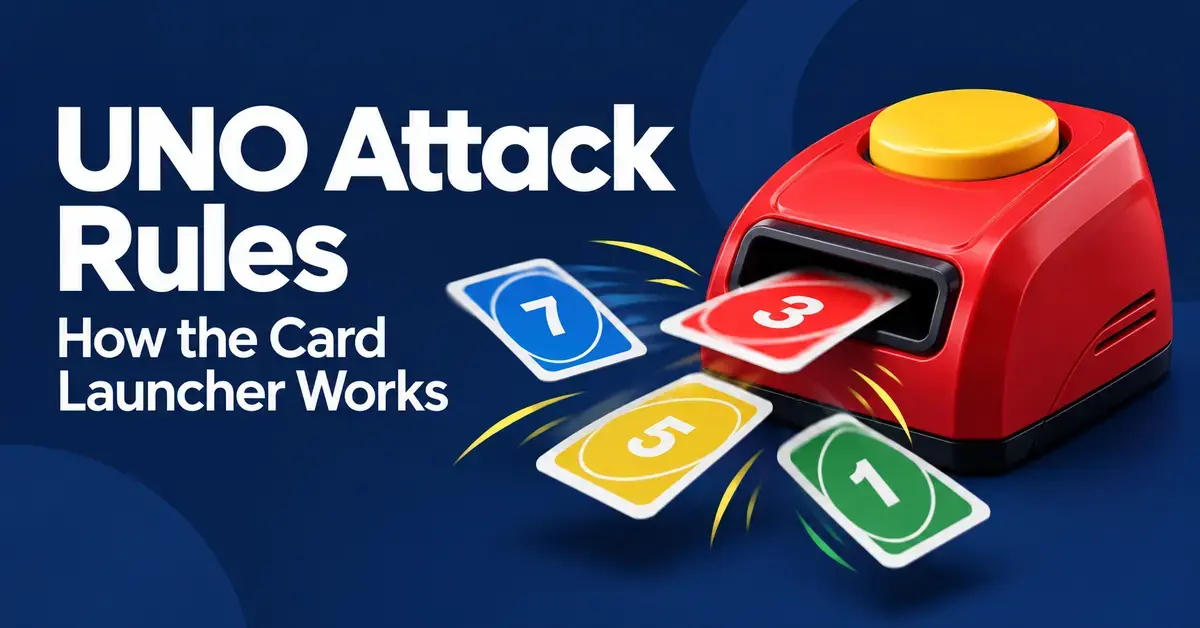
UNO Attack is a battery-powered version of the classic card game in which the familiar draw pile is replaced by an electronic card launcher. Instead of quietly drawing one card when you cannot play, you press a button and the machine may fire anywhere from zero to a small handful of cards straight into your hand. This guide explains exactly how that launcher works, what the special Hit and Discard cards do, how scoring runs to 500 points, and whether anyone actually gets eliminated — all fact-checked against Mattel’s own instructions and other authoritative rule sources.
Quick Facts
| Game | UNO Attack (also sold as UNO Extreme) |
|---|---|
| Publisher | Mattel |
| First released | 1998–1999 |
| Players | 2–10 |
| Recommended age | 7 and up |
| Deck size | ~112 cards (varies by edition) |
| Power | Electronic card launcher (classic unit uses 3 C batteries) |
| Goal | Empty your hand; first to 500 points wins the game |
What is UNO Attack?
UNO Attack is a Mattel card game, first released in 1998–1999, that keeps the core goal of UNO — be the first to empty your hand — but swaps the manual draw pile for a spring-loaded electronic launcher. In several regions the same game is sold under the name UNO Extreme, and a later edition is branded UNO Attack Mega Hit. It plays with 2 to 10 players and works for children and adults, because the rules are simple but the random launcher adds tension every turn.
If you already know standard UNO, most of the game will feel familiar: you match the top card of the discard pile by colour, number, or symbol, and you call “UNO” when you have one card left. The big difference is what happens when you cannot play. For the full basics of matching and calling, see our guide on how to play UNO.
How does the UNO Attack card launcher work?
The launcher replaces drawing entirely: when you cannot (or choose not to) play a card, you press the yellow button on the machine instead of taking a card from a pile. The launcher makes a chime and then randomly either does nothing or shoots out a burst of cards. Whatever fires out is added to your hand, and your turn ends. Because the number is random, one press might cost you nothing while the next costs you five or six cards.
What does the yellow launcher button do?
The yellow button is the heart of the game. Pressing it once is the equivalent of “drawing” in classic UNO, but the outcome is unpredictable: the internal mechanism releases a random number of cards, from 0 up to several at a time. You do not get to choose how many, and you cannot play any card the launcher gives you until your next turn. The launcher should always be turned to face whoever is currently taking their turn.
Why is the number of cards random?
The randomness is the whole point of the “Attack” theme. Inside the launcher, cards are held under spring tension behind a release gate. Each press advances the mechanism a little, but it only ejects cards when enough tension has built up, so most presses release nothing and occasional presses release a cluster. This means pressing the button is a gamble every time — a single unlucky press can undo several good turns.
Do you need batteries for UNO Attack?
Yes. The launcher is a motorised, battery-powered device; the classic UNO Attack unit runs on three C batteries. Without working batteries the launcher will not chime or dispense cards, so the game cannot be played as intended. This battery dependence is the main practical drawback compared with a normal deck of UNO.
UNO Attack setup: what you need
Setup is quick and only takes a minute once the batteries are installed:
- Choose a dealer, shuffle the deck, and deal seven cards to each player.
- Turn over the top card of the remaining deck to start the discard pile face-up in the middle.
- Load the rest of the deck face-down into the launcher, following the unit’s clip-and-door instructions, then switch it on.
- Place the launcher in the centre of the table, facing the first player.
If the very first card turned up is a special action card, most rule sets simply apply its effect to the first player, exactly as you would in standard UNO.
How to play UNO Attack, step by step
Play passes around the table, and on your turn you try to match the top card of the discard pile. Here is the basic turn structure:
- Match the top card by colour, by number, or by symbol (for example, play any red card on a red card, or any 7 on a 7).
- Wild cards can be played at any time and let you choose the colour that play continues with.
- If you cannot or do not want to play, press the yellow launcher button once, take any cards that fire out, and your turn ends.
- Call “UNO” the moment you play your second-to-last card, leaving you with one card in hand.
- Get caught not calling UNO and the penalty is harsher than in classic UNO — you must press the launcher button twice.
A round ends the instant one player plays their final card and has an empty hand.
UNO Attack special cards explained
UNO Attack keeps the familiar Reverse, Skip, and Wild cards, but replaces the classic “Draw 2” and “Draw 4” with launcher-based Hit cards, and adds colour-clearing Discard All cards. The exact mix of cards varies slightly between the original edition and UNO Attack Mega Hit, but the effects below are standard. The table lists what each card does and its typical point value for scoring.
| Card | What it does | Point value |
|---|---|---|
| Number cards (0–9) | Match by colour or number; no special effect. | Face value |
| Skip | The next player misses their turn. | 20 |
| Reverse | Reverses the direction of play. | 20 |
| Hit 1 | The next player must press the launcher button once. | 20 |
| Hit 2 | The next player must press the launcher button twice. | 20 |
| Discard All | Discard every card in your hand that matches this card’s colour. | 30 |
| Wild | Choose the colour that play continues with. | 50 |
| Wild Hit-Fire | Choose a colour; the next player presses the button repeatedly until cards fire out, then loses their turn. | 50 |
| Wild Attack-Attack | Choose a colour and a target player; that player presses the launcher twice. | 50 |
| Wild All Hit | Choose a colour; every other player presses the launcher button once. | 50 |
Point values follow UNO’s standard scoring conventions and can vary a little between editions, so always check the leaflet that came with your set. UNO Attack is one of several launcher and twist-based editions; you can compare it with the rest in our overview of UNO versions.
How do you win UNO Attack, and can you be eliminated?
You win the overall game by being the first to reach 500 points across multiple rounds — there is no player elimination in the standard rules. Each round has a single winner, but the game itself keeps going until someone crosses the points target.
Winning a single round
A round ends when one player gets rid of their last card. That player wins the round and scores points based on the cards still held by everyone else. Cards drawn from the launcher on your final move do not stop you winning as long as your hand is empty afterwards.
Playing to 500 points
At the end of each round, the winner adds up the point values of all the cards left in the other players’ hands (using the values in the table above) and banks that total. Rounds continue, and the first player to reach 500 points wins the whole game. Some groups instead agree that whoever has the most points when someone crosses 500 is the winner — decide this before you start.
Is anyone eliminated in UNO Attack?
No — under the official rules nobody is knocked out of the game. Every player stays in for every round; the launcher just makes hands grow and shrink unpredictably. “Elimination” only appears in optional house rules that some families invent, such as removing a player once they pass a certain score. If you want that, agree on it up front, because it is not part of the printed rules.
UNO Attack vs UNO Blast vs classic UNO
These three games are often confused, but they are genuinely different products with different mechanics:
- Classic UNO: You draw a single card from a face-down pile when you cannot play. Fully manual, no batteries.
- UNO Attack (1998–1999, also sold as UNO Extreme): There is no draw pile. You press a button and a random number of cards may fire out of the launcher.
- UNO Blast (2012): A separate battery-powered edition. You still draw a card, but instead of keeping it you feed it into a slot on the blaster; if that triggers the mechanism, the fired cards are yours.
So if you searched for “UNO Blast rules” expecting a button, note that UNO Blast uses a card-feeding slot rather than the press-button launcher used in UNO Attack.
Key Points
- The electronic launcher replaces the draw pile — press the yellow button and 0 to several cards may fire out at random.
- Hit cards force an opponent to press the button; Discard All lets you dump every card of one colour from your hand.
- Getting caught without calling “UNO” costs two button presses, not one card.
- There is no elimination — rounds are scored and the first player to 500 points wins.
- UNO Attack (button) is not the same game as UNO Blast (card-feeding slot).
Common UNO Attack mistakes to avoid
Most rule disputes at the table come from a handful of easy misunderstandings:
- Trying to play a launched card immediately. Cards the launcher gives you go into your hand and can only be played on a later turn, not the same turn.
- Forgetting the double penalty. Getting caught not calling “UNO” costs two button presses in UNO Attack, not one card as in classic UNO.
- Turning the launcher the wrong way. The launcher should face the current player, so nobody presses the button while it is aimed at someone else.
- Mixing up Hit and Discard cards. A Hit card forces an opponent to press the button; a Discard All card clears your own matching-colour cards — they do opposite things.
- Assuming pressing the button always costs cards. Many presses release nothing, so pressing is not automatically a punishment — it is a gamble.
Who is UNO Attack for?
UNO Attack suits players who like the familiar UNO format but want more unpredictability and a physical gadget on the table. It works well for family game nights and mixed-age groups because the rules stay simple while the launcher adds excitement and laughter. The main trade-offs are that it needs working batteries and the launcher can jam or wear out over time, so it is less portable and durable than a plain deck. If you prefer a purely card-based twist, other editions in the UNO family may suit you better.
Sources
Frequently Asked Questions (FAQ)
Does UNO Attack have a draw pile?
No. UNO Attack has no draw pile at all. When you cannot play a card, you press the yellow button on the electronic launcher instead, and it may fire a random number of cards into your hand.
How many cards does the launcher shoot out?
A random amount, from zero up to several at once. The mechanism only releases cards when enough internal tension has built up, so most presses release nothing while occasional presses release a burst.
Do you need batteries to play UNO Attack?
Yes. The launcher is motorised and the classic unit runs on three C batteries. Without them the launcher will not chime or dispense cards, so the game cannot be played as designed.
What is the difference between UNO Attack and UNO Blast?
In UNO Attack you press a button and the launcher may shoot out cards. In UNO Blast you draw a card and feed it into a slot on the blaster; only if that triggers the mechanism do the fired cards become yours. They are two separate Mattel products.
Can you get eliminated in UNO Attack?
Not under the official rules. Every player stays in for the whole game, which is played to 500 points across several rounds. Elimination only appears in optional house rules that groups invent themselves.
