
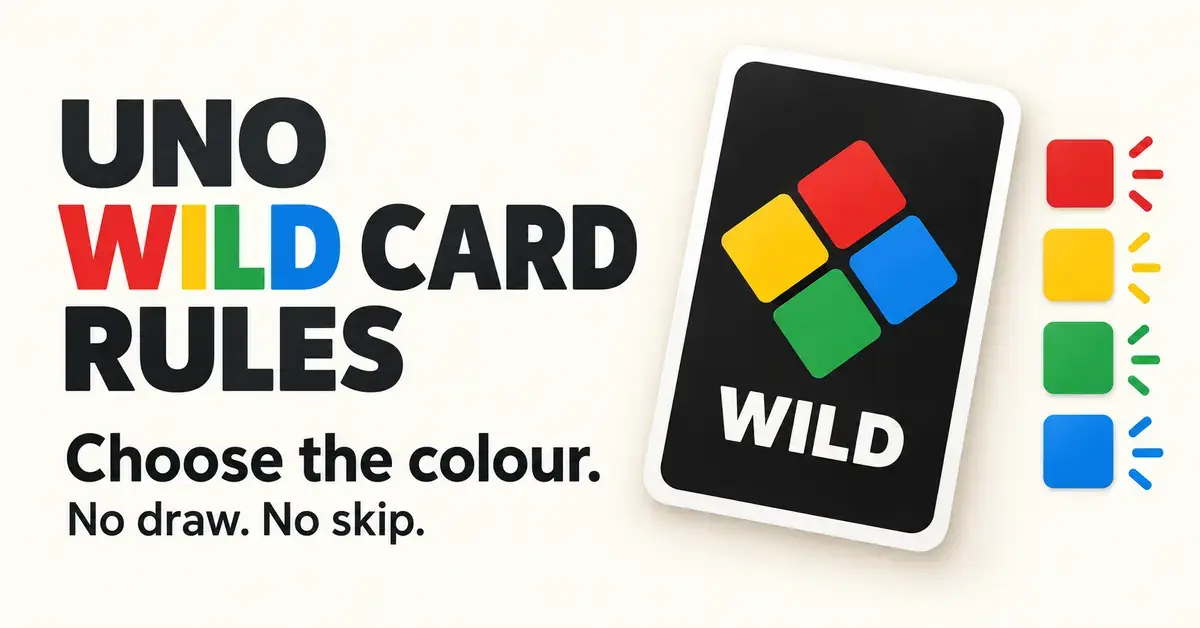
In UNO, a Wild card is the one card you can almost always play: it matches any colour, so you can lay it down on your turn no matter what is showing on the discard pile, and when you do, you choose the colour that play continues in. The plain Wild does not force anyone to draw cards or miss a turn — that is the job of its more aggressive cousin, the Wild Draw Four. This guide covers when and how to play a Wild, the full family of wild cards in a modern deck, how many points they are worth, and the mistakes that cost players games.
Wild Cards at a Glance
- Play it any turn: a standard Wild matches every colour, so it is always a legal play on your turn — no matching needed.
- You choose the colour: name red, yellow, green or blue (you may keep the current colour) before your turn ends.
- No draw, no skip: a plain Wild has no penalty — only the Wild Draw Four makes the next player draw and lose a turn.
- Worth 50 points each if caught in your hand at the end of a round.
- Count: 8 wild cards in a classic 108-card deck (4 Wild + 4 Wild Draw Four); 112-card decks add 4 more.
What is a Wild card in UNO?
A Wild card is a black, colourless card that matches every colour. Because it has no colour or number of its own, it can be played on top of any card during your turn, and the moment you play it you name the colour — red, yellow, green or blue — that the next player must follow. There are two black cards in classic UNO: the standard Wild and the Wild Draw Four. They share the colour-changing power, but only the Wild Draw Four adds a penalty.
Wild cards exist to give you an escape hatch. If you are stuck with nothing that matches the colour or number on the pile, a Wild lets you keep playing and steer the game into a colour that suits your hand. They are the most flexible cards in the deck, which is also why they are worth the most points if you are caught holding one at the end of a round.
When can you play a Wild card?
You can play a standard Wild card on any of your turns, regardless of the card showing on the discard pile. There is no colour, number or symbol you need to match first — a Wild beats that requirement by design. This is the key difference from the Wild Draw Four, which the official rules only let you play when you have no card matching the current colour.
Playing a Wild on your turn
On your turn you have two choices: play a card that matches the top of the pile by colour, number or symbol, or play a Wild. A plain Wild is always a legal play. After you place it, you announce the new colour out loud and your turn ends — nobody draws, nobody is skipped, and play simply continues to the next person in the current direction. You do not have to be stuck to play a Wild; you can play one whenever it is strategically useful.
What if a Wild is the first card turned up?
Sometimes the very first card flipped from the draw pile to start the discard pile is a Wild. Under the traditional printed rule, the player to the dealer’s left chooses the starting colour and then plays the first card. Some newer UNO sets and the official app instead return the Wild to the deck and flip again until a number card appears. Decide which version your group is using before the first hand so there is no argument mid-game.
How to choose a colour after playing a Wild
After you play any Wild, you must declare the new colour before your turn ends. Say the colour clearly — “blue” — so every player knows what the next person has to match. You are allowed to pick the colour that was already in play if that works best for you; the rule simply requires that a colour is named. If you forget to call a colour, the standard fix is that you must still choose one before the next player can act; you cannot leave the colour undecided.
Choosing the right colour is where the skill lies. Pick the colour you hold the most of so you can follow your own Wild, and watch which colours opponents have been dodging — a colour someone keeps avoiding is often one they cannot play.
Wild card vs Wild Draw Four: what’s the difference?
Both cards change the colour, but the Wild Draw Four also forces the next player to draw four cards and lose their turn. Crucially, the two cards have different rules about when you may play them. A plain Wild can be played any time; a Wild Draw Four may officially only be played when you hold no card of the colour currently in play. That restriction is what makes the Wild Draw Four challengeable — if the next player suspects you played it illegally, they can challenge, and a bluffer who is caught draws the four cards instead. The full challenge mechanic, including the six-card penalty for a failed challenge, is covered in our UNO Wild Draw Four rules guide. For how every symbol card behaves, see our breakdown of UNO action cards.
Wild Card Comparison
| Card | What it does | When you can play it | Points | In a 112-card deck |
|---|---|---|---|---|
| Wild | Changes the colour; no penalty | Any turn | 50 | 4 |
| Wild Draw Four | Changes colour; next player draws 4 and is skipped | Only when you hold no card of the current colour | 50 | 4 |
| Wild Shuffle Hands | Collects all hands, shuffles, re-deals; changes colour | Any turn | 40 | 1 |
| Customizable Wild | Blank card for a house rule, or play as a normal Wild | Any turn | 40 | 3 |
The other wild cards in modern UNO decks
Newer UNO decks print 112 cards instead of the classic 108, and the extra four are all wild cards. Knowing them prevents confusion when a deck contains cards the old rulebook never mentioned.
- Wild Shuffle Hands — the player collects every player’s hand, shuffles them all together, and re-deals the whole pile one card at a time starting with the player to the left. It also lets you choose the next colour. (In 2015–17 sets this card was Wild Swap Hands, which instead swapped your hand with one chosen opponent.)
- Customizable Wild cards — three blank black cards you can write a house rule on, or treat as an ordinary Wild if you prefer not to use them. They let a group add its own twist without changing the official deck.
If you enjoy the colour-changing chaos, Mattel also sells an entire UNO All Wild deck in which every single card is a wild of some kind.
How many Wild cards are in an UNO deck?
A classic 108-card UNO deck contains eight wild cards: four standard Wild cards and four Wild Draw Four cards. A 112-card deck — standard in most sets sold since 2017 — contains twelve wild cards in total, adding one Wild Shuffle Hands card and three customizable Wild cards to the original eight. Everything else in the deck (the numbered and coloured action cards) stays the same between the two versions.
How many points is a Wild card worth?
Standard Wild and Wild Draw Four cards are each worth 50 points — the highest value in the game. The Wild Shuffle Hands (or Swap Hands) card and the customizable Wild cards are worth 40 points each. Because the winner of a round scores the value of the cards still in everyone else’s hands, being caught holding a Wild at the end is expensive, which is one reason strong players try to play theirs rather than sit on them too long. For the complete point table and how rounds add up to 500, see our UNO scoring rules.
Can you stack Wild cards?
No — stacking is not part of the official UNO rules. Mattel has publicly confirmed that you cannot respond to a Wild Draw Four by playing your own Draw Four (or a Draw Two) to pass the penalty along. When someone plays a Wild Draw Four against you, you draw four and lose your turn; you do not get to stack. Stacking is a widely used house rule, and some editions such as UNO No Mercy build it in, but it is unofficial in standard play. The details and the editions that allow it are covered in our UNO stacking rules guide.
Can you win UNO on a Wild card?
Yes. Officially you may play your last card even if it is a Wild or Wild Draw Four, and the card’s effect still applies — so winning on a Wild Draw Four still makes the next player draw four, which is then scored against them. A common house rule bans finishing on any action or wild card, but that is unofficial. We cover both positions in our guide to the UNO finishing rules.
Common mistakes with Wild cards
Even experienced players slip up on the wild rules. These are the errors that come up most often at the table.
- Forgetting to declare a colour. A Wild is not fully played until you name the new colour. Say it out loud every time.
- Confusing the Wild with the Wild Draw Four. A plain Wild does not make anyone draw or skip. Only the Wild Draw Four carries a penalty.
- Playing a Wild Draw Four when you have a matching colour. That is an illegal play under official rules and can be challenged — the plain Wild has no such restriction, but the +4 does.
- Trying to stack a Wild Draw Four. It is not allowed in official play unless the group has agreed to the house rule in advance.
- Hoarding Wilds too long. At 50 points each, a Wild left in your hand when someone else goes out is a painful score against you.
Wild card strategy: when to play and when to hold
The best time to play a plain Wild is when you are genuinely stuck with no matching card, or when you want to swing the colour to one you can follow on your next turn. Because a Wild is a guaranteed legal play, it is also a reliable way to dump a card and get closer to UNO without drawing from the pile.
Holding a Wild has value too. Late in a round, a Wild in reserve guarantees you a playable card, which can stop you being forced to draw when you are down to your last few cards. The balance is to keep a Wild for flexibility without carrying it so long that you eat 50 points if an opponent goes out first. If you are new to the game, start with the official UNO rules for the full turn structure, then layer wild-card timing on top.
Sources
Frequently Asked Questions (FAQ)
Can you play a Wild card at any time in UNO?
You can play a standard Wild on any of your turns, regardless of the card on top of the discard pile, because it matches every colour. You cannot play it out of turn in standard rules. The Wild Draw Four is the exception: officially you may only play it when you have no card of the current colour.
Do you have to say a colour when you play a Wild?
Yes. Declaring the new colour is part of playing the card — your turn is not complete until you name red, yellow, green or blue. You may choose the colour that was already in play if it suits your hand.
How many points is a Wild card worth in UNO?
A standard Wild and a Wild Draw Four are each worth 50 points, the highest in the deck. The Wild Shuffle Hands card and the customizable Wild cards found in 112-card sets are worth 40 points each.
What is the difference between a Wild and a Wild Draw Four?
Both change the colour, but a Wild Draw Four also forces the next player to draw four cards and lose a turn, and officially can only be played when you hold no card of the current colour. A plain Wild has no penalty and can be played any turn.
Can you stack a Wild Draw Four on another Wild Draw Four?
Not under official rules. Mattel has confirmed there is no stacking in standard UNO, so you draw the four cards and lose your turn. Stacking is a popular house rule that some editions build in, but it must be agreed before play.
