
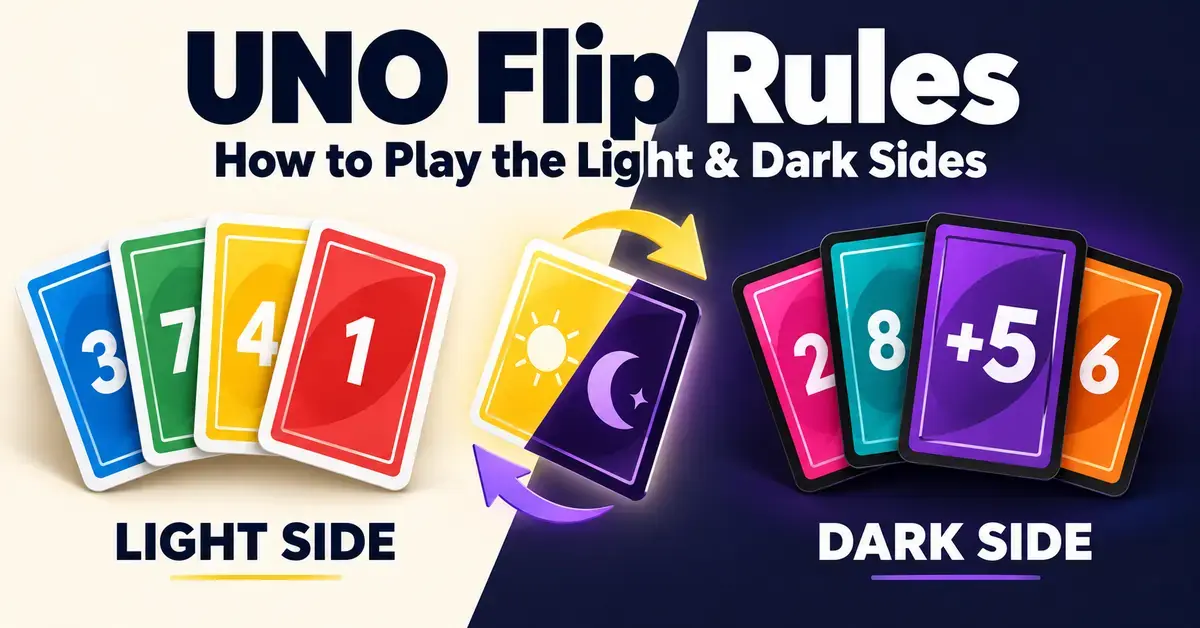
UNO Flip is a version of UNO played with a double-sided deck: every card has a bright Light side and a menacing Dark side, and a single Flip card can switch the whole table from one to the other in an instant. You start on the gentle Light side, but the moment someone plays a Flip card the entire game turns over — the draw pile, the discard pile and every player’s hand — revealing far harsher Dark-side penalties. This guide explains the full UNO Flip rules step by step, breaks down every Light- and Dark-side card, and shows exactly how the game differs from classic UNO.
Key Points
- Players: 2–10, ages 7+
- Deck: 112 double-sided cards (Light side and Dark side)
- Light colours: blue, green, yellow, red
- Dark colours: pink, teal, purple, orange
- Goal: be first to play all your cards; play to 500 points across rounds
- The twist: a Flip card turns the entire game — all piles and hands — to the opposite side
- Watch out: the Dark side’s Draw Five and Wild Draw Color are far harsher than classic UNO penalties
What is UNO Flip?
UNO Flip is an official UNO variant built around a reversible, double-sided deck of 112 cards for 2–10 players, aged 7 and up. The core goal is the same as regular UNO: be the first to get rid of all your cards by matching the top card of the discard pile by colour, number or symbol. The twist is that every card can be played from two different faces.
One face is the Light side, which uses the familiar blue, green, yellow and red colours and plays almost exactly like standard UNO. The other face is the Dark side, which swaps in pink, teal, purple and orange colours and replaces the usual mild penalties with much heavier ones. Because the sides are printed back-to-back, only one side is ever in play at a time — and the Flip card is what moves everyone between them.
What you need and how to set up
You only need the UNO Flip deck and two or more players to start. Setup mirrors classic UNO:
- Deal seven cards to each player. Everyone holds their cards with the Light side facing them — the game always begins on the Light side.
- Form the draw pile by placing the rest of the deck face down (Light side down) in the middle of the table.
- Turn over the top card to start the discard pile. If it is an action card, its effect usually applies to the first player, just as in regular UNO.
- Choose a starting player and a direction of play; play normally moves clockwise until a Reverse card changes it.
How do you play UNO Flip turn by turn?
On your turn you must play one card that matches the top card of the discard pile by colour, by number, or by symbol (for action cards). For example, on the Light side you can play any blue card on a blue card, any 7 on a 7, or any Skip on a Skip regardless of colour.
If you cannot play a matching card, you draw one card from the draw pile. If that drawn card can be played, you may play it immediately; if not, your turn ends and play passes to the next person. When you are down to one card, you must call “UNO” — if another player catches you failing to do so before the next player takes their turn, you draw a penalty of two cards. The round ends the moment a player plays their final card.
The Flip card: switching to the Dark side
The Flip card is the heart of UNO Flip, and it is the only card that moves the game between the two sides. When a Flip card is played, the entire game turns over at once: the draw pile is flipped, the discard pile is flipped, and every player turns their hand to the opposite side. Nothing is added or removed — the same cards are now simply read from their other face.
So if the game is on the Light side and someone plays a Flip card, everyone immediately switches to their Dark side, where the colours and penalties are completely different. Play a Flip card again later and the whole table flips back to the Light side. Because you can only ever see the side currently in play, a Flip card can suddenly expose a hand full of powerful Dark-side cards — or wipe out the strong cards you were saving.
Light-side action cards explained
The Light side plays much like classic UNO, with relatively forgiving penalties. These are the action cards you will meet before the first Flip:
| Light-side card | What it does |
|---|---|
| Draw One | The next player draws 1 card and loses their turn. |
| Skip | The next player is skipped and loses their turn. |
| Reverse | The direction of play reverses (clockwise becomes counter-clockwise). |
| Flip | Turns the entire game — all piles and hands — to the Dark side. |
| Wild | You choose the colour that play continues with. |
| Wild Draw Two | You choose the next colour and the next player draws 2 cards and loses their turn. |
Dark-side action cards explained
The Dark side is where UNO Flip earns its reputation. The penalties are dramatically harsher than anything on the Light side, and one badly timed Flip can bury you in cards. The three signature Dark-side cards — Draw Five, Skip Everyone and Wild Draw Color — are far more punishing than their Light-side counterparts.
Dark-Side Cards
| Dark-side card | What it does | Points |
|---|---|---|
| Draw Five | The next player draws 5 cards and loses their turn. | 20 |
| Skip Everyone | Every other player is skipped at once; you take another turn. | 30 |
| Reverse | The direction of play reverses. | 20 |
| Flip | Turns the whole game back to the Light side. | 20 |
| Wild | You choose the colour play continues with. | 40 |
| Wild Draw Color | You name a colour; the next player draws until they get that colour, then loses their turn. | 60 |
The Wild Draw Color is the most feared card in the game. Instead of forcing a fixed number of cards, you name a colour and the next player must keep drawing from the pile until they finally draw a card of that colour — then they lose their turn. Depending on the shuffle, that can mean drawing one card or nearly a dozen, which is why the Dark side raises the stakes on every hand.
How does UNO Flip differ from classic UNO?
The biggest difference from classic UNO is the double-sided deck and the far heavier Dark-side penalties. In standard UNO the toughest common penalty is a Draw Four; UNO Flip pushes well beyond that once the game flips over. The key differences are:
- Two decks in one: classic UNO has a single face; UNO Flip prints a Light and Dark side on every card, so the deck effectively contains two sets of rules.
- Draw Five instead of Draw Two: the Dark side’s basic draw penalty makes the next player take five cards rather than two.
- Skip Everyone: a Dark-side card that skips every other player at once and hands the turn back to you — there is no equivalent in classic UNO.
- Wild Draw Color: instead of a set penalty, the next player draws until they hit a named colour, which can be brutally uneven.
- The Flip mechanic: the entire table can swing from mild to punishing (and back) at any time, something classic UNO never does.
The scoring values also change to reflect these stronger cards, which we cover next. If you want a refresher on the standard game first, our guide on how to play classic UNO walks through the basics, and you can compare all the editions on our UNO versions hub.
Scoring and how to win UNO Flip
UNO Flip is won by the first player to reach 500 points across multiple rounds. When a player empties their hand to end a round, they score points based on the cards still held by every other player — scored from whichever side the game ended on. Higher-value action and wild cards are worth more, which rewards getting rid of them early.
| Card | Points |
|---|---|
| Number cards (0–9) | Face value |
| Draw One | 10 |
| Draw Five, Skip, Reverse, Flip | 20 |
| Skip Everyone | 30 |
| Wild | 40 |
| Wild Draw Two | 50 |
| Wild Draw Color | 60 |
Many families prefer to keep it simple and just play single rounds, where the first person to empty their hand wins outright. Either way, the round always ends the instant one player is out of cards.
Common mistakes to avoid
Most UNO Flip mistakes come from forgetting that the game can flip at any moment. Watch out for these:
- Hoarding cards before a Flip: a strong Light-side hand can turn into a weak Dark-side hand the instant a Flip card is played, so do not sit on cards too long.
- Ignoring the Dark-side penalties: triggering a Flip when you are low on cards can expose you to a Wild Draw Color or Draw Five on the very next turn.
- Forgetting to call “UNO”: the one-card call still applies on both sides, and getting caught costs you extra cards.
- Misreading colours after a Flip: Dark-side colours (pink, teal, purple, orange) are easy to confuse in a hurry — check the current side before you play.
- Assuming Dark-side rules match classic UNO: Draw Five and Wild Draw Color are far harsher than Draw Two and Draw Four, so plan around them.
UNO Flip strategy tips
Good UNO Flip play is about controlling when the game flips. A few practical tips:
- Save your Flip cards for moments when the Dark side hurts your opponents more than you — especially when a rival is close to winning.
- Track both sides of your hand. Even though you only see one face, remembering roughly what is on the other side helps you decide when to flip.
- Time your Wild Draw Color for when the pile is unlikely to hand your opponent an easy match, maximising how many cards they draw.
- Shed high-point cards early so you are not stuck holding a 60-point Wild Draw Color if someone else goes out first.
Who is UNO Flip for?
UNO Flip suits players who already enjoy classic UNO but want a higher-stakes, more unpredictable game. The rules are simple enough for children aged 7 and up, yet the swingy Dark-side penalties add tension that older players and larger groups tend to love. If you find UNO Flip too tame, the even more extreme UNO No Mercy rules push the draw penalties further still. For casual family game nights, UNO Flip hits a sweet spot: easy to learn, quick to teach, and dramatic enough to keep everyone on edge.
Sources
Frequently Asked Questions (FAQ)
What is the difference between UNO and UNO Flip?
UNO Flip uses a double-sided deck with a Light side that plays like classic UNO and a Dark side with much harsher penalties. A Flip card switches the whole game between the two sides, which is the main feature classic UNO does not have.
How many cards do you draw with a Wild Draw Color?
There is no fixed number. The next player must keep drawing cards until they draw one of the colour named by the person who played the Wild Draw Color, then they lose their turn. This can mean drawing anywhere from one card to many.
Can you flip back to the Light side?
Yes. Playing another Flip card turns the entire game — draw pile, discard pile and every hand — back to the Light side. The game can flip between sides as many times as Flip cards are played.
How many players can play UNO Flip?
UNO Flip is designed for 2 to 10 players, aged 7 and up. Each player is dealt seven cards to start, just like in classic UNO.
What happens if you cannot play a card in UNO Flip?
You draw one card from the draw pile. If the drawn card can be played, you may play it right away; if not, your turn ends and play passes to the next player.
