

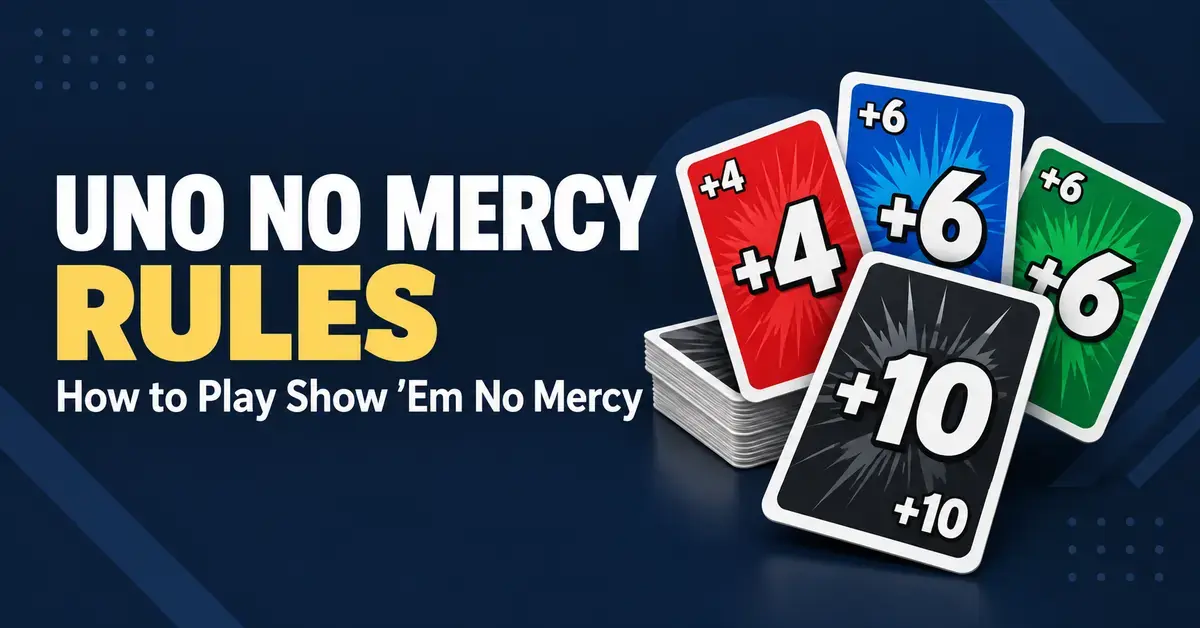
UNO No Mercy is the shorthand fans use for UNO Show ‘Em No Mercy, a harsher, faster edition of the classic card game that Mattel released in 2023. It plays like normal UNO — match the top card by colour, number or symbol — but four brutal twists and a batch of high-penalty action cards make hands swing wildly and can knock players out of the game entirely. This guide explains every rule from setup to victory, clears up the mistakes people make most often, and shows exactly how the four signature twists work together.
Key Facts
| Game | UNO Show ‘Em No Mercy (a.k.a. UNO No Mercy) |
|---|---|
| Publisher | Mattel |
| Released | 2023 |
| Players | 2–6 |
| Recommended age | 7+ |
| Cards in deck | 168 |
| Starting hand | 7 cards each |
| Typical price | Around US$10 |
| Ways to win | Empty your hand, or be the last player not eliminated |
What is UNO Show ‘Em No Mercy?
UNO Show ‘Em No Mercy is an official Mattel variant of UNO built around punishing penalties and player elimination. The name causes confusion because two labels point to the same game: the box says Show ‘Em No Mercy, while players, videos and searches usually shorten it to No Mercy. There is no separate “No Mercy” product — they are the same 168-card deck and the same rules.
The core of UNO is unchanged: on your turn you play a card that matches the colour, number or symbol of the card on top of the discard pile, and the first person to empty their hand wins. What makes this edition different is that the penalties are far bigger, draw cards pile on top of each other, and holding too many cards can eliminate you outright. It plays best with 2 to 6 players and is rated for ages 7 and up.
What’s in the box
The deck has 168 cards — more than double a standard 108-card UNO deck. Alongside the familiar number cards (0–9 in red, yellow, green and blue) it adds a run of heavier action and wild cards:
- Draw Two (+2) — the next player owes two cards.
- Wild Draw 4 (+4) — choose the colour and force four cards.
- Wild Draw 6 (+6) — a new, nastier wild that draws six.
- Wild Draw 10 (+10) — the single harshest card, forcing ten.
- Skip Everyone — skips every other player so your turn comes straight back.
- Wild Reverse Draw 4 — reverses direction and makes the previous player draw four.
- Wild Color Roulette — the next player keeps drawing until they hit the colour you name.
- Discard All — lets you dump every card of one matching colour at once.
Those extra draw values are the fuel for stacking, which is where hands get out of control.
How to set up and how to win
Setup is quick: shuffle the deck and deal seven cards to each player. Place the rest face down as the draw pile and turn the top card over to start the discard pile. If that first card is an action or wild card, shuffle it back in and flip a new one.
There are two ways to win, which is a big departure from normal UNO:
- Empty your hand. Play your last card — and remember to call “UNO” when you are down to one — and you win the round.
- Be the last one standing. Because players can be eliminated by the Mercy rule, a round can also end when everyone but you has been knocked out.
The four twists that change everything
Every special rule in UNO Show ‘Em No Mercy is mandatory, not optional. That single fact is what separates this edition from ordinary UNO versions, where twists like stacking are usually house rules you agree on first. Here they are printed rules of the game.
1. Mandatory stacking
When a draw card is played against you, you can “stack” instead of drawing — but only with a draw card of equal or higher value. Play a +2 on a +2, a +4 on a +2, and so on; you can never answer a +4 with a +2. Each stacked card adds its penalty to a running total that passes to the next player. The chain continues until someone cannot (or chooses not to) add a bigger card, and that unlucky player draws the entire accumulated pile at once. A single unbroken chain can force a player to pick up dozens of cards. If you already know classic stacking, the deeper mechanics are covered in our guide to UNO stacking rules.
Draw and Stacking Cards
| Draw card | Cards it forces | You may play it on top of |
|---|---|---|
| Draw Two (+2) | 2 | Another Draw Two |
| Wild Draw 4 (+4) | 4 | A Draw Two or a Wild Draw 4 |
| Wild Draw 6 (+6) | 6 | A +2, +4 or +6 card |
| Wild Draw 10 (+10) | 10 | Any draw card |
Rule of thumb: you can only stack a draw card whose value is equal to or higher than the one just played. When the chain stops, the next player draws the entire accumulated total.
2. The 25-card Mercy elimination
If you ever hold 25 or more cards at one time, you are immediately out of the game. This is the “Mercy” rule, and it is the reason stacking is so dangerous: a fat stacked draw pile can push a player past 25 in a single turn and eliminate them on the spot. It also creates the second win condition — you can win by outlasting everyone else rather than by emptying your hand.
3. The 7-swap and 0-pass rules
Number cards 7 and 0 carry special powers, borrowed from a popular house rule and made official here:
- Play a 7 and you must swap your entire hand with one other player of your choice — ideal for dumping a huge hand onto a rival.
- Play a 0 and every player passes their whole hand to the next player in the current direction of play.
These are the same mechanics that power the classic 7-0 rule, so if you have played with it before they will feel familiar. One key point: 7 and 0 are number cards, not draw cards, so they can never be stacked — playing one only triggers its swap or pass, then the turn continues normally.
4. Draw until you can play
If you have no card that matches the discard pile, you do not draw a single card and pass — you keep drawing until you turn up a card you can legally play, and then you must play it. On a bad run this rule alone can bloat your hand quickly, and combined with a stacked draw pile it is the fastest route to the 25-card Mercy elimination.
How a turn actually plays out
Putting it together, a single turn in UNO No Mercy looks like this:
- Check the top of the discard pile. If a draw penalty is sitting on you, decide whether to stack an equal-or-higher draw card or accept the whole total.
- If there is no penalty, play any card that matches the top card’s colour, number or symbol.
- Resolve the card’s effect — a 7 swaps hands, a 0 passes hands, a Skip Everyone loops the turn back to you, and so on.
- If you cannot match, draw until you can, then play that card.
- If you are down to one card, call “UNO.” If your hand hits 25 cards at any point, you are eliminated.
Common mistakes to avoid
Most disputes in UNO No Mercy come from a handful of misunderstandings:
- Stacking any draw card. You cannot stack a lower-value draw card on a higher one. The response must be equal or higher, so a +2 cannot answer a +4.
- Trying to stack 7s, 0s or Skip Everyone. Only draw cards (+2, +4, +6, +10) stack. Number and non-draw action cards do not.
- Forgetting the twists are compulsory. The 7-swap, 0-pass and draw-until-playable rules are not optional — you must carry them out even when they hurt you.
- Ignoring your card count. Players focus on emptying their hand and forget that crossing 25 cards ends their game instantly.
- Playing a 0 or 7 at the wrong moment. Because they move hands around, a mistimed 0 can hand your carefully built small hand straight to an opponent.
No Mercy versus classic UNO
The table below sums up how the two games differ in practice. The short version: classic UNO is a race to empty your hand, while No Mercy is a war of attrition where you can be knocked out before anyone wins.
No Mercy vs Classic UNO
| Feature | UNO No Mercy | Classic UNO |
|---|---|---|
| Deck size | 168 cards | 108 cards |
| Stacking draw cards | Official rule (equal or higher) | House rule only |
| 7-swap / 0-pass | Official rule | House rule only |
| Draw when you can’t play | Draw until you find a playable card | Draw one card, then pass |
| Player elimination | Yes — out at 25+ cards | No |
| Ways to win | Two | One (empty your hand) |
Simple tips for winning
Because a bad turn can bury you in cards, No Mercy rewards holding a few defensive options in reserve. A handful of habits help:
- Hoard a big draw card. Keeping a +6 or +10 in hand lets you break a stacking chain aimed at you, or start one that overwhelms a rival.
- Watch every hand size, not just your own. When an opponent nears 25 cards, a well-timed draw card or a 7-swap can tip them over into elimination.
- Use 7 and 0 to dump a bloated hand. If draw-until-playable has swollen your hand, a 7-swap onto a player with fewer cards resets your position.
- Don’t stack just because you can. Passing a modest penalty on is sometimes worse than simply drawing it, if stacking hands a monster pile to a player who will bounce it right back.
Who is UNO No Mercy for?
UNO Show ‘Em No Mercy suits groups that already enjoy stacking and other aggressive house rules and want a longer, swingier, more cut-throat game. Because penalties are severe and rounds can run long, it works best with players who take the ups and downs in good humour. Younger children can play — the box is rated 7+ — but the elimination rule and big draw chains can be frustrating for the very youngest, so mixed-age groups may want to agree on a friendlier pace.
Sources
Frequently Asked Questions (FAQ)
Is UNO No Mercy the same as Show ‘Em No Mercy?
Yes. “No Mercy” is just the common short name for UNO Show ‘Em No Mercy. There is one product, one 168-card deck and one set of rules under both labels.
How many cards do you start with in UNO No Mercy?
Each player is dealt seven cards at the start, the same as classic UNO. The difference is how quickly hands can grow afterwards through stacking and draw-until-playable.
What happens if you get 25 cards?
You are immediately eliminated from the game. This is the Mercy rule, and it is why a large stacked draw pile is so dangerous — it can push you past 25 in one turn.
Can you stack any draw card on another?
No. You can only stack a draw card of equal or higher value than the one played against you. A +2 can go on a +2, and a +4 on a +2, but a +2 can never be played on a +4.
Do the 7 and 0 cards stack?
No. Only draw cards stack. Playing a 7 forces a hand swap with one player, and playing a 0 makes everyone pass their hand along, but neither can be stacked.
