
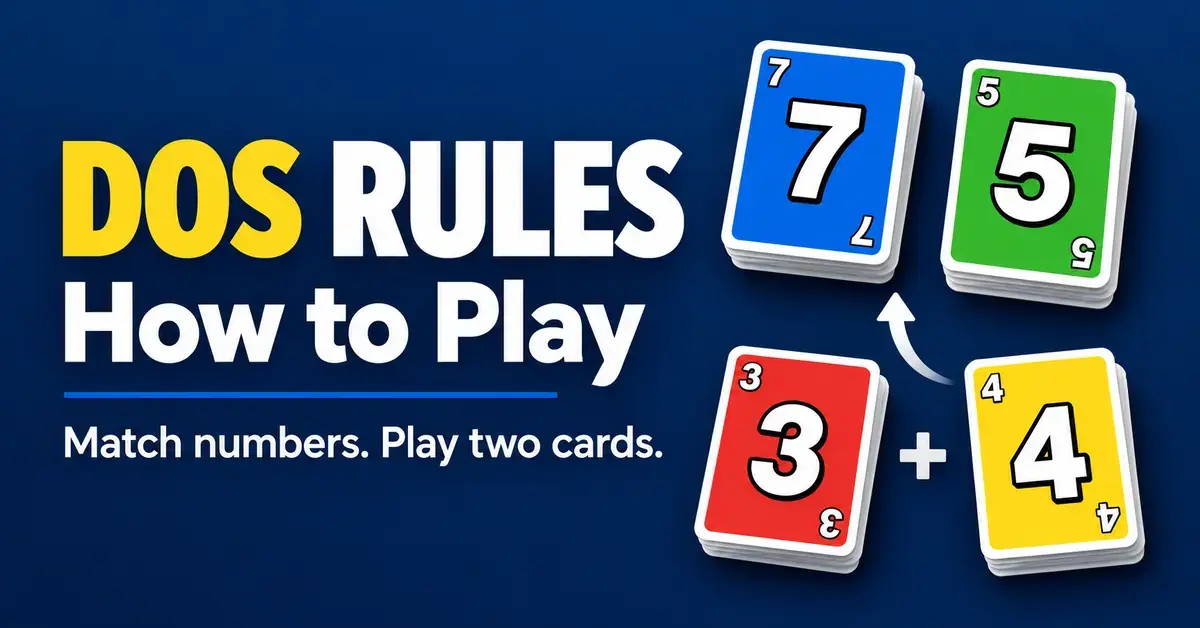
DOS is a card game from Mattel, the makers of UNO, first released in 2018. Despite the name and family resemblance, it is a separate game rather than an edition of UNO: instead of one discard pile you play onto two, you match cards by number rather than colour, and the twist that gives the game its name is that you can play two cards at once. This guide explains the full DOS rules from setup to scoring, including the two-pile Center Row, single and two-card plays, the colour-match bonuses, when to shout “DOS!”, and how to be first to 200 points.
DOS at a Glance
| Publisher | Mattel (from the makers of UNO) |
|---|---|
| First released | 2018 |
| Players | 2–4 |
| Age | 7 and up |
| Cards in deck | 108 (blue, green, red, yellow + wilds) |
| Starting hand | 7 cards each |
| Core rule | Match by number across two Center Row piles |
| Signature move | Play two cards that add up to a Center Row card |
| Call | Shout “DOS!” at two cards left |
| Winning score | First to 200 points |
What is DOS?
DOS is a fast, family-friendly shedding card game where the goal each round is to be the first player to get rid of every card in your hand. “Dos” is Spanish for “two”, and the number two runs through the whole design: there are two discard piles in the middle of the table, you can play two cards in a single turn, and you call out “DOS!” when you are down to two cards left. It plays with 2 to 4 players and takes about 15 minutes per round.
The most important thing to understand up front is that DOS is not an UNO variant or a reskin of the base game. It shares a publisher and a bright four-colour deck, but the core rule — matching by number across two central piles — makes it play quite differently from a standard game of how to play UNO. If you already know UNO, expect the familiar comfort of colourful number cards but a genuinely new puzzle at the centre of the table.
What cards are in a DOS deck?
A DOS deck has 108 cards. They come in four colours — blue, green, red and yellow — plus a set of wild cards. Knowing the make-up of the deck helps you understand why certain plays are common and why some numbers appear more often than others.
Number cards
Each of the four colours has 24 cards, for 96 coloured cards in total. Within a colour the numbers run from 1 to 10, but they are not evenly distributed:
- Three each of the numbers 1, 3, 4 and 5.
- Two each of the numbers 6, 7, 8, 9 and 10.
- Two Wild # cards per colour (explained below).
There is no number 2 printed on any card — fittingly for a game called DOS, the number two only ever appears as a total you make by combining cards or through a Wild DOS card.
Wild cards
DOS has two kinds of wild card:
- Wild DOS card (12 in the deck): counts as a 2 of any colour. These are the only way to “be” a 2 in the game.
- Wild # card (8 in the deck, two per colour): keeps its printed colour but can stand for any number you choose. You announce the number when you play it.
How do you set up DOS?
Setup is quick. Shuffle the deck and deal seven cards to each player. Place the rest face down in the middle as the Draw Pile, then turn over two cards side by side next to it to start the Center Row — the two discard piles you will play onto. Leave room for a discard pile where used cards are set aside. The player to the dealer’s left usually goes first, and play passes to the left.
How do you play a turn in DOS?
On your turn you try to get rid of cards by matching the numbers showing in the Center Row. You may play to one pile or to both piles in the same turn, in any combination of the plays below. There must always be at least two cards face up in the Center Row.
Playing a single card
The simplest play is to place one card whose number exactly matches a card in the Center Row. If a Center Row pile shows a 7, you can cover it with any 7 from your hand. Colour does not have to match for a basic play — only the number.
Playing two cards at once
The signature DOS move is playing two cards whose values add up to a Center Row card. If a pile shows a 9, you can play a 4 and a 5 together, or a 3 and a 6, to cover it. This is how you shed cards quickly, and it is why keeping a spread of low numbers in your hand is useful.
When you cannot match
If you cannot (or choose not to) match anything, you draw one card from the Draw Pile. If that card lets you make a match, you may play it straight away. If it does not, you must still add one card from your hand face up to the Center Row, which grows the row and gives the next players more targets to hit.
How do the colour-match bonuses work?
Matching by number is all you need to play a card, but matching the colour as well earns a bonus. There are two levels, and they are the fastest way to empty your hand.
Single Colour Match
A Single Colour Match happens when the one card you play matches a Center Row card in both number and colour. As a reward, you get to place one extra card from your hand face up into the Center Row — effectively discarding an additional card for free.
Double Colour Match
A Double Colour Match is the big one. It happens when you play two cards that add up to a Center Row card and both of those cards share that card’s colour. You again place an extra card into the Center Row, and on top of that every other player must draw one card from the Draw Pile. Setting up double colour matches is central to strong DOS play.
What do the wild cards do?
Wild cards give you flexibility when your hand does not fit the Center Row. A Wild DOS card acts as a 2 of any colour, so it can help complete a two-card sum or cover a pile showing a low number. A Wild # card keeps its own colour but can be declared as any number you like, which makes it valuable both for matching and for chasing colour bonuses. Because Wild # cards hold their colour, a well-timed Wild # can turn an ordinary play into a colour match.
When do you call “DOS!”?
You must call out “DOS!” the moment you are down to exactly two cards in your hand, just as you shout “UNO” at one card in the original game. It warns the table that you are close to going out. If another player catches you holding two cards without having called it, you draw two penalty cards from the Draw Pile. The call resets each time — if you go back up above two cards and later return to two, you must call “DOS!” again.
How does scoring work in DOS?
A round ends the instant one player gets rid of their last card. That player scores points based on the cards left in everyone else’s hands. The values are:
- Number cards: their face value (a 7 is worth 7 points, and so on).
- Wild DOS card: 20 points each.
- Wild # card: 40 points each.
Add up the value of every card still held by the other players and award that total to the winner of the round. Deal again and keep playing rounds. The first player to reach 200 points wins the game. Players can agree on a different target, but 200 is the standard finish line printed in the rules.
How is DOS different from UNO?
DOS keeps the friendly look of UNO but changes the engine underneath. The table below sums up the biggest differences so you can see at a glance why the two games feel distinct even though they come from the same maker. For a wider look at the whole family, see our guide to the different UNO versions.
DOS vs UNO
| Feature | DOS | UNO |
|---|---|---|
| Discard area | Two piles (the Center Row) | One pile |
| How you match | By number only (colour is a bonus) | By colour or number |
| Cards per turn | One or two (sums allowed) | One |
| Action cards | None in the original edition | Skip, Reverse, Draw Two, Wild |
| The call | “DOS!” at two cards | “UNO!” at one card |
| Winning score | First to 200 points | First to 500 points |
In short, UNO is about matching colour or number onto a single pile and using action cards to attack opponents, while DOS is about arithmetic across two piles and racing to shed cards through smart pairings. If you enjoy the tactical side, our tips on how to win at UNO share the same shedding-game mindset that rewards planning your hand ahead of time.
Are there different versions of DOS?
Yes. The original 2018 release is the one described above. In 2022–2023 Mattel put out a DOS Second Edition that plays noticeably differently: it adds UNO-style action cards — Skip, Reverse and Draw Two — plus a Wild Play Two card, and its scoring version typically plays up to 500 points rather than 200. If you buy a modern box, check whether it is the original DOS or the Second Edition, because the rules on the two are not interchangeable. There have also been travel and themed printings over the years, but the core matching-by-number idea carries through them all. DOS itself grew out of the design lineage of the original game, which you can trace in our overview of the history of UNO.
What are the most common DOS mistakes?
New players tend to trip over the same handful of rules. Watching for these will keep your games smooth and fair.
- Trying to match by colour alone. Colour never lets you play a card on its own in DOS — you always need the number to match. Colour only adds a bonus on top of a valid number match.
- Forgetting to add a card when you cannot match. Drawing a card that does not help does not end your turn quietly; you still have to place one card face up into the Center Row.
- Missing the “DOS!” call. Reaching two cards without shouting “DOS!” costs you two penalty cards if someone notices — an easy way to lose a strong position.
- Letting the Center Row shrink below two. There must always be at least two face-up piles; replenish from the Draw Pile whenever a pile is cleared.
- Overvaluing high cards. Because scoring is by face value, being caught with 9s, 10s and wilds when someone goes out hurts far more than holding low numbers.
What is a good DOS strategy?
The key point in DOS is that you empty your hand fastest by combining cards, not by playing one at a time. Hold on to a range of low numbers so you can always assemble a two-card sum for whatever appears in the Center Row. Hunt for colour matches, since a Double Colour Match both clears extra cards for you and forces every opponent to draw. Keep an eye on which numbers are still in the deck — with three each of 1, 3, 4 and 5 but only two of the higher numbers, low cards are easier to pair. Finally, try to offload high-value cards early so you are not left holding a 10 or a Wild # when someone else goes out.
Who is DOS for?
DOS suits families and casual groups who already like UNO but want a fresh challenge, and it works well for players aged 7 and up because the maths involved is simple addition. It rewards a little more thinking than the base game without becoming heavy, making it a good step up for children practising sums and a satisfying quick game for adults. If DOS appeals to you, you may also enjoy experimenting with UNO house rules to keep game nights varied.
Sources
Frequently Asked Questions (FAQ)
Is DOS the same as UNO?
No. DOS is a separate game from the makers of UNO, released in 2018. It shares the colourful four-colour deck but matches cards by number across two central piles and lets you play two cards at once, so it plays quite differently from UNO.
How many players can play DOS?
DOS is designed for 2 to 4 players. Each player is dealt seven cards to start, and a typical round lasts around 15 minutes.
What does the number two have to do with DOS?
“Dos” means “two” in Spanish, and the theme is everywhere: there are two centre piles, you can play two cards in one turn, and you shout “DOS!” when you have two cards left in your hand.
What happens if you forget to say “DOS”?
If you drop to two cards and another player catches you before you have called “DOS!”, you must draw two penalty cards from the Draw Pile. You have to call it again each time you return to exactly two cards.
How many points do you need to win DOS?
The first player to reach 200 points wins. Points come from the cards left in opponents’ hands when someone empties their hand: number cards score their face value, a Wild DOS card is worth 20, and a Wild # card is worth 40.
