
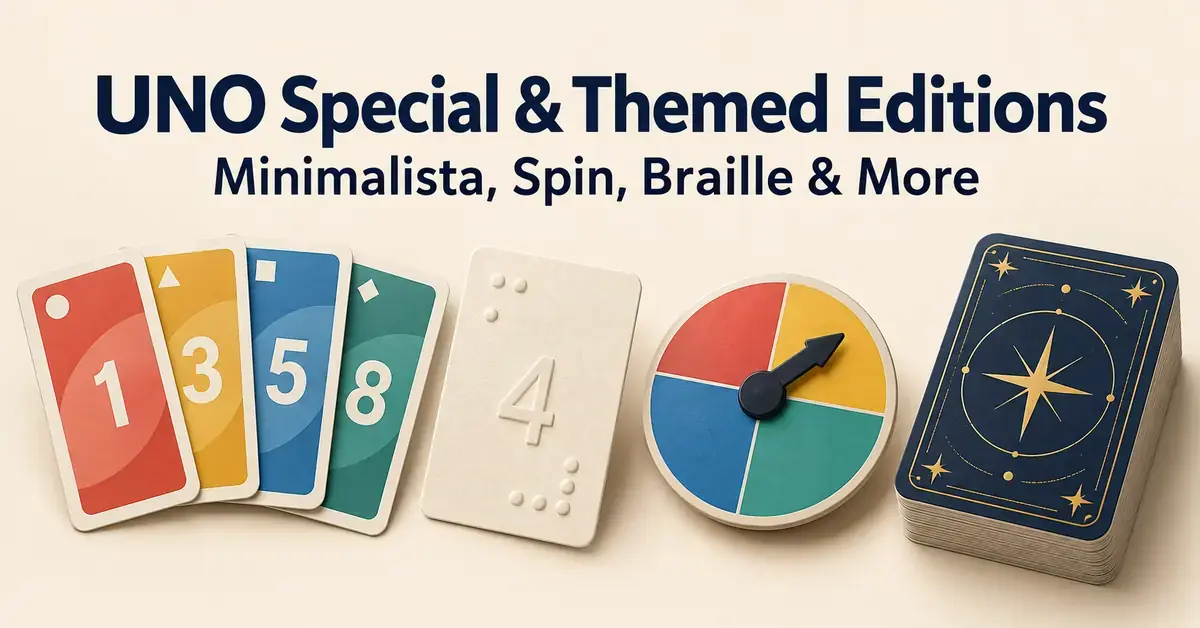
Beyond the familiar red-box deck, Mattel has released dozens of special UNO editions: designer redesigns, accessibility decks for blind and colour-blind players, spinner-powered twists, franchise tie-ins and premium collector sets. Most of them keep the classic rules and simply change how the cards look, feel or read — but a few genuinely change how you play. This guide sorts the best-known special and themed editions into clear groups, explains what makes each one different, and shows how their rules relate to standard UNO. It is an informational catalogue rather than a shopping list, so you will find descriptions and facts here, not purchase links.
Key Points
- Special editions vs. versions: most special UNO decks keep the classic rules and change the look, feel or accessibility — unlike separate games such as UNO Flip or DOS.
- Design: UNO Minimalista (2020) is a viral designer redesign with colour-identifying symbols.
- Accessibility: UNO Braille (2019) adds touch-readable Braille; UNO ColorADD (2017) adds shape symbols for colour-blind players.
- Rules twist: UNO Spin adds a spinner wheel — the main rules-changing edition in this guide.
- Themed & collectible: UNO Fandom, franchise reskins and the 50th Anniversary sets add art, premium materials or a small bonus rule.
- This is an informational catalogue, not a buying guide.
What counts as a “special edition” of UNO?
A special edition is any UNO deck that differs from the standard game in its design, materials, accessibility or theme rather than being a separate game in its own right. That is an important distinction. Titles such as UNO Flip, UNO Attack and DOS are full UNO versions with their own rules and components; the editions in this guide, by contrast, usually play by the same rules as classic UNO and change something else — the artwork, the finish, the packaging, or the way a card can be read by touch or by shape.
Broadly, special UNO editions fall into four families:
- Design editions — a fresh visual style, such as UNO Minimalista.
- Accessibility editions — decks made playable for blind or colour-blind people, such as UNO Braille and UNO ColorADD.
- Rules-twist editions — a special edition that adds a mechanic, such as the spinner in UNO Spin.
- Themed and collectible editions — franchise reskins and premium anniversary sets.
UNO Minimalista: the designer deck that went viral
UNO Minimalista is a stripped-back redesign of the classic deck created by Brazilian graphic designer Warleson Oliveira. Oliveira first posted his concept, “Versão Minimalista,” on the Adobe Behance portfolio platform in early 2020. It spread quickly online, and Mattel turned the concept into an official product in under 30 days, releasing it in 2020.
The cards drop UNO’s usual oval and busy graphics in favour of clean type, flat colour and simple icons. The backs show a two-tone UNO logo on a black base. Crucially, each card also carries a small graphic symbol that identifies its colour, so people with colour blindness can tell cards apart without relying on colour alone. That makes Minimalista both a style piece and a quietly accessible deck.
Rules: identical to standard UNO. Nothing about play changes — only the look.
Accessibility editions: Braille and ColorADD
Two special editions exist specifically to widen who can play UNO. Both keep the standard rules and add information to each card so more people can read their hands independently.
UNO Braille
UNO Braille is the first official UNO deck to feature Braille, released on 1 October 2019 in partnership with the National Federation of the Blind, the largest organisation of blind people in the United States. Each card has Braille embossed in the corner indicating its colour and its number or action, so blind and low-vision players can identify their cards by touch.
The packaging also carries Braille pointing players to downloadable rule files in Braille-readable formats, and the instructions can be read aloud through smart-home assistants such as Amazon Alexa and Google Assistant. Because it is the same size and shape as a normal deck, sighted and blind players can share one game — part of the stated goal of normalising Braille at the table.
UNO ColorADD
UNO ColorADD is a deck designed for colour-blind players, first released in 2017. It uses ColorADD, a colour-identification code created by Portuguese designer Miguel Neiva that represents colours with geometric symbols. On the UNO cards, a small ColorADD symbol sits beside the number in the corner, so a player who cannot reliably distinguish red from green can still tell which colour a card belongs to.
The clever part is that the symbols convey colour the way pigments mix: a handful of base shapes stand for the primary colours, and combinations of those shapes represent the mixed colours. Mattel reissued a special ColorADD edition in a collectible metal box in 2024, and the company has said it is making the majority of its games colour-blind accessible.
Rules for both: unchanged. The extra Braille or symbols add information; they do not alter how the game is played.
UNO Spin: the special edition that adds a spinner
UNO Spin is the one deck in this guide that genuinely changes the rules, because it bundles a spinner wheel with the cards. It was first released in 2005 and relaunched in a refreshed version in 2025. The set contains 112 cards plus one spinner, and plays for 2–10 players aged 7 and up.
On top of the normal UNO cards, 20 cards — the numbers 1 to 5 in each of the four colours — carry a swirl pattern that marks them as Spin cards. You can play a Spin card exactly like an ordinary number card, but doing so forces the next player to spin the wheel and obey whatever it lands on. Typical spinner outcomes include Color Draw (draw cards of a named colour), Color Discard (discard all cards of a colour), Swap Hands and a double-play effect. Because the spinner can suddenly empty or fill a hand, Spin swings faster than standard UNO and rewards timing your Spin cards well.
Rules: classic UNO turn structure, plus the spinner mechanic layered on top.
Themed and franchise UNO editions
Themed editions reskin UNO with the art of a film, show or brand while keeping the core game. Some add a single bonus card or “special rule” tied to the theme, but the underlying matching-and-discarding game is the one you already know.
The UNO Fandom line
UNO Fandom is Mattel’s modern collection of pop-culture decks aimed at older fans and collectors. The range has included decks themed on Avatar: The Last Airbender, Star Trek, Monster High, Masters of the Universe, Disney Villains and Harry Potter, among others. Many pair standard UNO play with a themed twist card that nods to the source material.
Franchise decks over the years
Long before the Fandom label, Mattel produced franchise UNO decks tied to major properties. Harry Potter alone has appeared in several UNO releases, and there are Marvel, Disney and Disney–Pixar editions, including four Hogwarts-house Harry Potter decks and Marvel character sets. These are collector-friendly reskins: expect familiar rules, occasionally with one themed house-style card added. If you enjoy those tweaks, they sit close in spirit to UNO house rules — small, optional additions rather than a new game.
Collectible and anniversary editions
Some special editions are made to be kept as much as played. The clearest examples came for UNO’s 50th anniversary in 2021, half a century after the game’s 1971 invention — a milestone covered in more depth in UNO’s history.
50th Anniversary Iconic Series
The Iconic Series is a set of five decks, each celebrating one decade of UNO’s existence from the 1970s through the 2010s. Every deck borrows the visual style of its era — for example, the 1980s deck uses neon-metallic art on black inspired by early video games, while the 2000s deck leans into an early-computer aesthetic. The cards and rules are standard UNO; the appeal is the decade-themed artwork.
Premium 50th Anniversary Edition
The Premium 50th Anniversary set is a deluxe collector’s version with slick black cards, a velvety-smooth finish and a specially designed box. It adds an exclusive commemorative gold coin and a special “50/50” card, both tied to a bonus rule that brings the coin into play. It is the rare collectible edition that layers a small optional rule onto the classic game.
Special and Themed UNO Editions Compared
| Edition | Type | Key feature | Rules vs. classic UNO |
|---|---|---|---|
| UNO Minimalista | Design | Warleson Oliveira redesign; colour-identifying symbols | Same rules |
| UNO Braille | Accessibility | Braille in each corner for colour and value | Same rules |
| UNO ColorADD | Accessibility | Geometric symbols identify colours for colour-blind players | Same rules |
| UNO Spin | Rules twist | Spinner wheel triggered by Spin cards | Adds spinner mechanic |
| UNO Fandom / franchise | Themed | Pop-culture artwork (e.g. Harry Potter, Star Trek) | Same rules; sometimes one bonus card |
| 50th Anniversary Iconic Series | Collectible | Five decade-themed decks (1970s–2010s) | Same rules |
| Premium 50th Anniversary | Collectible | Deluxe black cards, gold coin, “50/50” card | Adds a coin bonus rule |
How do special-edition rules relate to classic UNO?
Most special editions play by the exact same rules as classic UNO — the differences are cosmetic or accessibility-focused, not mechanical. If you can play the standard game, you can pick up a Minimalista, Braille, ColorADD or themed deck and start immediately, because dealing seven cards, matching by colour, number or symbol, playing action cards, calling “UNO” and scoring all work the same way.
The exceptions are the editions that deliberately add a component or rule. UNO Spin introduces the spinner and its wheel outcomes. The Premium 50th Anniversary edition adds a coin-and-“50/50”-card rule. Some franchise decks include a single themed special card. In every case, though, the changes stack on top of the familiar foundation rather than replacing it — which is why these decks are treated as editions rather than as separate games in the wider UNO versions lineup. If you want the underlying tactics that carry across all of them, our guide to winning at UNO applies to every deck here.
Common mistakes and misconceptions
The biggest misconception is that a special edition changes the game. In most cases it does not — buyers sometimes expect Minimalista or a Harry Potter deck to play differently and are surprised to find identical rules. Knowing which editions are cosmetic and which add a mechanic saves confusion at the table.
Other frequent mistakes:
- Mixing incompatible decks. Accessibility and design decks shuffle fine with a standard deck, but a rules-twist edition like UNO Spin needs its spinner to work as intended — combining it blindly with other decks breaks the balance.
- Assuming accessibility decks are “kids only.” Braille and ColorADD are full standard decks meant for everyone at the table, not simplified versions.
- Confusing editions with variants. Special editions (this guide) reskin or repackage classic UNO; variants such as UNO Flip or DOS are distinct games. Treat the two lists separately.
- Expecting every themed deck to add a rule. Many franchise decks are pure reskins; only some include a bonus card.
- Losing collectible value by mixing sets. Anniversary and premium decks are often kept intact by collectors; shuffling them into a house deck defeats the point.
Sources
- National Federation of the Blind — UNO Introduces First Official Braille Deck
- CNN — Mattel releases a Braille version of UNO
- ColorADD — Mattel launches special edition UNO ColorADD
- Mattel — UNO Minimalista (GYH69) product page
- Highsnobiety — Mattel Introduces New Minimalist UNO Deck
- Mattel — UNO Spin card game
- Mattel — UNO Premium 50th Anniversary Edition (HBF05)
- Hypebeast — UNO 50th Anniversary Iconic Series
- The Toy Book — Mattel’s UNO Fandom Decks
Frequently Asked Questions (FAQ)
Do special UNO editions use different rules?
Usually not. Design and accessibility editions such as Minimalista, Braille and ColorADD play by the standard UNO rules; only editions that add a component — like the spinner in UNO Spin or the coin in the Premium 50th Anniversary set — change how you play.
What is the difference between UNO Braille and UNO ColorADD?
UNO Braille adds Braille in each card’s corner so blind and low-vision players can read cards by touch, while UNO ColorADD adds geometric ColorADD symbols so colour-blind players can identify colours by shape. Both keep the normal rules and can be shared with sighted players.
Is UNO Minimalista good for colour-blind players?
Yes, to a degree. Alongside its clean redesign, UNO Minimalista prints a small symbol on each card that indicates its colour, which helps players who cannot rely on colour alone. For a deck built specifically around colour-blind accessibility, UNO ColorADD is the dedicated option.
What makes UNO Spin different from regular UNO?
UNO Spin comes with a spinner wheel. Certain number cards are marked as Spin cards, and playing one makes the next player spin the wheel and follow its result, such as drawing or discarding cards of a colour or swapping hands. Everything else follows classic UNO.
Are themed UNO decks like Harry Potter just for collectors?
They work as both. Franchise decks such as the UNO Fandom line and Harry Potter editions are fully playable standard UNO games with themed artwork, and some add a single special card. Many people buy them to play, while others keep them as collectibles.
