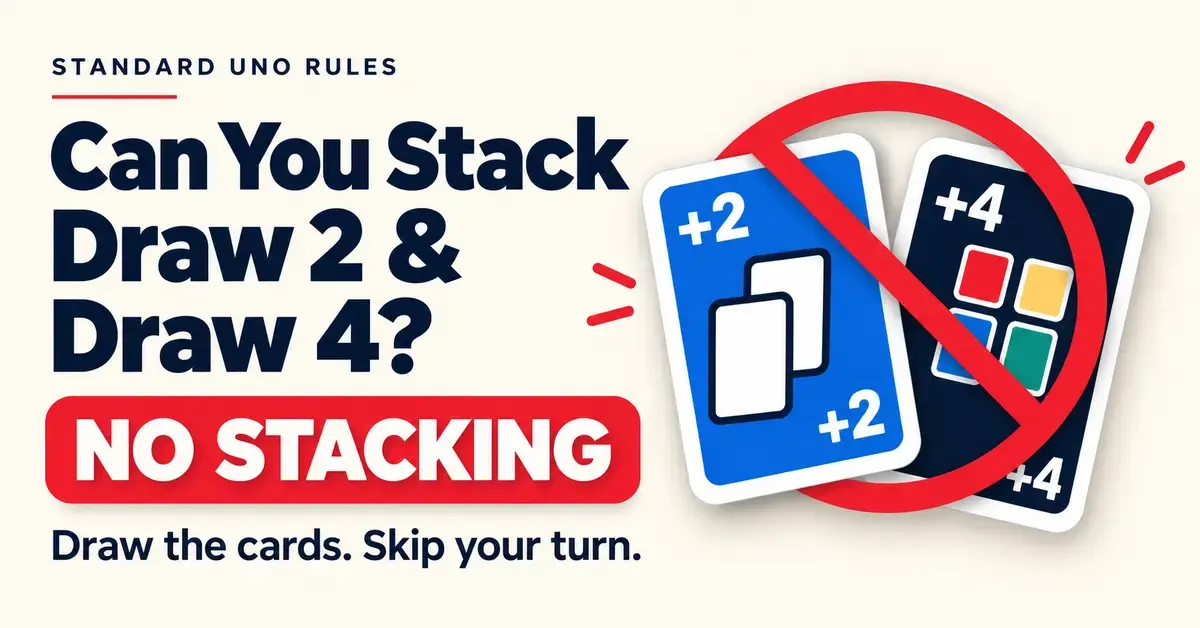
Short answer: no. Under the official UNO rules published by Mattel, you cannot stack a Draw 2 on a Draw 2, you cannot stack a Wild Draw 4 on a Wild Draw 4, and you cannot answer either card by piling on another Draw card to push a bigger penalty onto the next player. When a Draw card is played against you, you draw the cards and your turn is skipped — full stop. Stacking is one of the most popular house rules in the world, and a few newer editions build it in on purpose, but it has never been part of the standard game. This guide separates the official rule from the house rule so you always know which version you are playing.
Key Points
- Official verdict: No stacking. You cannot stack Draw 2 or Wild Draw 4 cards in standard UNO.
- What happens instead: The next player draws the cards (2 or 4) and immediately loses their turn.
- Confirmed by Mattel: UNO’s official account (@realUNOgame) stated this in 2019 and repeated it in 2022.
- Popular house rule: Stacking is one of the most common player-added variations — fun, but not in the rulebook.
- Exception: UNO Show ‘Em No Mercy officially allows stacking Draw cards of equal or greater value.
- The real official counter: A Wild Draw 4 can be challenged if you think it was played illegally — not stacked.
What does “stacking” mean in UNO?
Stacking means responding to a Draw card by playing another Draw card instead of drawing, so the penalty grows and passes to the next player. In a typical stacked round, someone plays a Draw 2, the next player adds a Draw 2 (“now you draw 4”), the player after that adds another Draw 2 or a Wild Draw 4, and the pile of cards owed keeps climbing until a player has no Draw card to add and must pick up the entire total.
It is a dramatic, high-swing way to play, which is exactly why it spread so widely. But the mechanic is not written anywhere in the official rulebook — it is something players added themselves. Understanding that distinction is the whole point of this article, because “can I stack?” almost always really means “are we playing the official rules or a house rule tonight?”
What the official UNO rules actually say
Officially, Draw cards are resolved immediately and cannot be passed along. The rulebook treats each Draw card as a penalty plus a skipped turn for the very next player, with no option to counter it. If you are learning the game from scratch, our full guide on how to play UNO walks through every card type; here is what matters for stacking.
What happens when a Draw 2 is played
When a Draw 2 (also called a “+2”) is played, the next player must draw two cards and immediately lose their turn. They do not get to play anything first — not another Draw 2, not a matching color, nothing. Play then moves on to the following player as normal. A standard 108-card UNO deck contains eight Draw 2 cards (two in each of the four colors), so multiple Draw 2s appearing in one round is common, but officially each one is resolved on its own.
What happens when a Wild Draw 4 is played
When a Wild Draw 4 (“+4”) is played, the next player must draw four cards and lose their turn, and the player who laid it down chooses the color that continues play. You cannot respond with your own Wild Draw 4 or a Draw 2 to bounce the penalty forward. There are four Wild Draw 4 cards in the deck, and each is meant to be the strongest single-turn hit in the game — not the opening move of an escalating chain. For the finer points of when this card is even legal to play, see our dedicated breakdown of the Wild Draw Four rules.
The official Mattel confirmation
This is not up for interpretation. In 2019, UNO’s official account (@realUNOgame) publicly stated that if a +2 or +4 card is put down, the next player must draw and be skipped — they cannot stack a Draw 2 or Draw 4 to “add” to the penalty. Mattel restated the same point in 2022, confirming that you cannot officially stack Draw 2 and Draw 4 cards. The announcements caused an uproar precisely because so many people had been playing with stacking for years and assumed it was in the rulebook. It was not, and it still is not.
Why so many players think stacking is allowed
Most people believe stacking is official because they learned UNO at a kitchen table, not from the rulebook. House rules pass down through families and friend groups the same way the game itself does, and after enough rounds an added rule feels indistinguishable from an original one. Three things reinforce the myth:
- It is genuinely fun. Stacking creates big momentum swings and tense stand-offs, so groups keep it and rarely question where it came from.
- Everyone else does it too. Because stacking is so widespread, new players learn it as “the way UNO works” from the very first game.
- Newer editions really do include it. Some official spin-off sets are built around stacking (more on those below), which blurs the line between the classic game and its variants.
None of that makes stacking wrong to play — it just makes it a house rule rather than an official one. If you enjoy inventing your own twists, our roundup of the most popular UNO house rules collects the variations that groups add most often.
Official Rule vs House Rule
| Situation | Official UNO rule | Common house rule |
|---|---|---|
| Draw 2 played against you | Draw 2 cards and lose your turn | Play your own Draw 2 to pass on a growing total |
| Wild Draw 4 played against you | Draw 4 cards and lose your turn | Play another Draw 4 to bounce the penalty forward |
| Mixing +2 and +4 | Not applicable — no stacking exists | Sometimes allowed, sometimes not (agree first) |
| Who draws the cards | Always the very next player | The first player who cannot add a Draw card |
| Countering a Wild Draw 4 | Challenge it if you suspect it was illegal | Stack a Draw card on top of it |
| Official status | Written in the Mattel rulebook | Player-added; official only in UNO No Mercy |
How the stacking house rule usually works
If your group agrees to stack, settle the details before you deal, because “stacking” means slightly different things in different homes. The most common version works like this:
- Draw 2 on Draw 2: a player hit with a +2 can play their own +2 instead of drawing, passing the running total to the next player.
- Wild Draw 4 on Wild Draw 4: similarly, a +4 can be answered with another +4, moving the growing penalty along.
- Mixing +2 and +4: some groups allow a +2 to be stacked onto a +4 (or the reverse), while stricter tables only let like cards stack on like cards. Decide this in advance — it changes the game a lot.
- The payout: the first player who cannot add a Draw card draws the entire accumulated total and loses their turn.
Because these details vary, the single most useful habit is a quick house-rules check before the first card is dealt. It prevents the mid-game argument that stacking is famous for.
Which UNO editions officially allow stacking?
The clearest exception is UNO Show ‘Em No Mercy, an official Mattel edition released in 2023 that is designed around stacking and heavy penalties. Its 168-card deck adds bigger Draw cards — including Draw 6 and Draw 10 wilds, plus a Reverse Draw 4 — alongside the familiar Draw 2 and Wild Draw 4.
In No Mercy, you can stack Draw cards, but only by playing one of equal or greater value than the card facing you; when you cannot go higher, you draw the whole pile. The edition also introduces a “Mercy Rule”: any player who reaches 25 or more cards in hand is instantly knocked out. Crucially, this is a separate product with its own rulebook — it does not change the rules of classic UNO. Our full guide to UNO Show ‘Em No Mercy covers every one of its special cards in detail.
The Wild Draw Four challenge: the real official “counter”
The official game does give you one way to fight back against a Wild Draw 4, and it is not stacking — it is the challenge. A Wild Draw 4 may only legally be played when the player has no card matching the current color. If you suspect the person who played it was holding a matching color, you can challenge instead of drawing.
- If the challenge is correct (they were bluffing), the player who played the card draws the four cards instead of you, and your turn continues normally.
- If the challenge is wrong (the play was legal), you draw the original four cards plus two more — six in total — and still lose your turn.
The challenge is the official rulebook’s built-in tension mechanic. Many groups who think they “need” stacking for excitement are often surprised at how much drama the challenge already provides when played properly.
Common mistakes players make with Draw cards
A few misunderstandings come up again and again around Draw cards and stacking:
- Assuming stacking is official. It is the single biggest UNO myth. If you are playing standard rules, no Draw card can be countered with another Draw card.
- Trying to “stack” in a tournament or app. Official digital UNO and organized play follow the standard rules, so a stack move simply will not be allowed there.
- Skipping the pre-game rules talk. Not agreeing on stacking (and whether +2 and +4 can mix) before dealing is what causes most UNO arguments.
- Confusing editions. Rules that are correct for UNO Show ‘Em No Mercy are not correct for classic UNO, and vice versa — always match the rule to the deck in front of you.
- Forgetting the skipped turn. A Draw card doesn’t only add cards; it also skips the drawing player’s turn. That skip is easy to overlook in a fast game.
Should you play with or without stacking?
Both versions are valid — the right choice depends on your group. Play the official no-stacking rules when you want faster, more predictable rounds, when you are teaching new players, or when you are practicing for app or tournament play where stacking is never allowed. Add the stacking house rule when your table enjoys big swings and doesn’t mind the occasional player picking up a huge stack of cards. If you want the escalation baked in and balanced by design, reach for an edition built for it, such as UNO Show ‘Em No Mercy, rather than bolting stacking onto the classic deck.
Whatever you decide, say it out loud before the game starts. “Official rules, no stacking” or “we stack +2s and +4s, and they can mix” takes five seconds and saves the argument later.
Sources
- UNO (@realUNOgame) on X — “There is no stacking in UNO”
- UNO (@realUNOgame) on X — 2022 restatement on stacking
- TODAY — UNO says stacking Draw 2 and Draw 4 is illegal
- Hypebeast — UNO confirms players can’t stack +4 or +2 cards
- Reader’s Digest — UNO Draw Four rules explained
- Mattel UNO Wiki — Stacking
- UNO Show ’Em No Mercy — official rules overview
Frequently Asked Questions (FAQ)
Can you stack Draw 4 cards in UNO?
Not under the official rules. When a Wild Draw 4 is played, the next player must draw four cards and lose their turn — they cannot answer with another Draw 4 or a Draw 2. Stacking Draw 4s is a house rule, and it is also officially built into some spin-off editions like UNO Show ‘Em No Mercy.
Can you stack a Draw 2 on a Draw 2?
Officially, no. A Draw 2 forces the next player to draw two cards and skip their turn, with no option to play another Draw 2 in response. Many households allow it as a house rule, but it is not part of the standard Mattel rules.
Did Mattel really say you can’t stack in UNO?
Yes. UNO’s official account (@realUNOgame) confirmed in 2019, and again in 2022, that Draw 2 and Draw 4 cards cannot be stacked in the standard game. The next player simply draws the cards and is skipped.
Why do so many people stack if it isn’t official?
Because stacking is a hugely popular house rule passed down at kitchen tables, and because some official newer editions include it. Most players learn it as “normal” UNO and never check the rulebook, so the myth spreads on its own.
Which UNO game lets you stack cards officially?
UNO Show ‘Em No Mercy, a 2023 Mattel edition, is designed around stacking. You can stack Draw cards of equal or greater value, and any player who collects 25 or more cards is eliminated. It uses its own 168-card deck and rulebook, separate from classic UNO.
