

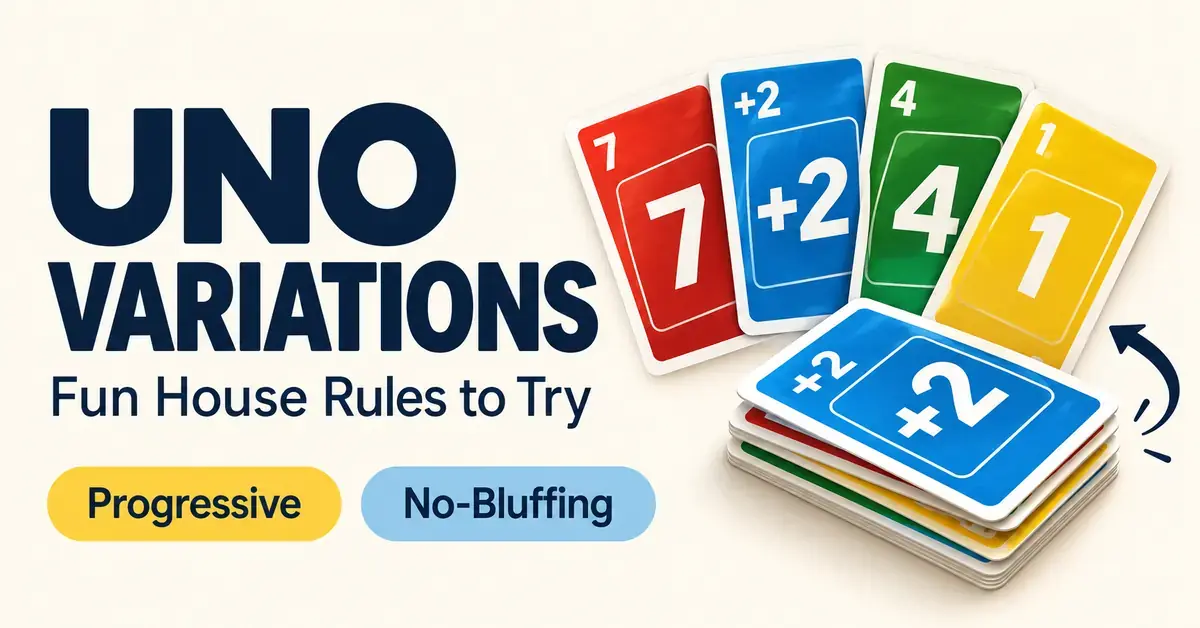
UNO ships with a short official rulebook, yet almost nobody plays it exactly as printed. Over the years players have invented dozens of custom twists — commonly called “house rules” — that speed the game up, add chaos, or reward bluffing. This guide collects the most popular UNO variations, explains precisely how each one works, and makes clear which are genuine Mattel rules and which are fan-made. Every variation below is described so you can teach it in under a minute before your next round.
What are UNO variations?
UNO variations are optional rule changes players add to the standard game, not new products you buy. A house rule alters how the existing cards behave — for example, letting Draw Two cards “stack” so the penalty passes down the table. Because a normal UNO deck already contains every card these twists rely on, you can switch a variation on or off simply by agreeing to it before you deal.
It helps to separate two things that sound similar. House rules are informal tweaks to the classic game. Official editions are separate boxed products sold by Mattel — such as UNO Flip!, UNO All Wild! or UNO Show ’em No Mercy — each printed with its own distinct rules and cards. This article is about house rules you can apply to a standard deck; if you want the full catalogue of boxed products, see our overview of every current UNO version and edition rather than mixing the two up.
What do the official UNO rules actually say?
The official UNO rules are the baseline every house rule modifies, so it pays to know them exactly. A standard deck holds 108 cards, and each player is dealt seven at the start of a round. On your turn you match the top discard by colour, number or symbol, or you play a Wild card.
Three official points matter most because so many house rules bend them:
- Drawing when you cannot play: if you have no legal card, you draw exactly one card from the draw pile. You may play it immediately if it fits; otherwise your turn ends. You do not keep drawing.
- Wild Draw Four: you may only play it when you have no card matching the current colour (you can still be holding other-coloured numbers, Skips, Reverses, Draw Twos or a plain Wild). The next player may challenge. You then show your hand: if you were hiding a matching colour, you draw the four cards yourself; if the challenge is wrong, the challenger draws six (the original four plus a two-card penalty).
- Saying “UNO”: when you play your next-to-last card you must call “UNO.” If another player catches you before the next player takes their turn, you draw two cards.
Draw Two and Wild Draw Four cards do not “stack” in the official game: the targeted player simply draws the cards and loses the turn. Rounds are scored by adding up the cards left in opponents’ hands — number cards at face value, Skip, Reverse and Draw Two at 20 points each, and Wild and Wild Draw Four at 50 points each — and the first player to reach 500 points wins the game.
Official UNO Basics
- Deck: 108 cards; each player is dealt 7 to start a round.
- No playable card: draw exactly one card, then play it or pass.
- Wild Draw Four: legal only with no matching colour in hand; can be challenged.
- Saying “UNO”: call it on your next-to-last card or draw 2 if caught.
- Scoring: number cards at face value, action cards 20, Wild and Wild Draw Four 50.
- Winning: first player to reach 500 points across rounds wins.
How do house rules change the game?
House rules change UNO by rewriting what a card does, how drawing works, or how you win, without adding any new cards. Most fall into three buckets: rules that let cards chain together (stacking), rules that add out-of-turn actions (jumping in, hand swaps), and rules that change penalties (bigger UNO catches, longer draws). Because they can dramatically shift pace and strategy, the golden rule is to agree on every variation before the first card is dealt — mid-game rule changes are the fastest way to start an argument.
The most popular UNO variations to try
The variations below are the ones you will meet most often at kitchen tables and game nights. Each explains what changes, how to run it cleanly, and how it feels in play so you can pick the ones that fit your group.
Progressive UNO (stacking Draw cards)
Progressive UNO lets Draw penalties pile up instead of hitting a single player. When someone plays a Draw Two or Wild Draw Four, the targeted player can avoid drawing by playing their own matching Draw card, pushing an ever-growing total onto the next player. The stack keeps building until a player cannot respond, and that unlucky person draws the entire pile at once — six, eight, ten cards or more.
Groups differ on what may be stacked. The strictest version allows only identical cards (a Draw Two on a Draw Two, a Wild Draw Four on a Wild Draw Four). Looser versions let any Draw card stack on any other. Decide which before you play, because “can a Draw Two go on a Draw Four?” is the single most common UNO argument. Note that stacking is not part of the official rules at all — Mattel has stated a Draw card ends your turn and the next player must simply draw.
No-Bluffing (removing the Wild Draw Four challenge)
The No-Bluffing rule deletes the Wild Draw Four challenge entirely, so no one can question whether the card was played legally. That removes the official bluff-and-challenge mini-game, in which a player gambles on playing a Wild Draw Four even while holding a matching colour. Two versions are common: in the honour-system version you still may only play the card when you genuinely have no matching colour, but nobody checks; in the free version you may play a Wild Draw Four whenever you like with no penalty at all. Pick one up front, because they play very differently — the free version makes the card far more powerful.
Draw Until You Can Play
Draw Until You Can Play replaces the official single draw with a keep-drawing rule: if you have no legal card, you draw from the pile until you turn up one you can play, and then you must play it. Hands grow quickly, rounds last longer, and luck plays a bigger part. It is popular with players who dislike “passing” and want everyone to stay in the action, but it burns through the draw pile fast, so expect frequent reshuffles. Remember the official game has you draw only one card and then pass if it is unplayable.
The 7-0 Rule (Seven-O)
The 7-0 rule turns two ordinary number cards into hand-swapping bombs. Playing any 7 lets you trade your whole hand with another player of your choice, while playing any 0 forces every player to pass their entire hand to the next player in the current direction of play. It is chaotic and a great equaliser, because a player about to win can suddenly be handed a fistful of cards. Seven-O appears in some official UNO instruction materials as an optional variant, so it is semi-official, but it is still not part of the core rules.
Jump-In UNO
Jump-In UNO lets any player slam down a card out of turn if it is an exact match for the current discard — same colour and same number. Play then jumps to that player and continues from them, skipping anyone in between. It rewards attention and makes the game faster and louder, but it causes disputes, so agree in advance that the match must be exact (a red 5 on a red 5, not just any 5) and that ties go to whoever’s card hits the pile first.
Callouts and UNO catch penalties
Callout rules change what happens when someone forgets to say “UNO”. Officially the penalty is drawing two cards if you are caught before the next player takes their turn. House versions often raise the stakes — drawing four cards is common — or tighten the timing so you must be caught the instant you set down your second-to-last card. Some groups also penalise “false callouts,” where a player wrongly accuses someone, to stop constant heckling. Whatever you choose, define exactly when a catch is still valid so late accusations do not derail the round.
Other fun twists worth trying
Beyond the headline variations, plenty of small tweaks change the feel of a game:
- Stacking Skips or Reverses: chain Skip cards to knock out several players in a row, or bounce Reverses back and forth in duels.
- Play to a lower score: race to 200 or 300 points instead of 500 for a quicker night, or play a single-round “first to empty their hand wins.”
- Write-your-own rule cards: agree that a Wild card can carry a house effect the player names when it is played, such as “everyone draws one.”
- No passing: if a drawn card is playable, you must play it rather than keep it, forcing quicker turns.
Variations at a Glance
| Variation | What it changes | Official? |
|---|---|---|
| Progressive UNO (stacking) | Draw Two / Wild Draw Four penalties chain and grow until someone cannot respond | No — house rule |
| No-Bluffing | Removes the Wild Draw Four challenge; may also let the card be played any time | No — house rule |
| Draw Until You Can Play | You keep drawing until you get a playable card instead of drawing one | No — house rule |
| 7-0 (Seven-O) | Playing a 7 swaps hands with a chosen player; playing a 0 rotates all hands | Optional UNO variant |
| Jump-In | Play an exact-match card (same colour and number) out of turn | No — house rule |
| Callout penalty | Increases the penalty for forgetting to say “UNO” beyond two cards | No — house rule |
Are these UNO variations official?
Most popular UNO variations are house rules, not official Mattel rules. Mattel publicly confirmed in 2019 that Draw Two and Wild Draw Four cards cannot be stacked in the official game, which means Progressive UNO, No-Bluffing and Draw Until You Can Play are all unofficial. The main exception is the 7-0 rule, which appears in some official UNO instruction materials as an optional variant — it is semi-official but still not part of the standard game. In short: enjoy any variation you like, but do not assume the rest of the table knows it, and never claim a house rule is “the real way” to play.
How to introduce house rules without arguments
The best way to add UNO variations is to settle every rule before the deal, out loud, so no one is surprised later. A quick pre-game checklist keeps things friendly:
- Name each variation you are using and explain it in one sentence.
- For stacking, state exactly what can stack on what.
- Decide the UNO catch penalty and how late a callout can be.
- Confirm the target score and whether you play multiple rounds.
- Agree that no new rules are added once the first card is dealt.
Common mistakes when playing UNO variations
The most common mistake is mixing house rules with official rules without telling everyone, which turns disagreements into arguments. Watch for these traps:
- Assuming stacking is official. Many players are shocked to learn Mattel does not allow it; agree on it explicitly.
- Vague stacking rules. “Can a Draw Four go on a Draw Two?” must be answered before, not during, a heated turn.
- Forgetting the Wild Draw Four restriction. If you keep the challenge, remember the card is only legal with no matching colour in hand.
- Overpowered combos. Free Wild Draw Fours plus stacking can make rounds swing wildly; test with lower stakes first.
- Piling on penalties. Huge draw stacks and harsh UNO catches can bury newer players and kill the fun.
Which UNO variation suits your group?
The right variation depends on who is playing and how long you want the game to last. For younger children, keep it simple — the 7-0 rule and gentle callouts add fun without much bookkeeping. For competitive adults, Progressive UNO and Jump-In reward quick thinking and sharp attention. For large groups, stacking and 7-0 create big, memorable swings that keep everyone involved. For a fast game, play to a lower score and skip the longer draw rules. When in doubt, start with one or two variations and add more only once everyone is comfortable.
Sources
Frequently Asked Questions (FAQ)
Is stacking Draw Two and Draw Four cards allowed in UNO?
Not in the official rules. Mattel confirmed in 2019 that a Draw card ends your turn and the next player must draw the cards without responding. Stacking, also called Progressive UNO, is a popular house rule you can add by agreement, but it is not part of the standard game.
What is the 7-0 rule in UNO?
The 7-0 rule makes playing a 7 swap your hand with a chosen player and playing a 0 pass every player’s hand to the next player in the direction of play. It appears in some official UNO instruction materials as an optional variant, but it is not part of the core rules.
How many cards do you draw if you have no playable card?
In the official game you draw exactly one card, which you may play if it fits; otherwise your turn ends. “Draw Until You Can Play,” where you keep drawing until you find a playable card, is a house rule, not the standard rule.
What is the No-Bluffing house rule?
No-Bluffing removes the Wild Draw Four challenge, so no one can question whether the card was played legally. Groups either keep the honour-system restriction (play it only with no matching colour) or allow the card to be played any time with no penalty.
Are UNO house rules the same as UNO editions?
No. House rules are optional tweaks to the classic game using a standard deck, while UNO editions such as UNO Flip! or UNO All Wild! are separate boxed products with their own printed rules and cards.
