
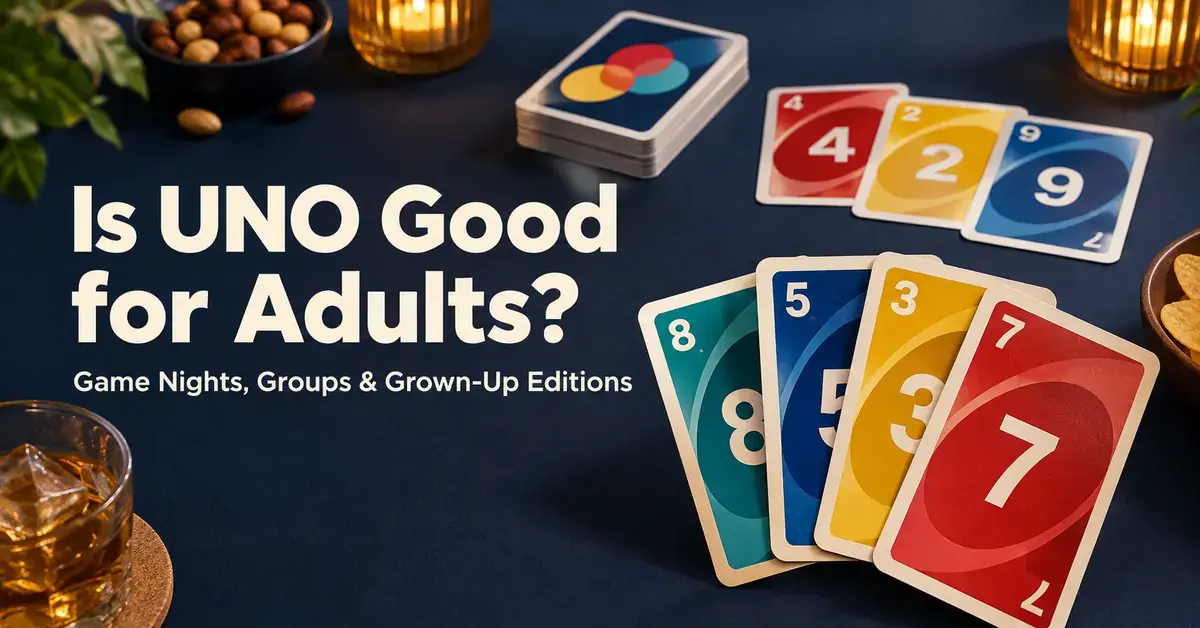
Yes, UNO is genuinely good for adults — and it is far more than a children’s filler game. UNO is fast to learn, quick to play, works for 2 to 10 players, and now comes in deliberately brutal “grown-up” editions built for competitive game nights. Mattel itself markets the classic game for “kids, adults and family game night,” and the harder editions have become a social-media phenomenon with grown-ups. This guide explains exactly why UNO works for adults, which editions and house rules suit older players, how it scales to big groups, and the few mistakes that spoil it.
Key Takeaways
- Short answer: Yes — UNO is well suited to adults, not just children.
- Why it works: fast rounds (about 30 minutes or less), almost no learning curve, 2–10 players, and highly portable.
- Grown-up edge: bluffing, targeting the leader and house rules add real competitive depth.
- Adult editions: UNO Show ‘Em No Mercy, UNO Flip and UNO All Wild are built for tougher, faster play.
- Big groups: combine two decks or use UNO Party to seat more than 10 players.
Is UNO actually good for adults?
UNO is a strong choice for adults because it combines a near-zero learning curve with real tactical decisions and endless replay value. The base game is a shedding game — a card game where the goal is to empty your hand before anyone else — so a new player can join mid-evening and understand it within one round. That accessibility is exactly what makes it reliable for mixed adult groups where not everyone wants to read a rulebook.
At the same time, UNO is not purely luck. Deciding when to drop a Wild, when to change colour to cut off an opponent, and when to hold a Draw card for a finishing blow are genuine choices. For adults who want more bite, Mattel now sells editions designed specifically around aggression, bluffing and knockout rules, so the game scales from a relaxed family round to a cut-throat tournament.
Why UNO works so well for adult game nights
UNO fits adult game nights because it removes the usual friction of grown-up socialising: long setup, complicated rules and uneven player counts. A round starts in under a minute and ends in roughly 30 minutes or less.
- It is fast and low-commitment. Rounds are short, so people can arrive late, leave early, or play “just one more” without derailing the night.
- Everyone already knows it. UNO has been sold since the early 1970s, so most adults learned it as children — there is almost no teaching time.
- It scales to the room. The standard game supports 2 to 10 players, and dedicated editions push that higher for parties.
- It travels. A single deck fits in a pocket or bag, making it ideal for trips, camping, pubs, hotel rooms and back gardens.
- It is social, not silent. Unlike many strategy games, UNO encourages table talk, trash talk and alliances, which is what adults actually want from a game night.
What makes UNO fun for grown-ups specifically?
The grown-up appeal of UNO comes from the social and competitive layer that sits on top of the simple rules. Adults rarely care about matching colours for its own sake — they care about the moment they drop a Wild Draw Four on the player who was about to win.
Several things sharpen that appeal for older players. Bluffing and timing matter: the Wild Draw Four can legally be played as a bluff, and reading whether an opponent is holding one adds a poker-like edge. Rivalries and targeting develop quickly, because you can gang up on the point leader. And house rules let a group dial the chaos up or down to taste — the same deck can be a gentle warm-up or a merciless grudge match.
Grown-up UNO editions worth knowing
Several UNO editions are aimed squarely at older, more competitive players rather than young children. The most talked-about is UNO Show ‘Em No Mercy, released in 2023, which went viral on TikTok and — according to market tracker Circana — became the second most popular traditional game in early 2024, behind only classic UNO. It layers on a Draw 10 card, mandatory stacking of Draw cards, and a rule that knocks you out of the round the moment your hand hits 25 cards.
Other editions add their own adult-friendly twists, from the double-sided deck of UNO Flip to the all-wild chaos of UNO All Wild and a wide range of collectible themed decks (The Office, Harry Potter and more) that appeal to grown-up fandoms. The table below compares the main options; follow the linked guides for full rules of each. For the complete catalogue, see our overview of every current UNO version and edition.
UNO Editions for Adults
| Edition | Players | Age | Why adults like it |
|---|---|---|---|
| Classic UNO | 2–10 | 7+ | Familiar, fast and endlessly house-ruleable; the flexible default |
| UNO Show ‘Em No Mercy | 2–6 | 7+ | Mandatory stacking, a Draw 10 card and a 25-card knockout — built for ruthless play |
| UNO Flip | 2–10 | 7+ | Double-sided deck flips to a punishing “Dark” side with harsher penalties |
| UNO All Wild | 2–10 | 7+ | Every card is wild and there is no colour matching — chaotic and quick |
| UNO Party | Big groups | 7+ | Passing hands and Speed Play designed for large game-night crowds |
| Themed & collectible decks | 2–10 | 7+ | The Office, Harry Potter and designer editions that appeal to grown-up fandoms |
If you enjoy the format but want something new, it is also worth exploring card games like UNO, several of which skew more strategic and suit adult groups well.
House rules and variations that level up adult play
House rules are the single biggest reason UNO stays fresh for adults, because they turn a simple game into whatever the table wants. These are unofficial — Mattel does not print them in the standard rules — but they are hugely popular, and some have since been baked into official editions such as No Mercy.
- Stacking: letting players pile Draw 2s (and sometimes Draw 4s) onto each other so the penalty snowballs. This is a house rule in classic UNO but mandatory in No Mercy.
- The 7-0 rule: playing a 7 swaps your whole hand with another player, and a 0 passes every hand around the table — brutal when someone is one card from winning.
- Jump-in: if you hold an exact duplicate of the card just played (same colour and number), you can play it out of turn and skip ahead.
- Progressive / draw-until-you-can-play: variations that raise the stakes and the chaos.
A full catalogue of these lives in our guide to UNO house rules. Adults also sometimes run UNO as a drinking game, assigning a sip to penalties or to forgetting to call “UNO.” If your group does this, keep it optional and drink responsibly — it is a social add-on, not part of the game.
UNO for big groups and parties
UNO scales to large adult gatherings better than most card games, which is why it is a party staple. The standard deck officially supports up to 10 players, and you can combine two decks to seat even more people at one table.
For dedicated party play, Mattel’s UNO Party edition is built for big groups and adds mechanics such as passing hands and a faster “Speed Play” mode. If you are planning a large night, read how to handle numbers and seating in our guides to playing UNO with large groups and the specific UNO Party rules. The key practical tip: with big groups, Skip and Reverse cards become far more powerful, because they can jump a penalty right back to the person who started it.
Does UNO have real strategy for adults?
UNO rewards skill more than casual players assume, which is part of why it holds adult interest. Over many rounds, the stronger player wins noticeably more often. The core tactics are straightforward to list but take practice to time well:
- Shed high-value cards early so you are not caught holding big points if someone else goes out.
- Track colours — notice which colour opponents keep drawing on, and deny it to them.
- Save your Wilds for a moment when you need to change colour under pressure or finish a round.
- Target the leader with Skips, Reverses and Draw cards rather than spreading penalties randomly.
- Bluff the Wild Draw Four and know when to challenge an opponent’s.
Competitive adults can go deeper into card counting, bluff timing and team play in our advanced UNO strategy guide.
Cognitive and social benefits of UNO for adults
Beyond entertainment, UNO offers the same low-key mental and social benefits that research associates with card games generally. Playing engages memory (tracking what has been discarded), attention and quick decision-making, and the light strategy exercises mental flexibility as you adapt to each turn.
Just as importantly, UNO is a shared, screen-free focus that lowers the barrier to conversation — useful at family reunions, with older relatives, or when bringing a new group together. For seniors in particular, a familiar, easy-to-handle game like UNO can be an accessible way to stay socially and mentally active without a steep learning curve.
Common mistakes adults make with UNO
Most of what spoils UNO for adults comes from a handful of avoidable mistakes, not from the game itself.
- Dismissing it as “just a kids’ game.” Groups that write UNO off never try the harder editions or house rules where the adult fun lives.
- Confusing house rules with official rules. Stacking Draw cards feels standard but is not in the official rules — agree before you deal to avoid arguments.
- Piling on too many house rules at once. One or two twists sharpen the game; five at once makes rounds drag and confuse newcomers.
- Forgetting to call “UNO.” Failing to announce your last card can cost you a penalty if an opponent catches you in time.
- Picking the wrong edition for the group. No Mercy is punishing and slow with beginners; classic or All Wild is friendlier for a mixed, casual table.
Who is UNO best suited for?
UNO suits almost any adult group, but it shines for specific situations. Choose it for casual, mixed-skill gatherings where you need something everyone already knows; for competitive friends who will enjoy No Mercy’s knockout rules; for big parties where you need a game that scales; and for multi-generational play where it bridges children, parents and grandparents at one table. It is also an excellent travel and pub game thanks to its tiny footprint.
If your evening includes younger children as well, it is worth reading the companion question of whether UNO is good for kids so you can pick an edition and house-rule set that works for every age at the table.
Sources
Frequently Asked Questions (FAQ)
Is UNO too childish for adults?
No. While UNO is rated for ages 7 and up and is popular with children, Mattel markets it for adults and family game nights alike, and its harder editions are designed specifically for grown-ups. Added bluffing, house rules and competitive editions give it plenty of adult appeal.
What is the best UNO edition for adults?
It depends on your group. For aggressive, competitive play, UNO Show ‘Em No Mercy is the current favourite. For fast, chaotic fun, UNO All Wild works well, and classic UNO remains the most flexible because you can layer on any house rules you like.
Can adults play UNO without kids?
Absolutely. UNO works just as well as an adults-only game. A group of adults can run competitive house rules, use the tougher editions, or treat it as a quick social game between longer activities — no children required.
Is UNO No Mercy suitable for adults?
Yes — it is arguably built for them. UNO No Mercy adds mandatory stacking, a Draw 10 card and a 25-card knockout rule, making rounds longer and far more ruthless. That intensity appeals to adults but can frustrate young or first-time players.
How many adults can play UNO at once?
Standard UNO officially supports 2 to 10 players. For larger adult parties you can combine two decks or use the UNO Party edition, which is designed for bigger groups and adds party-specific mechanics.
