

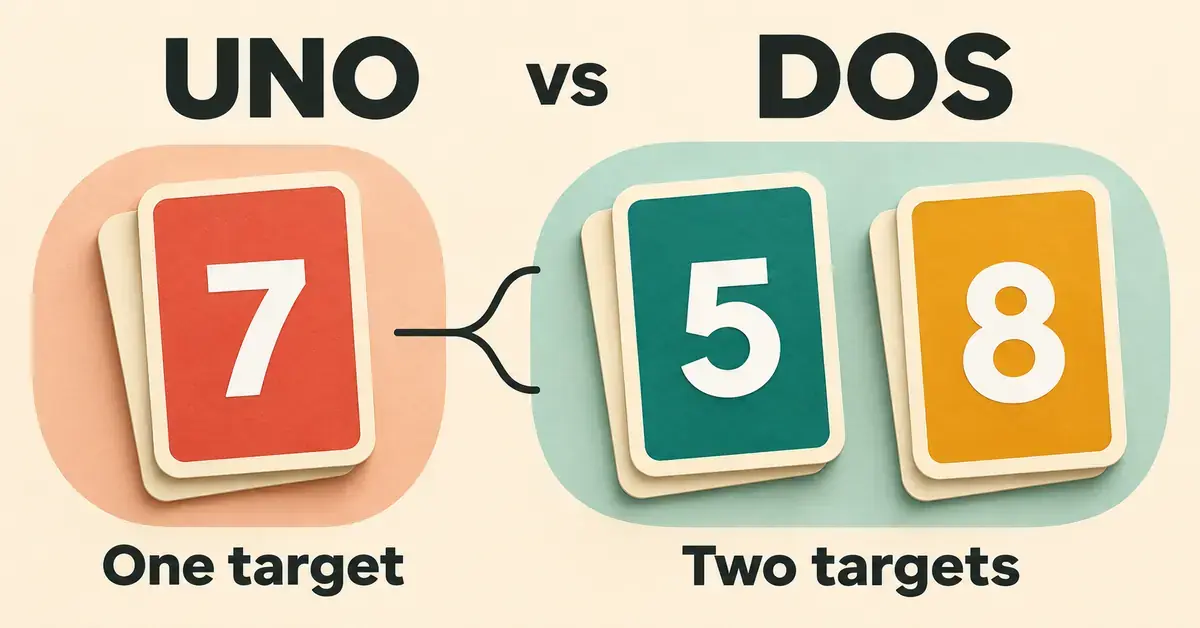
UNO and DOS are both Mattel card games built on the same goal – be the first to empty your hand – but they are not the same game. The headline difference is that UNO uses a single discard pile and lets you match the top card by colour, number or symbol, while DOS uses two discard piles, leans heavily on matching and adding numbers, and lets you play more than one card in a turn. You also shout a different word near the end: “UNO!” when you are down to one card, and “DOS!” when you are down to two. If you already play UNO, DOS will feel familiar within a round or two – it just asks you to watch two targets at once and do a little quick arithmetic.
One thing worth knowing before you compare them: there are two quite different versions of DOS. The original 2018 release used a spread-out centre row and matched by number only, while Mattel’s current DOS Second Edition (2022) was re-built to play much more like UNO. This guide covers both so it is accurate whichever box is on your table.
UNO vs DOS at a Glance
| Feature | UNO | DOS |
|---|---|---|
| Maker | Mattel | Mattel |
| Goal | Be first to empty your hand | Be first to empty your hand |
| Players | 2–10 | 2–4 |
| Deck size | 108 cards (classic) | 108–112 cards, depending on edition |
| Discard piles | One | Two |
| Cards per turn | One | One or two (and to both piles) |
| How you match | Colour, number or symbol | Number-led; combine two cards that add up to a pile’s number |
| The call | “UNO!” at one card | “DOS!” at two cards |
| Wild cards | Wild, Wild Draw Four | Wild DOS (any colour, counts as 2), Wild Play Two |
| Win target (points) | First to 500 | First to 200 (original) or 500 (2022 edition) |
| Age | 7+ | 7+ |
What is UNO?
UNO is the classic shedding card game where you race to get rid of every card in your hand. Barber Merle Robbins invented it in Reading, Ohio, in 1971, and Mattel has published it since the early 1990s. A standard deck holds 108 cards: four colours (red, yellow, green and blue), number cards from 0 to 9, and action cards – Skip, Reverse and Draw Two – plus Wild and Wild Draw Four cards.
Each player is dealt seven cards and the rest form a single draw pile, with one card turned over to start one discard pile. On your turn you play a card that matches the top of that pile by colour, number or symbol, or you draw one card. Action cards change the flow: Skip misses the next player, Reverse flips the direction of play, and Draw Two forces the next player to pick up two and lose their turn. When you are down to your last card you must call “UNO!” before it touches the pile, or a player who catches you can make you draw two. For the full walkthrough, see our guide on how to play UNO.
What is DOS?
DOS is a standalone card game “from the makers of UNO”, first released by Mattel in 2018. The name is the Spanish word for “two”, and the number two runs through everything: two discard piles, playing two cards at once, and calling “DOS!” when you hold two cards. The goal is the same as UNO – be first to empty your hand – but the matching rules revolve around numbers rather than colours.
The signature move is the number combo: you can play two cards from your hand that add up to the number showing on a pile. For example, a 3 and a 4 together can cover a 7. There is no printed “2” card in the original deck – every two is a Wild DOS card that counts as a two of any colour. DOS has been reissued more than once, so the exact rules depend on your edition; our dedicated how to play DOS page walks through the current set-up, scoring and special cards in full. There is also a light-and-dark spin-off, DOS Flip, that adds a double-sided deck.
The key differences between UNO and DOS
One discard pile versus two
UNO builds on a single discard pile – there is only ever one top card to beat. DOS keeps two discard piles going at the same time, so on your turn you choose which pile to play on, and you may add to both piles in the same turn if you can. That extra target is the biggest reason DOS feels different: you are always weighing two options instead of one, and the piles can push you toward numbers you would not have played in UNO.
How you match cards
In UNO you match by colour, number or symbol – a red 7 can be followed by any red card, any colour 7, or a Wild. DOS centres on numbers. In the original 2018 edition colour was ignored for legality: you matched the number on a pile, full stop, and matching the colour as well earned a bonus. The current DOS Second Edition softened this – you match at least one attribute (colour, number or symbol), much like UNO – but the number-combo rule stays front and centre in both versions. Matching the colour as well as the number is where DOS hands out its bonuses rather than relying on a big menu of action cards.
Playing one card versus combining two
UNO is a one-card-per-turn game, unless your group adds a house rule to play two cards at once. DOS lets you play one card or two, and the clever part is the addition: two cards that total the number on a pile count as a legal play. In the original edition any two cards that add up to the target number are legal regardless of colour – matching the colour as well simply earns a bonus (the Double Colour Match). The rule that the two combined cards must share a colour is a Second Edition addition. This single rule is why DOS rewards a bit of mental maths – you are constantly checking whether two cards in your hand add up to a target.
The call: “UNO!” at one card, “DOS!” at two
Both games make you announce when you are close to winning, but at different points. In UNO you shout “UNO!” the moment you are down to a single card. In DOS you shout “DOS!” when you are down to two cards. The penalty is similar in spirit: if another player catches you staying silent before the next turn begins, you draw penalty cards (two, in both games). The earlier warning in DOS – one card sooner – gives opponents a little more time to react.
Scoring and the winning total
UNO is played to 500 points. When someone empties their hand, they score the value of the cards still in everyone else’s hands – number cards at face value, Skip, Reverse and Draw Two at 20 points each, and Wild and Wild Draw Four at 50 each – and the first player to reach 500 wins the match. You can read the worked examples on our UNO scoring rules page. DOS also lets the hand winner score the cards left in opponents’ hands, but the target has changed between editions: the original 2018 game was first to 200 points, while a 2021 printing already made scoring an optional variant that plays to 500 – a method the 2022 Second Edition keeps – otherwise you simply win the hand by going out first.
Players, deck size and action cards
UNO supports 2 to 10 players; DOS is built for 2 to 4. UNO’s classic deck is 108 cards and is packed with UNO action cards (Skip, Reverse, Draw Two, Wild, Wild Draw Four). DOS carries fewer action cards and instead leans on its number and colour bonuses; its Second Edition deck has 112 cards and does include Skip, Reverse and Draw Two along with the Wild DOS card and a Wild Play Two card. Both games are rated for ages 7 and up.
Does DOS still feel different from UNO? First edition versus Second Edition
DOS has changed enough between editions that “is DOS like UNO?” has two answers. Knowing which box you own matters, because the rules moved.
- Original DOS (first edition, 2018): the most distinct version. Cards were laid out in a loose centre row, you matched by number only, and the colour match was a pure bonus. The win target was 200 points, though a 2021 printing already made scoring an optional variant to 500. This is the version Google’s summaries and most older articles describe, which is why DOS gets a reputation for being “UNO but with maths”.
- DOS Second Edition / “Refresh” (2022-present): Mattel re-designed it to play, in its own words, “just like the classic UNO you know and love, except for a few special cards and rules”. It tidies the layout into two clear discard piles, lets you match by colour, number or symbol, adds UNO-style Skip, Reverse and Draw Two action cards, and scores to 500. The number-combo and the two-pile idea survive, but it sits much closer to UNO than the original did.
So if someone tells you DOS is “totally different from UNO”, they are usually thinking of the 2018 game. The current retail edition is closer to a two-pile UNO variant with an addition twist.
Which should you play?
Neither game is objectively better – they suit different tables. Here is how to choose.
- Play UNO if you want the familiar party staple, a bigger group (it handles up to 10), lots of action cards and “take that” moments, or you are teaching younger children the basics of colour-and-number matching.
- Play DOS if you want a quicker, brainier twist for 2 to 4 players, enjoy the light arithmetic of adding cards to a total, and like having two piles to plan around. It is a good next step for a group that already knows UNO inside out.
- Play either for a casual family game night – both are easy to learn in a few minutes and play in roughly 20 to 30 minutes per session.
If you are weighing DOS against other UNO-style games rather than UNO itself, our roundup of UNO vs Crazy Eights compares the family’s best-known cousin on the same kind of criteria.
Frequently Asked Questions (FAQ)
Is DOS harder than UNO?
DOS asks for a little more thinking because you track two piles and look for cards that add up to a total, but it is not a complex game. Most UNO players pick it up within a round. UNO is slightly more forgiving for very young children.
Can you use an UNO deck to play DOS?
Not properly. DOS has its own deck with Wild DOS cards (which replace the printed 2s) and different card counts, so the matching and combo rules do not line up with an UNO deck. You need an actual DOS set.
Did DOS replace UNO?
No. Mattel released DOS as a companion game, not a replacement. UNO remains the flagship and is still sold and updated alongside DOS and the wider range of UNO versions.
Which came first, UNO or DOS?
UNO came first by decades – it was invented in 1971 and sold by Mattel since the early 1990s. DOS arrived much later, in 2018, as a companion game built around the number two.
