
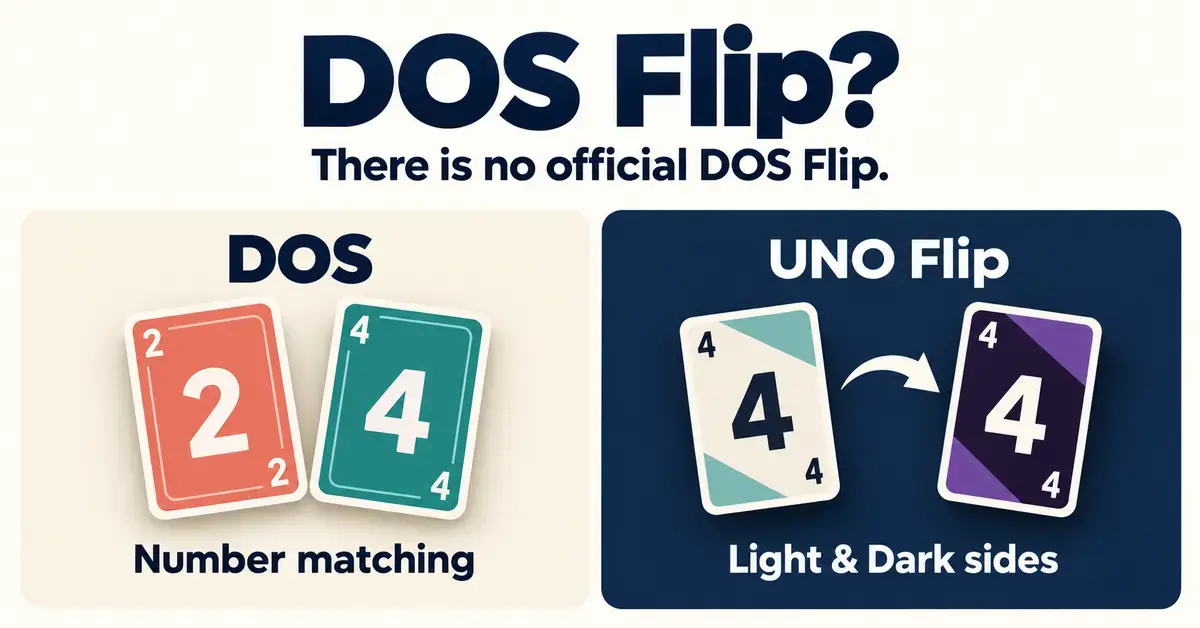
If you are searching for DOS Flip rules, here is the short answer first: there is no official DOS Flip card game. Mattel makes DOS and it makes UNO Flip, but it has never released a double-sided, light-and-dark version of DOS. The flip mechanic that turns every card over in the middle of a game belongs to UNO Flip, which is a completely separate game. This guide explains why the two get mixed up, how DOS and UNO Flip each actually play, and which one you probably mean.
Is there an official DOS Flip card game?
No. Mattel has never published a game called DOS Flip, and there are no official DOS cards with a “light” side and a “dark” side. What exists is three different products from the makers of UNO:
- DOS — the original number-matching card game, released in 2018.
- DOS Second Edition — a refreshed version of DOS released in 2022 with simplified, updated rules.
- UNO Flip — a double-sided deck with a Light side and a Dark side, released in 2019. This is the only game in the family that “flips.”
When you see a “Flip” game sold in a multipack alongside DOS, that “Flip” is UNO Flip, not a flip edition of DOS. So if a website or video promises “DOS Flip rules,” it is either describing UNO Flip by mistake or mixing two game names together.
Key Points
- No official DOS Flip exists: Mattel makes DOS and UNO Flip as separate games.
- The light-and-dark flip format is UNO Flip (released 2019), not DOS.
- DOS is a number-matching game with a two-card Center Row (original 2018; refreshed as DOS Second Edition in 2022).
- UNO Flip: 112 double-sided cards, 2–10 players, first to 500 points wins.
- DOS: match or add up to the Center Row, call “DOS!” at two cards, first to 200 points wins (original edition).
Why do people search for DOS Flip?
The confusion is easy to understand because both games sit in the same family and are marketed together. A few things feed the mix-up:
- Shared heritage. DOS and UNO Flip are both “from the makers of UNO,” so shoppers lump every spin-off into one mental category.
- The word “Flip” is tied to the UNO brand. Once you have heard of UNO Flip, it is natural to assume there must be a DOS Flip too.
- Combo packs. Retailers often bundle DOS and UNO Flip in the same box of two, three or four games, so the two names appear side by side on the packaging.
- Name blending. “DOS,” “UNO,” and “Flip” are short, similar words that are easy to recombine from memory.
Whatever brought you here, you most likely want one of two things: the rules for the light-and-dark flip game (that is UNO Flip) or the rules for the two-pile number game (that is DOS). Both are covered below.
UNO Flip: the real light-and-dark flip game
UNO Flip is the game with the light and dark sides, so if the “flip” idea is what you are after, this is it. Mattel released it in 2019 with a 112-card, double-sided deck for 2 to 10 players, ages 7 and up. It plays like classic UNO on the surface but adds one big twist: every card has two faces, and a special card can turn the whole game over.
How the two sides work
Every card is printed on both sides. You hold your hand with the Light side facing you and the Dark side facing your opponents, and each round starts on the Light side. On your turn you match the top of the discard pile by colour, number or symbol, exactly like regular UNO. The Light side plays gently; the Dark side is much harsher.
The Flip card and the brutal Dark side
When any player plays a Flip card, the entire game turns over at once: the draw pile, the discard pile and every player’s hand all flip to the Dark side, and play continues on those faces until someone plays another Flip card to switch everyone back. The Dark side swaps the mild actions for punishing ones:
- Draw Five replaces the Light side’s Draw One, forcing the next player to pick up five cards.
- Skip Everyone skips every other player and gives you another turn.
- Wild Draw Color makes the next player draw until they pull your chosen colour, then lose their turn.
Scoring matches classic UNO: the round winner collects the point value of the cards left in everyone else’s hands, and the first player to reach 500 points wins the game. For the full card-by-card breakdown, see our dedicated UNO Flip rules guide.
DOS: the number-matching game people confuse with it
DOS is a separate shedding game built around matching numbers, not around flipping sides. It also comes from the makers of UNO (the original launched in 2018), but it looks and plays differently from both UNO and UNO Flip. Instead of one discard pile, DOS uses a Center Row of at least two face-up cards that you try to match from your hand.
The core rules of the original DOS are:
- Match the Center Row. On your turn you match a Center Row card either with a single card of the same number, or with two cards that add up to that number (a “double match”).
- Colour Match Bonus. If the card or cards you play also match the colour of the Center Row card, you earn a bonus and add a card from your hand to the Center Row.
- Call “DOS!” When you are down to two cards you must shout “DOS!” (Spanish for “two”), or you draw a penalty if another player catches you.
- Winning. The round winner scores points for the cards left in opponents’ hands, and in the original edition the first player to reach 200 points wins.
The 2022 DOS Second Edition streamlined things: all number “2” cards became Wild DOS cards, a Wild Play Two card forces the next player to lay down at least two cards, and two action cards played together stack their effects onto the next player. Either way, nothing in DOS flips to a dark side. For the complete walkthrough, read our full DOS rules guide.
DOS vs UNO Flip: the key differences
The fastest way to see why there is no single “DOS Flip” is to put the two games side by side. They share a publisher and an age rating, but almost everything about how a turn works is different.
DOS vs UNO Flip
| Feature | DOS | UNO Flip |
|---|---|---|
| First released | 2018 (Second Edition 2022) | 2019 |
| Players | 2–4 | 2–10 |
| Deck | Single-sided cards | 112 double-sided cards |
| Core play | Match or add up to a two-card Center Row | Match colour, number or symbol on one discard pile |
| Light & Dark sides? | No | Yes |
| Flip card? | No | Yes — flips everyone to the Dark side |
| Signature twist | Colour Match Bonus adds cards to the Center Row | Dark-side Draw Five, Skip Everyone, Wild Draw Color |
| Call out at | Two cards (“DOS!”) | One card (“UNO!”) |
| Game won at | 200 points (original) | 500 points |
Can you add a flip rule to DOS yourself?
You can invent a house rule, but you cannot make DOS into an official flip game, because DOS cards are printed on one side only. Some players enjoy combining ideas across the UNO family — for example, borrowing a “swap sides” or penalty twist — but any such change is a homemade variation, not an official Mattel rule, and it only works if every player agrees before the game starts. If you like tinkering with rules, our overview of UNO house rules shows how the community labels official rules versus homemade ones so nobody argues mid-game. The honest takeaway: the light-and-dark experience you are picturing already exists as a finished product called UNO Flip, so you do not need to build it onto DOS.
Common mistakes and points of confusion
Most of the trouble around “DOS Flip” comes from treating two games as one. Watch for these:
- Assuming DOS has a dark side. It does not. If a card you are holding has two printed faces, you are playing UNO Flip, not DOS.
- Calling the wrong word. In DOS you call “DOS!” at two cards; in UNO Flip you call “UNO!” at one card. Mixing them up can cost you a penalty.
- Using UNO Flip’s single pile in DOS. DOS needs a Center Row of at least two cards and lets you double-match; forgetting that breaks the game.
- Buying the wrong box. If you want the flip mechanic, look for “UNO Flip,” not “DOS.” If you want number matching, look for “DOS.”
- Trusting third-party “DOS Flip” pages. Any guide claiming to teach official DOS Flip is really describing UNO Flip.
Which game is right for you?
Choose based on the kind of play you enjoy, not the name. UNO Flip suits players who already love UNO and want higher stakes, bigger groups (up to 10) and the drama of flipping everyone onto the harsh Dark side. DOS suits players who prefer a quicker numbers puzzle, enjoy adding cards up to make matches, and usually play in smaller groups of two to four. Both are inexpensive, travel well and take only minutes to learn.
If neither is quite what you pictured, it is worth browsing the wider range of UNO versions and editions or our roundup of card games like UNO to find the twist you actually want.
Sources
Frequently Asked Questions (FAQ)
Is DOS Flip a real game?
No. There is no official DOS Flip card game. Mattel makes DOS and, separately, UNO Flip. The light-and-dark “flip” format belongs only to UNO Flip.
Does DOS have a dark side like UNO Flip?
No. DOS cards are printed on one side and have no dark side. Only UNO Flip uses double-sided cards with a Light side and a Dark side that you switch between using a Flip card.
What is the difference between DOS and UNO Flip?
DOS is a number-matching game with a two-card Center Row where you can combine cards that add up to a match. UNO Flip plays like classic UNO but flips the whole game to a harsher Dark side when a Flip card is played.
When do you call out in each game?
In DOS you shout “DOS!” when you have two cards left. In UNO Flip you shout “UNO!” when you have one card left. Forgetting either call can earn you a penalty if an opponent catches you.
Which game should I buy if I want the flip mechanic?
Buy UNO Flip. It is the only game in the UNO family with the Light-and-Dark flipping deck. If you want number matching with a two-pile Center Row instead, buy DOS.
