
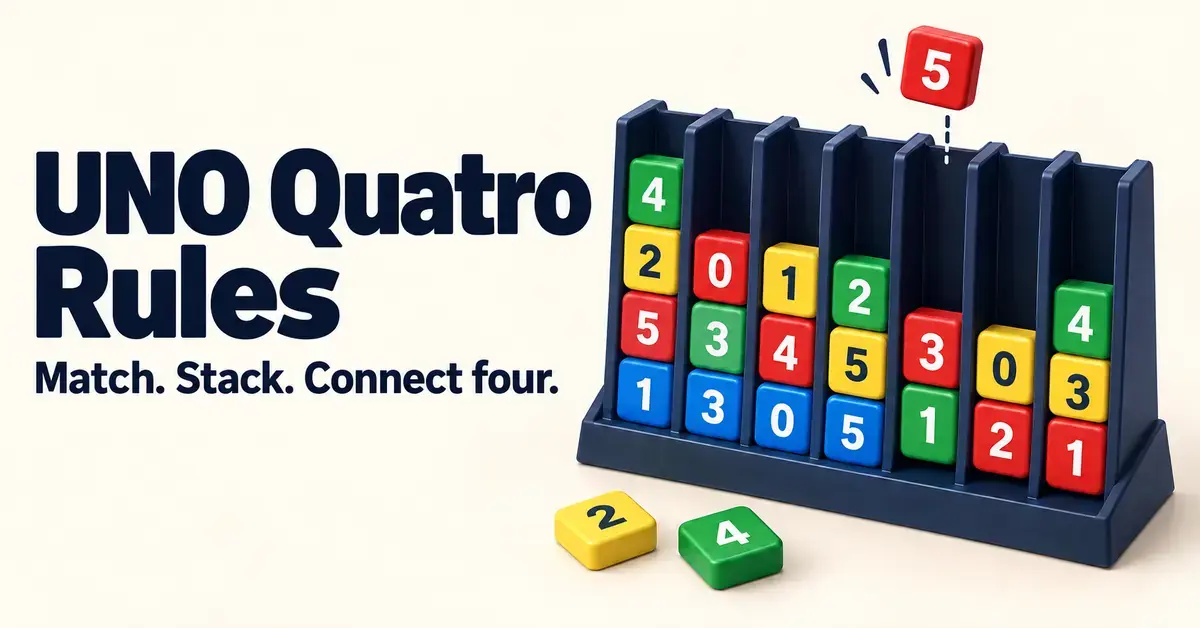
UNO Quatro is a physical tabletop game from Mattel that blends the colour-and-number matching of UNO with the four-in-a-row stacking of Connect Four. Instead of a deck of cards, you drop numbered colour tiles into a seven-column grid and race to line up four tiles that share an attribute. It launched in 2023, plays in about 5 to 10 minutes, and suits 2 to 4 players aged 7 and up. This guide explains the components, setup, turn order, the three action tiles and exactly how you win.
Quick Facts
| Game | UNO Quatro |
|---|---|
| Maker | Mattel Games |
| Designer | Tara Taehyun Kim |
| Released | 2023 |
| Players | 2–4 |
| Age | 7+ |
| Play time | ~5–10 minutes |
| Components | 44 tiles, 7 trays, 1 base, 1 bag |
| Tiles | Numbers 0–5 in 4 colours (11 per colour); colourblind-friendly shape symbols |
| Goal | Line up four tiles that share a colour or number |
| Typical price | Around US$10 |
What is UNO Quatro?
UNO Quatro is a hybrid game that keeps UNO’s familiar colours and numbers but swaps the card-matching for a drop-and-stack board. It was designed by Tara Taehyun Kim and released by Mattel in 2023. You still match by colour or number, but your goal is spatial: build a straight line of four matching tiles rather than empty your hand.
Because it uses tiles and a grid, UNO Quatro feels closer to Connect Four than to a standard UNO round. It sits alongside the many other UNO versions and editions Mattel has produced, but the physical format makes it one of the most distinct members of the family. If you only know the classic UNO card rules, expect a different rhythm: shorter games, more board awareness and no “UNO!” call.
What comes in the box?
UNO Quatro is a compact set built around a plastic grid. The contents are:
- 44 tiles numbered 0 to 5 in the four UNO colours (red, yellow, green and blue), with 11 tiles in each colour.
- 7 trays that form the columns of the grid and can be lifted out and repositioned.
- 1 base that holds the trays upright like a vertical frame.
- 1 drawstring bag for drawing tiles at random and storing the set.
Some tiles carry a small action icon in the corner. The tiles also use shape symbols next to the colours, a colourblind-friendly feature that lets players identify a tile without relying on colour alone.
How do you set up UNO Quatro?
Setup takes under a minute. Slot the seven trays into the base so the empty grid stands up between the players, then put all 44 tiles into the bag and shake it. Each player draws 3 tiles to form their starting hand, keeping them hidden from opponents. Decide who goes first in any way you like, then play passes clockwise.
Keep the bag within reach of everyone, because you will draw from it throughout the game to refill your hand back up to three tiles.
How do you play UNO Quatro?
On your turn you drop one tile from your hand into any column, and the tile slides down to rest on top of whatever is already in that column, exactly like Connect Four. The catch is the matching rule, which is where the UNO part comes in.
The colour-or-number matching rule
When a tile lands, it must sit next to at least one tile that shares either its colour or its number. “Next to” counts in every direction: left, right, above, below and diagonally. So a red 3 is a legal drop if it ends up touching any other red tile, or any other 3, in any of those eight neighbouring positions.
The very first tile of the game has nothing to touch yet, so it can go anywhere. After that, every drop must satisfy the adjacency match. Planning where a tile will fall – and which neighbours it will touch – is the core of the game.
What happens if you cannot play?
If none of your three tiles can be dropped legally, you may make a one-time swap: return one tile from your hand to the bag and draw a new one. If that new tile still cannot be played, your turn ends and play passes on. You cannot keep swapping repeatedly in a single turn.
When your turn is over – whether you played a tile or not – draw from the bag until you are holding three tiles again, unless the bag has run empty.
What do the action tiles do?
Action tiles are regular numbered, coloured tiles that also have an icon in the corner. You still have to play them legally by colour or number, but once one lands you must immediately carry out its action. There are three:
Swap
The Swap action lets you exchange the positions of any two trays on the base. Because the trays carry their stacked tiles with them, this can instantly make or break a four-in-a-row – you can slide your own developing line into a safer spot or pull an opponent’s line apart.
Push
The Push action is played by pressing the tile you just dropped. This ejects the tile at the very bottom of that column back into the bag, and every remaining tile in the column drops down one space. Push is useful for clearing a blocking tile or shifting a whole column down to change which tiles line up.
Minus 2
The Minus 2 action targets the next player. They must return two tiles from their hand to the bag at random, so they take their following turn with fewer options before refilling. It is a direct way to slow down whoever is about to move.
How do you win UNO Quatro?
You win the moment you create a straight line of four tiles that all share one attribute. The line can run horizontally, vertically or diagonally, and the four tiles must match on the same feature – either all four the same colour, or all four the same number. The first player to complete such a line wins immediately, and the game ends there.
Note the difference from classic UNO: there is no scoring to 500 and no round-by-round hand clearing. One completed four-in-a-row ends the game. Players often agree to play a best-of series instead, which keeps sessions lively for a group.
UNO Quatro vs classic UNO and Connect 4
UNO Quatro borrows from both of its parents but is its own game. The matching logic comes from UNO, while the drop-and-stack grid and the four-in-a-row goal come from Connect Four. The table below lines up the key differences so you know what to expect before your first game.
UNO Quatro vs Classic UNO vs Connect 4
| Feature | UNO Quatro | Classic UNO | Connect 4 |
|---|---|---|---|
| Format | Tiles in a 7-column grid | Card deck | Discs in a 7-column grid |
| Players | 2–4 | 2–10 | 2 |
| Match by | Colour or number (adjacent) | Colour, number or symbol | Your own colour only |
| Goal | Four in a row (colour or number) | Empty your hand first | Four of your discs in a row |
| Direction to win | Horizontal, vertical, diagonal | N/A | Horizontal, vertical, diagonal |
| Special actions | Swap, Push, Minus 2 | Skip, Reverse, Draw, Wild | None |
| Scoring | First line wins | Race to 500 points | First line wins |
Common mistakes to avoid
New players tend to trip over the same few things. Watch for these:
- Forgetting diagonals. A tile is legal if it matches a neighbour diagonally, and you can win on a diagonal too. Players who only scan rows and columns miss both threats and chances.
- Ignoring opponents’ lines. Because a single four-in-a-row ends the game, blocking is as important as building. If someone has three matching tiles in a row, deal with it before finishing your own plan.
- Treating action tiles as free. Swap, Push and Minus 2 still have to be dropped legally by colour or number, and their effects resolve whether you like it or not – so think before you place one.
- Wasting the swap. You only get one hand-for-bag swap when you are stuck, and only that turn. Use it when you genuinely have no legal move, not out of habit.
- Dropping a tile that hands over the win. A column fills from the bottom up, so your tile may put an opponent’s matching tile exactly where they need it next. Trace where your tile lands before you commit.
Who is UNO Quatro for?
UNO Quatro works best as a quick, head-to-head or small-group filler for 2 to 4 players. The age 7+ rating and the simple drop-a-tile action make it approachable for families, and it is a natural pick if UNO is already good for the kids in your house. The strategy ceiling – diagonals, blocking and tray swaps – gives older players and adults enough to think about, while games stay short enough to replay.
If you enjoy it, it pairs well with other tactile Mattel titles and the broader world of card games like UNO. Collectors chasing every variant will also find it in roundups of special and themed UNO editions, even though Quatro is a board game rather than a deck.
Sources
Frequently Asked Questions (FAQ)
Is UNO Quatro the same as UNO cards?
No. UNO Quatro is a separate board game that uses numbered colour tiles and a seven-column grid instead of a card deck. It keeps UNO’s colours and numbers but the goal is to make four in a row, not to empty your hand.
How many players can play UNO Quatro?
UNO Quatro is built for 2 to 4 players and is rated for ages 7 and up. It plays quickly, usually finishing in about 5 to 10 minutes.
Do you have to say “UNO” in UNO Quatro?
No. There is no “UNO!” call in UNO Quatro. You do not announce anything when you are close to winning; you simply win the instant you complete a line of four matching tiles.
What happens when you cannot make a move?
You may swap one tile from your hand for a new tile from the bag, once. If you still have no legal move after that swap, your turn ends and play passes to the next person.
What counts as a win in UNO Quatro?
A win is any straight line of four tiles – horizontal, vertical or diagonal – where all four share the same colour or the same number. The first player to form that line wins the game outright.
