
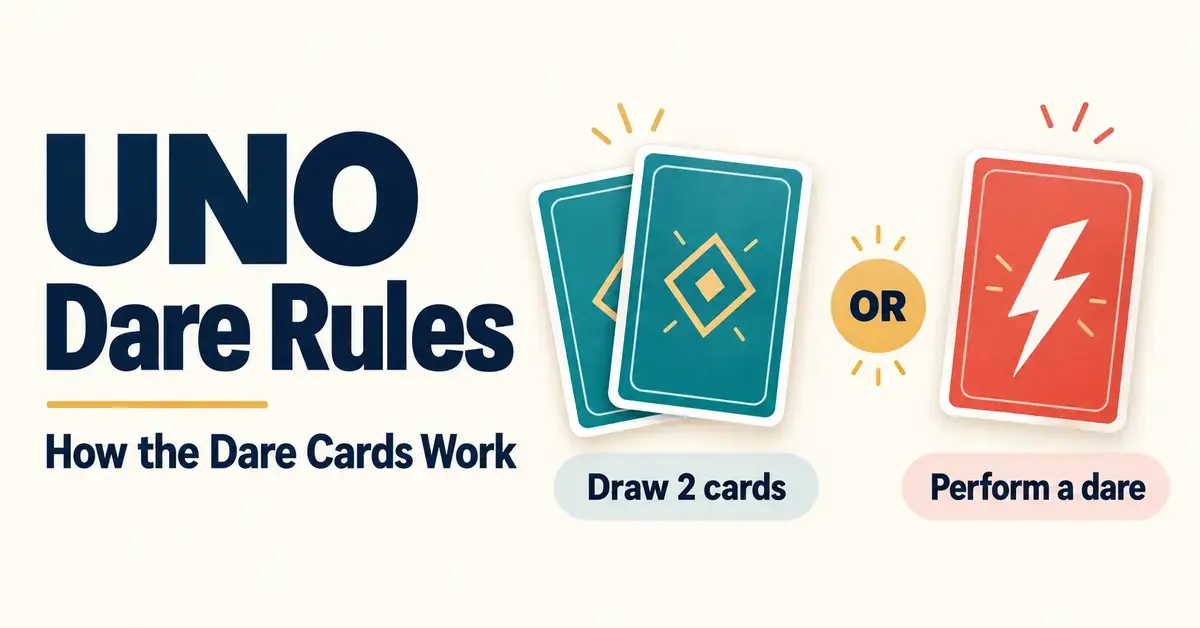
UNO Dare is a party twist on the classic card game in which some of the usual penalty cards are swapped for Dare cards: instead of simply drawing cards, the next player gets a choice — draw 2 cards or perform a dare. It plays almost exactly like standard UNO, so if you already know the basics you only need to learn how the two special Dare cards work and how the Dare List decides what you have to do. This guide covers the official Mattel rules: the deck, setup, how a turn works, the Dare and Wild Dare cards, the penalty for failing a dare, scoring, common mistakes, and how UNO Dare differs from the classic game.
Quick Facts
| Game | UNO Dare (Mattel, toy no. CDY11, 2013) |
|---|---|
| Players | 2–10 |
| Recommended age | 7+ |
| Deck | 108 playing cards + 4 Dare List reference cards |
| Special cards | 8 Dare cards, 8 Wild Dare cards (no Draw Two, Wild or Wild Draw Four) |
| Dare List categories | Family, Show-Off, Daredevil, House Rules |
| Fail-a-dare penalty | Draw 2 cards |
| Goal | First player to reach 500 points |
What is UNO Dare?
UNO Dare is an official Mattel edition of UNO (toy number CDY11, released in 2013) built around dares. The match-a-card core is identical to the official UNO rules: you race to empty your hand by matching the colour, number or symbol on the discard pile. What changes is the special cards. UNO Dare removes the Draw Two and both types of Wild card and replaces them with Dare cards and Wild Dare cards, each of which forces the next player to either take a two-card penalty or attempt a dare chosen from a reference card called the Dare List.
It is designed for 2 to 10 players, ages 7 and up, and like most editions it is listed on the UNO versions overview alongside Flip, No Mercy, Attack and the other variants.
What is in the box: 108 cards and 4 Dare Lists
A UNO Dare game contains 108 playing cards plus 4 Dare List reference cards. The playing deck breaks down like this:
- 76 number cards — 19 in each colour (blue, green, red and yellow), numbered 0 to 9.
- 8 Reverse cards — two in each colour.
- 8 Skip cards — two in each colour.
- 8 Dare cards — two in each colour.
- 8 Wild Dare cards — colourless, playable on anything.
The most important thing to notice is what is missing. A standard UNO deck also has 108 cards, but it includes eight Draw Two cards, four Wild cards and four Wild Draw Four cards. UNO Dare has none of those. The Dare card takes the place of the Draw Two, and the eight Wild Dare cards take the place of the classic Wild and Wild Draw Four cards. If you want the full breakdown of a normal deck for comparison, see our guide to how many cards are in an UNO deck.
The 4 Dare List cards are not part of the shuffled deck. They are kept to the side as a lookup chart that tells you what each dare is.
Setting up: pick a Dare List and deal seven cards
Setup follows the standard UNO routine with one extra step at the start:
- Choose a Dare List card. Before the game, the group picks one of the four Dare List cards to use for the whole game. Each one sets the tone of the dares (the categories are explained below).
- Pick a dealer. Each player draws one card; the highest number deals. Count any card with a symbol (Reverse, Skip, Dare, Wild Dare) as zero.
- Deal 7 cards to each player. Place the rest of the deck face down as the draw pile.
- Flip the top card to start the discard pile. If an action card is flipped, its effect applies to the first turn, just as in classic play.
The player to the left of the dealer goes first, and play normally moves clockwise until a Reverse changes direction.
UNO Dare rules for each turn: match or draw
On your turn you must play one card that matches the top of the discard pile by colour, number or symbol. For example, on a red 7 you can play any red card or any colour 7. If you cannot (or choose not to) play, you draw one card from the draw pile; if that card is playable you may lay it down immediately, otherwise your turn ends.
The ordinary action cards behave exactly as they do in the base game, so we will keep this short — our full guide to the UNO action cards covers them in detail:
- Reverse flips the direction of play. It can only be played on a matching colour or another Reverse.
- Skip makes the next player lose their turn. It can only be played on a matching colour or another Skip.
Everything above is familiar UNO. The dares are where this edition earns its name.
How do the Dare cards work?
The Dare card is the signature card of UNO Dare: when you play it, the next player must either draw 2 cards or perform a dare. They choose which. This is the core mechanic, and it replaces the Draw Two from classic UNO — the two-card penalty is still there, but now there is an escape route through the dare.
What happens when you play a Dare card
A Dare card has both a colour and a number, so it can only be played on a matching colour or on another Dare card. When you lay it down, look at the number printed on the card and compare it with the matching number on the chosen Dare List card — that entry is the dare the next player faces. The next player then decides:
- Take the penalty: draw 2 cards from the draw pile and forfeit the dare.
- Do the dare: attempt the dare on the list instead of drawing.
If a Dare card happens to be the card flipped to start the game, the player to the left of the dealer makes this choice before their first turn.
How does the Wild Dare card work?
The Wild Dare card combines a dare with the power of a Wild. Because it is colourless, you can play it on any card at any time — even if you are holding another playable card. When you play it, you do two things: you choose the colour that play continues in (any colour, including the one already in play), and the next player must again choose between drawing 2 cards and performing the dare tied to the number on the card.
Note that there is no “Draw Four” here. The Wild Dare lets you steer the colour and hand out a dare, but it never forces the next player to draw four cards the way a Wild Draw Four does in the standard game.
What happens if you fail a dare?
If a player chooses the dare and fails it, the penalty is to draw 2 cards — the same cost as simply taking the penalty in the first place. A dare runs until the player’s next turn comes around. For example, if the dare is “remain perfectly frozen until your next turn” and the player moves too soon, they have failed and draw 2.
Two points matter here. First, many dares are subjective, so the group must agree on whether it was completed; how strict you are is up to the table. Second, the official rules actively encourage the other players to make the dare harder — you may tease, distract, ask questions or speed up and slow down play to trip up the person doing the dare. If a dare is “talk like a pirate until your next turn,” the others can start a conversation to catch them dropping the accent.
What are the four Dare List categories?
Each of the four Dare List cards sets the flavour of the dares. You pick one for the whole game:
- Family: gentle, all-ages dares suitable for younger players and family game night.
- Show-Off: sillier performance dares meant to make everyone laugh.
- Daredevil: the boldest, most challenging dares in the box.
- House Rules: a blank card where your group writes its own dares before the game.
The three themed cards are marketed with sixteen dares each. The House Rules card is a popular hook for groups who like to customise play — if that is your style, you will find plenty more ideas in our roundup of fun UNO variations and house rules.
How do you call “UNO” and go out?
Calling UNO works exactly as it does in the classic game. When you play your next-to-last card, leaving you with one card, you must call out “UNO.” If another player catches you before the next player begins their turn, you draw 2 cards as a penalty. Our dedicated guide to the UNO call rule explains the timing and who can catch you.
You go out — and win the round — when you play your last card. There is one dare-specific wrinkle: if the last card played in a round is a Dare or Wild Dare card, the next player still has to either draw 2 or perform the dare, and those cards are still counted when the leftover hands are scored. If the draw pile runs out before anyone goes out, reshuffle the discard pile and keep playing.
Scoring: card values and the 500-point target
Scoring is standard UNO scoring. When a player empties their hand, they score the total value of the cards still held by everyone else. The point values are:
- Number cards (0–9): face value.
- Reverse: 20 points.
- Skip: 20 points.
- Dare: 20 points.
- Wild Dare: 50 points.
The first player to reach 500 points across rounds wins the game. As an alternative, you can keep a running total of the points each player is left holding; when someone hits 500, the player with the lowest total wins instead. For a worked example and the full method, see our guide to UNO scoring rules.
UNO Dare rules vs classic UNO: what changes
UNO Dare keeps the same object, the same number cards, the same Reverse and Skip cards, the same 7-card deal and the same 500-point finish. The differences are concentrated in the penalty cards, which is why the game feels familiar but plays more playfully. The table below lines up the two decks side by side.
UNO Dare vs Classic UNO
| Feature | Classic UNO | UNO Dare |
|---|---|---|
| Deck size | 108 cards | 108 cards + 4 Dare List cards |
| Number cards (0–9) | 76 (19 per colour) | 76 (19 per colour) |
| Reverse / Skip | 8 each | 8 each |
| Draw Two | 8 | None |
| Wild / Wild Draw Four | 4 Wild + 4 Wild Draw Four | None — replaced by 8 Wild Dare |
| Dare cards | None | 8 Dare + 8 Wild Dare |
| Main twist | Draw cards as a penalty | Next player chooses: draw 2 or do a dare |
| Players / age | 2–10 / 7+ | 2–10 / 7+ |
| Goal | 500 points | 500 points |
In short, UNO Dare trades the harshest “take four” moment of classic UNO for a lighter dare-or-draw-2 decision, which keeps the game social rather than punishing.
Common mistakes to avoid
A few errors come up again and again at the table:
- Assuming there is a Draw Four. There isn’t. The Wild Dare lets you pick a colour and set a dare, but it never forces four cards on anyone.
- Forgetting the dare is optional. The player who is targeted always has the choice to just draw 2. Nobody can be made to do a dare — they can always decline and take the cards.
- Not agreeing the rules first. Because many dares are subjective, decide before the game how strict you will be and who makes the final call, or arguments stall the game.
- Playing a Dare card on the wrong card. A coloured Dare card can only go on a matching colour or on another Dare card — it is not a wild. Only the Wild Dare can be played on anything.
- Dropping the “UNO” call. The next-to-last-card call still applies and still costs 2 cards if you are caught.
Who it suits: party groups, ages 7 and up
UNO Dare suits groups who enjoy party games and are happy to perform or be teased — it is at its best with four or more players, where the dares create the most chaos. The Family Dare List keeps it appropriate for children aged 7 and up, while the Daredevil list and the blank House Rules card let older groups ramp up the challenge. If your table prefers pure card strategy with no performing, a standard deck or one of the special and themed UNO editions may be a better fit.
There is also a separate, newer adults-only party version sold under the UNO Dare name with grown-up dares; it is aimed at adult gatherings rather than family play, so check the box if you are buying for mixed ages.
Sources
Frequently Asked Questions (FAQ)
Are there Draw Two or Wild Draw Four cards?
No. UNO Dare has no Draw Two, no plain Wild and no Wild Draw Four. The Dare card replaces the Draw Two, and eight Wild Dare cards replace the classic wild cards. The strongest penalty is still only two cards.
Can you refuse to do a dare?
Yes. When a Dare or Wild Dare card is played against you, you always have the choice to simply draw 2 cards instead of attempting the dare. The dare is never mandatory.
How many players does the game take?
UNO Dare is designed for 2 to 10 players, ages 7 and up. It plays best as a party game with larger groups, since more players make the dares livelier.
What are the four dare categories?
The four Dare List cards are Family, Show-Off, Daredevil and House Rules. You choose one list for the whole game; the Family list is the mildest and Daredevil the boldest, while House Rules is blank for your own dares.
How do you win UNO Dare?
You win a round by being the first to play all your cards, then you score the value of the cards left in your opponents’ hands. The first player to reach 500 points wins the game.
