

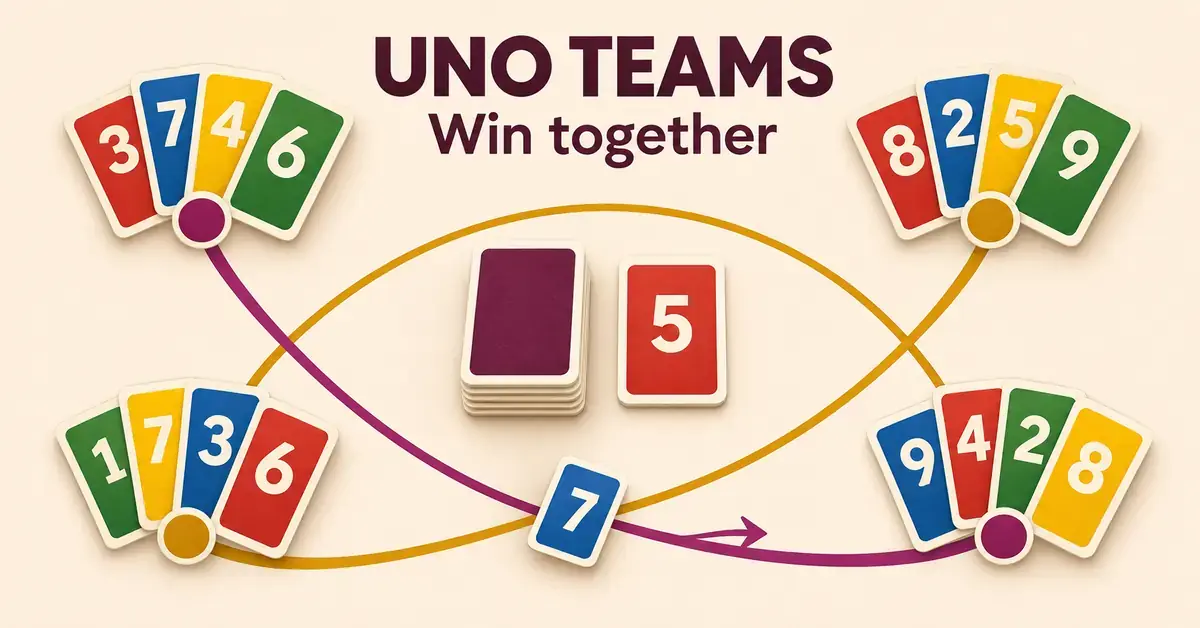
UNO Teams is a 2-vs-2 version of UNO where you play in fixed pairs and win only when both partners have emptied their hands. It plays like classic UNO — you match the top card by colour, number or symbol — but adds partner card-passing, two team-only Wild cards and a “going out” rule that keeps a finished player involved. This guide walks through the official Mattel rules (edition HXT58, released 2024): setup, every special card, calling “UNO!”, scoring, and how to fake the game with a regular UNO deck.
Key Facts
| Game | UNO Teams (Mattel) |
|---|---|
| Item number | HXT58 |
| Released | 2024 |
| Players | 4, 6 or 8 (2–4 teams of two) |
| Recommended age | 7+ |
| Cards | 112 |
| Cards dealt | 7 per player |
| Objective | Be the first team with both partners’ hands empty |
| Winning score (optional) | First team to 500 points |
What is UNO Teams?
UNO Teams is an official Mattel edition built around partner play instead of every-player-for-themselves. The deck has 112 cards, including familiar numbers and action cards plus two new team cards — Wild Team Play and Wild Team Draw Four — and a “passing symbol” printed on some low number cards. The core of UNO is unchanged, so if you already know how to play classic UNO you only need to learn the team-specific twists below.
The aim of each hand is simple: be the first team to get rid of all the cards in both players’ hands. One partner finishing is not enough, which changes how you think about every turn.
How many players do you need for UNO Teams?
UNO Teams is for 4, 6 or 8 players — always an even number, because everyone plays as part of a two-person team. The instruction sheet supports 2 to 4 teams, so you can have two, three or four pairs at the table. You cannot play the official team game with an odd number of people, and classic one-on-one play is a different format with its own small-table tactics.
Partners always sit directly across from each other, so the two teams alternate around the table. That seating matters: Wild Team Play passes the turn straight to the player opposite you, and the alternating order is what makes the team cards work.
How to set up UNO Teams
Setup takes under a minute and follows these steps:
- Pick partners and sit across from each other. Each pair stays a team for the whole game.
- Choose a dealer and shuffle. The dealer handles the cards for the first hand.
- Deal 7 cards to every player.
- Make the draw pile. Place the rest of the deck face-down in the centre of the table.
- Start the discard pile. Flip the top card of the draw pile face-up next to it. If it is an action card, ignore its effect and flip the next card instead.
- Do the opening swap. Every player secretly passes one card from their hand to their partner. Try to pass a card you think your partner can use — but you may not say or hint which card to expect.
- Begin play. The player to the dealer’s left goes first, and play moves clockwise.
How do you play a turn in UNO Teams?
On your turn you play one card onto the discard pile that matches the top card by at least one attribute — its colour, its number, or its symbol. If the card you play is an action card, it does something special (see below), and then play passes to the next player.
If you have no matching card, draw one card from the draw pile. If that drawn card can be played, you may play it immediately; otherwise you keep it and your turn ends. You are also allowed to draw a card even when you are holding a playable one. If the draw pile runs out, reshuffle the discard pile to form a new draw pile.
What does the passing symbol do in UNO Teams?
The passing symbol triggers a one-card swap between you and your partner. It is printed on some of the low number cards — one of each number from 1 to 5 in every colour. When you (or your partner) play a card carrying the passing symbol, you and your partner each choose one card from your own hand and pass it to each other at the same time.
The same gag order applies as in the opening swap: you may not say, indicate or hint anything that would influence which card your teammate hands over. The passing symbol is the main way teammates feed each other useful cards during the game, so it rewards paying attention to what your partner has been forced to draw.
UNO Teams special cards explained
UNO Teams keeps the classic action cards and adds two Wild cards made for partner play. Here is what each card does:
Special Cards
| Card | Effect | Wild? |
|---|---|---|
| Skip | The next player loses their turn. | No |
| Reverse | Reverses the direction of play. | No |
| Draw Two | The next player draws 2 cards and loses their turn. | No |
| Wild | Matches any card; you choose the colour that continues play. | Yes |
| Wild Team Play | Choose a colour, then skip the turn directly to your partner. If they cannot play, you draw 2 cards. | Yes |
| Wild Team Draw Four | The next player draws 2 and is skipped; their partner also draws 2 (even if out). You choose the colour. | Yes |
The ordinary Skip, Reverse and Draw Two cards behave exactly as they do in standard UNO, affecting the next player in turn order. The two team Wilds are where UNO Teams gets interesting, so they are worth spelling out.
Wild Team Play
Wild Team Play lets you hand your partner a free turn. First you choose a colour (without consulting your partner). Play then skips directly to your partner. If they can play a card on their turn, they do, and play continues from there. If they cannot play a card, you must draw 2 cards as a penalty, and play still continues from your partner with the colour you chose. Because a Wild counts as playable on any colour, a partner holding a Wild can always follow.
Wild Team Draw Four
Wild Team Draw Four punishes the whole opposing team. When you play it, the next player must draw 2 cards and skip their turn, and that player’s partner must also draw 2 cards — even if that partner is currently out of the game. It is also a Wild, so you choose the colour that continues play. Note the difference from the classic Wild Draw Four card: the UNO Teams instruction sheet lists no “only if you have no matching colour” restriction and no challenge rule for this card; the four cards are simply split as 2 + 2 across the two opponents.
Can you stack Draw 2 and Draw 4 cards in UNO Teams?
No — stacking is not an official UNO Teams rule. You cannot answer a Draw Two with your own Draw Two to pass the penalty along, and you cannot pile a Wild Team Draw Four on top of another draw card to dodge drawing. The player hit by a draw card simply draws and loses their turn. Stacking is a popular house rule many groups add, and some editions build it in, but if you want the specifics of stacking Draw 2 and Draw 4 cards you should agree on it before the game rather than assume it.
How do you call “UNO!” in UNO Teams?
The moment you are down to one card you must yell “UNO!” to warn the other players. In the team game your partner may also call “UNO!” on your behalf, which is a real advantage — two people are watching your hand instead of one. If an opponent catches you and neither you nor your partner called “UNO!” before the next player begins their turn, you must draw 2 cards as a penalty.
What happens when a player runs out of cards?
In UNO Teams the hand does not end when one player empties their hand — it ends only when both partners are out. When you play your last card, your partner passes you half the cards from their hand and you keep playing. If your partner holds an odd number of cards, they keep the larger half: with 9 cards they pass you 4 and keep 5.
There is one exception. If your partner has only 1 card left when you go out, they pass nothing and you stay out of the game for now. Being out is not the same as winning — your team still needs both hands empty at the same time.
How does “tagging back in” work?
Even after you are out, you can be pulled back into the game. While you are out, if your partner has to draw cards for any reason, they immediately pass you half the cards in their hand and you are back in the game. This is why a Wild Team Draw Four aimed at a team with an “out” player can backfire: forcing the active partner to draw grows their hand, and they then have to split that hand with the partner who had already escaped — pulling that player right back into the game.
How do you win UNO Teams?
A team wins the hand when both partners have played their final card and neither has any cards left. At that point you shuffle and, if you are keeping score, tally points before dealing the next hand. Because both hands must be empty, the strongest teams coordinate their finish — it is often better to slow your own exit than to go out early and leave your partner stranded with a full hand.
How is UNO Teams scored?
Scoring is an optional way to play multiple hands to a target. When a team wins a hand, it scores points for every card left in the opponents’ hands:
- Number cards (0–9): face value.
- Skip, Reverse, Draw Two: 20 points each.
- Wild, Wild Team Play, Wild Team Draw Four: 50 points each.
Keep a running total across hands; the first team to reach 500 points wins the game. The point values match standard UNO, so the same habits from the usual UNO scoring rules apply — try to offload high-value Wilds and action cards before an opposing team closes out a hand.
Can you talk to your partner during the game?
Yes, teammates can talk to each other throughout the game — that is part of the fun — but with two firm limits. You may not tell or hint at what cards are in your hand, and when any Wild card is played you may not say anything that influences which colour your partner chooses. General table talk and strategy are fine; coded signals about specific cards or colours are not.
How to play UNO Teams with a regular UNO deck
You can run a partner-style 2-vs-2 game with an ordinary UNO deck, but it is a house-rule adaptation rather than true UNO Teams, because a standard deck has no passing symbols and no team Wild cards. To approximate it: seat partners across from each other, deal 7 cards each, and agree that a hand is won only when both members of a team are out. Add the opening one-card swap, and let a partner call “UNO!” for you.
For the card passing, pick a trigger you all accept — many groups swap one card whenever anyone plays a number from 1 to 5, mirroring the real passing symbol. You will miss Wild Team Play and Wild Team Draw Four entirely, so the game is simpler and less interactive than the retail edition. If you want a built-for-groups experience without house-ruling, the dedicated UNO Party rules edition is designed around passing cards and larger tables.
Classic UNO vs UNO Teams
If you already play standard UNO, here is a quick recap of what changes in the team game:
Classic UNO vs UNO Teams
| Classic UNO | UNO Teams |
|---|---|
| Everyone plays for themselves. | You play in fixed pairs sitting opposite each other. |
| The first player to empty their hand wins. | A hand ends only when both partners are out. |
| No card passing. | Partners swap cards at setup and on every passing symbol. |
| Standard Wild and Wild Draw Four only. | Adds Wild Team Play and Wild Team Draw Four. |
| Once you are out, you are done. | A finished player can be tagged back in. |
For how this edition sits next to Flip, No Mercy, Party, Junior and the rest, see the overview of UNO versions.
Sources
Frequently Asked Questions (FAQ)
What do the different coloured cards in UNO Teams mean?
The colours are just the four standard UNO colours — red, yellow, green and blue — used for matching; colour alone gives a card no special power. What matters is the card type: numbers, the action cards (Skip, Reverse, Draw Two) and the Wild cards. Only the two team Wilds and the passing symbol are unique to UNO Teams.
How do you play UNO Teams with 6 or 8 players?
Form three teams of two for 6 players, or four teams of two for 8 players, and seat partners across from each other so the teams alternate around the table. Everything else is unchanged: deal 7 cards each, pass one card to your partner at the start, and a team wins only when both of its partners have emptied their hands.
Can you finish UNO Teams on an action or Wild card?
Yes. The official rules do not forbid winning on an action or Wild card, so you may play your last card even if it is a Skip, Reverse, Draw Two or a team Wild. Remember that your team still only wins once both partners have emptied their hands.
What happens if you go out on a passing-symbol card?
The official instruction sheet does not spell this out. The sensible reading is that you cannot pass a card you no longer hold, so the passing-symbol swap is skipped and the Going Out rule takes over instead: your partner passes you half the cards in their hand and you keep playing. Agree on it with your group before the game if you want to be certain.
