
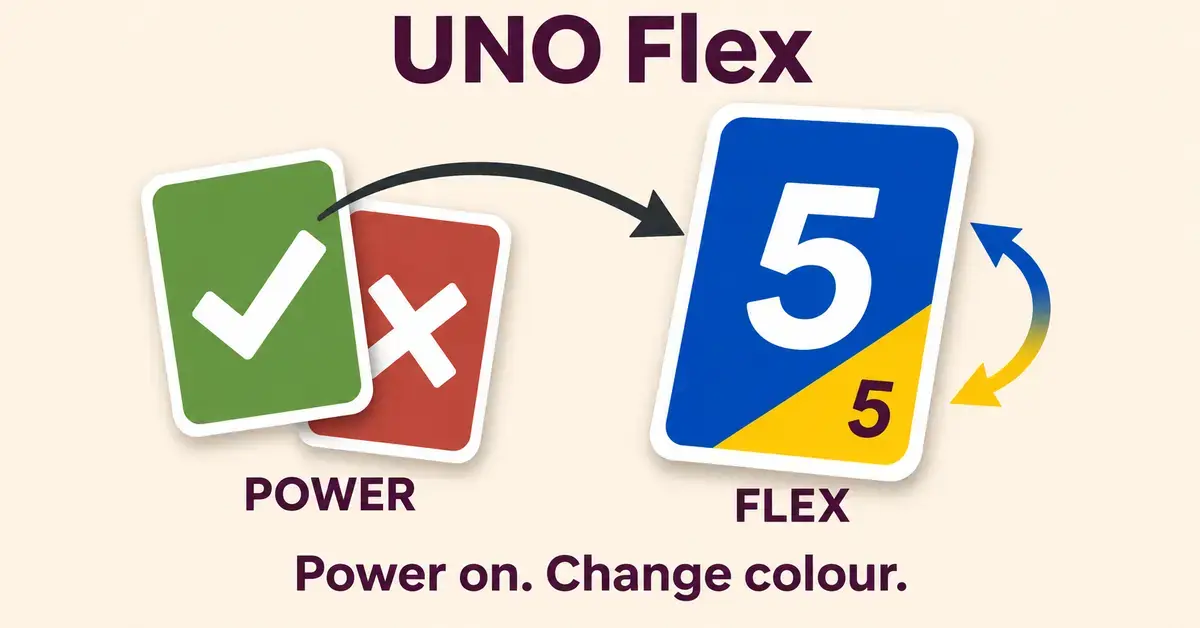
UNO Flex is Mattel’s 2023 twist on the classic card game, and it turns on two new ideas: Flex cards that have two sides so you can change a card’s colour to make a match, and a personal Power card that decides whether you are even allowed to use that flex side on your turn. You still play by matching colour, number or symbol, you still shout “UNO!” on your last card, and you still win by emptying your hand first. This guide walks through the full official rules – setup, how Flex and Power cards work, every flex action card, and how to keep score.
UNO Flex at a Glance
| Publisher | Mattel (official rules, PDF) |
|---|---|
| Released | 2023 |
| Item number | HMY99 |
| Players | 2–8 |
| Recommended age | 7+ |
| Number of cards | 112 (including 8 Power cards) |
| Number range | 1–8 |
| Object | Be the first to get rid of all the cards in your hand |
| Scoring (optional) | First player to reach 500 points wins |
What is UNO Flex?
UNO Flex is a standalone UNO edition that Mattel launched in 2023 for 2 to 8 players, ages 7 and up. It plays almost exactly like classic UNO – match the top discard by colour, number or symbol, or draw a card if you cannot – but it adds two mechanics that change how you plan a turn.
The deck holds 112 cards, eight of which are Power cards that never go into the draw pile. The remaining cards come in three families: ordinary Classic cards, double-sided Flex cards, and the flex versions of the action and Wild cards. One quirk worth noting up front: the number cards in UNO Flex run from 1 to 8, not 0 to 9 as in some decks, which is why the Power card itself shows a “9” on its green side and an “8” on its red side.
What are the three types of cards?
UNO Flex sorts its cards into three groups, and knowing which is which makes the rest of the rules fall into place.
- Classic cards – the familiar single-sided cards: number cards (1–8) plus Skip, Reverse and Draw Two action cards. Some number cards carry a small “flip” icon that affects your Power card (more on that below).
- Flex cards – double-sided cards with a “regular” side and a “flex” side. The flex side lets you change the colour you play so you can make a match you otherwise could not.
- Power cards – the eight cards you separate before dealing. Each player keeps one in front of them, and it acts as an on/off switch for using flex sides.
How do you set up UNO Flex?
Setup takes under a minute and only differs from classic UNO because of the Power cards. Follow these steps:
- Separate the 8 Power cards from the rest of the deck.
- Give one Power card to each player. In a game with fewer than eight players, the extra Power cards are simply set aside.
- Have everyone start with their Power card on the green side (the “9”, or “on”, side).
- Choose a dealer and shuffle the remaining cards.
- Deal 7 cards to each player.
- Place the rest face down in the middle as the draw pile.
- Flip the top card face up to start the discard pile. If it is an action card, bury it and turn over the next one instead.
- The player to the dealer’s left goes first, and play moves clockwise.
How does a turn work?
On your turn you play one card onto the discard pile, then play passes to the next player. A card is legal if it matches at least one attribute of the top discard – its colour, its number or its symbol.
If you have no matching card, you draw a single card from the draw pile. If that drawn card can be played, you may play it immediately; otherwise your turn ends. You are also allowed to draw a card by choice even when you hold a playable one. If the draw pile runs out, reshuffle the discard pile to make a fresh draw pile. This basic flow is identical to how a normal game runs, so if you already know the standard rules the only new decisions are around the Flex and Power cards.
How do Flex cards work?
A Flex card has a primary “regular” side and a secondary “flex” side, and it plays as the regular side by default. You only use the flex side when you choose to – and when your Power card allows it.
The flex side lets you play a card as a different colour so you can make a match. Say the top discard is green and you hold no green cards, but you have a Flex card whose regular side is yellow and whose flex side is green. You can play it on its flex side to match the green discard. Here is the catch that trips up new players: the colour that continues play is the regular side, not the flex side. In the example, the next player must match the yellow regular side (the centre oval colour), even though you played it against a green card. The flex side only gets you onto the pile; it does not set the colour going forward.
Crucially, you can only use a flex side at all when your Power card is on its green “on” side. That is the whole point of the Power card, and it is what stops every player from flexing on every turn.
How does the Power card work?
The Power card is a personal on/off switch that decides whether you may use the flex side of a card on your turn. It has a green “9” side and a red “8” side.
- Green side (on): you may choose to play the flex side of any Flex or flex action card.
- Red side (off): you may not use flex sides; you can still play the regular side of those cards as normal.
The twist is that using a flex side costs you the switch. After you play a card on its flex side, you must immediately flip your Power card from green to red. So each player only gets to flex once before their switch turns off, which keeps the flex sides scarce and strategic rather than something you spam.
When do Power cards flip back on?
Once your Power card is on the red “off” side, it stays there until one of three things happens:
- Everyone is off at once. The moment every player’s Power card is on the red side at the same time, all players turn their cards back to the green side together.
- You play a number card with the “flip” icon. Playing one of these Classic number cards forces you to flip your own Power card – green to red, or red back to green.
- Someone plays a Wild All Flip card. This card makes every player flip their Power card, turning on anyone who was off (and off anyone who was on).
Because the flip icon and the Wild All Flip card can switch your card either direction, timing them well is the heart of UNO Flex strategy: you want your Power card green exactly when you are holding a flex card you need to play.
What do the flex action cards do?
UNO Flex keeps the familiar action cards and adds flex versions that do something stronger when you use the flex side. Each flex action card acts like its classic cousin on the regular side and gains a new effect on the flex side, as summarised below.
Flex Action Cards: Regular Side vs Flex Side
| Card | Regular side | Flex side |
|---|---|---|
| Flex Draw Two | Acts as a classic Draw Two: next player draws 2 and loses their turn | Every other player draws 1 card; no one loses a turn |
| Flex Skip | Acts as a classic Skip: next player loses their turn | Skip All – skips every other player so the turn returns to you |
| Flex Reverse | Acts as a classic Reverse: direction of play switches | Reverse then Skip – reverses direction and skips the first player that way |
| Flex Wild Target Draw 2 | Acts as a classic Wild: call the next colour | Targeted Draw 2 – choose any player to draw 2; also call the colour |
| Flex Wild All Draw | Acts as a classic Wild: call the next colour | Every other player draws 2 cards; no one loses a turn; call the colour |
| Flex Wild Draw Four | Matches anything (only if you hold no colour match); next player draws 4 or challenges; call the colour | Targeted Draw 4 – choose any player to draw 4; call the colour |
A few points are easy to miss:
- Flex Draw Two and Flex Wild All Draw hand out cards to every other player on their flex side, but nobody loses a turn – play simply continues with the next player.
- Flex Skip on its flex side is a “Skip All”: it passes over all the other players so the turn comes straight back to you – a powerful move in a two-player game, where the regular Skip already does the same thing.
- Flex Reverse on its flex side reverses the direction and skips the first player in the new direction.
- The two Flex Wild draw cards let you target a specific player on the flex side instead of hitting the next player in line, and they are still Wild cards, so you call the colour that continues play.
How do the classic and Wild cards work in UNO Flex?
The single-sided action and Wild cards behave exactly as they do in standard UNO, which keeps the game approachable for anyone who already knows how Skip, Reverse and Wild cards work in classic UNO.
- Draw Two: the next player draws two cards and loses their turn.
- Skip: the next player loses their turn.
- Reverse: the direction of play switches between clockwise and counter-clockwise.
- Wild All Flip: every player flips their Power card; it is also a Wild, so you call the next colour.
- Flex Wild Draw Four: on its regular side it matches anything, but you may only play it if you hold no card matching the discard’s colour. The next player either draws four and loses their turn, or challenges. If you were caught bluffing, you draw four instead; if the challenge was wrong, the challenger draws six. Either way, you call the next colour.
Action cards can be played on other action cards of the same colour, just as in the base game. Note that the official rules do not include any “stacking” rule for piling Draw Two cards on each other – if you want that, it is a house rule rather than part of UNO Flex, much like the optional UNO stacking rules that fans add to other editions.
How do you win and keep score?
You win a hand the moment you play your final card – the goal never changes. Many groups simply reshuffle and play another round, but UNO Flex also includes an optional points system for a longer match.
When someone goes out, they score the value of the cards left in everyone else’s hands. The UNO scoring rules here mirror the wider UNO family:
- Number cards (1–8): face value.
- Any action card (Skip, Reverse, Draw Two, Flex Skip, Flex Reverse, Flex Draw Two): 20 points.
- Any Wild card (Flex Wild Target Draw 2, Flex Wild All Draw, Flex Wild Draw Four, Wild All Flip): 50 points.
Keep a running tally from hand to hand. The first player to reach 500 points wins the game.
What are the most common UNO Flex mistakes?
The new mechanics create a handful of errors that come up again and again, especially for players arriving from the base game.
- Forgetting the regular side sets the colour. After you flex, the next player matches the card’s regular (centre oval) colour, not the flex colour you played against. Announce the colour out loud to avoid arguments.
- Flexing without an on switch. You cannot use a flex side while your Power card is red. Check your switch before you plan a flex play.
- Forgetting to flip after flexing. Using a flex side immediately turns your Power card to red. It is easy to leave it on green by mistake, which effectively cheats.
- Missing the flip icon. Playing a number card with the flip icon forces you to flip your own Power card – sometimes turning you off right when you wanted to flex next turn.
- Assuming draw cards stack. The official rules have no Draw Two stacking, so you cannot pile a Draw Two on a Draw Two to pass the penalty along unless your group agrees to a house rule.
How does UNO Flex compare to classic UNO and UNO Flip?
UNO Flex sits between standard UNO and the double-sided UNO Flip in both feel and complexity. Compared with the base game, it swaps the 0–9 number range for 1–8, adds 112 cards instead of the usual count, and layers the Power-card switch on top of ordinary play. If you are curious how that count stacks up, see our breakdown of how many cards are in a standard UNO deck.
The double-sided Flex cards invite comparison with UNO Flip rules, but the two work differently. In UNO Flip the whole deck flips between a light and a dark side at once, changing every card in play; in UNO Flex only you decide, card by card, whether to use a flex side, and only when your personal Power card allows it. UNO Flex is one of many spin-offs in the series, and you can explore the rest through our guide to the different UNO versions and the collectible UNO special editions.
Sources
Frequently asked questions (FAQ)
How many cards are in UNO Flex?
UNO Flex has 112 cards, including the 8 Power cards that are set aside at the start and never shuffled into the draw pile. The remaining 104 cards form the play deck of Classic, Flex and flex action cards.
Can you use a flex side whenever you want?
No. You may only play a flex side while your Power card is on the green “on” side, and as soon as you do, you must flip the Power card to the red “off” side. You cannot flex again until something flips your card back to green.
What happens when everyone’s Power card is off?
As soon as every player’s Power card is on the red side at the same moment, all players turn their cards back to the green side together, re-enabling flex plays for everyone at once.
How many players can play UNO Flex?
UNO Flex is for 2 to 8 players, ages 7 and up. There are exactly eight Power cards, so the eight-player maximum is a hard limit of the components.
Does UNO Flex use Draw Two stacking?
The official rules do not include stacking, so you cannot play a Draw Two (or Flex Draw Two) onto another to pass the penalty along. Stacking is a popular house rule, but it is not part of the printed UNO Flex rules.
