
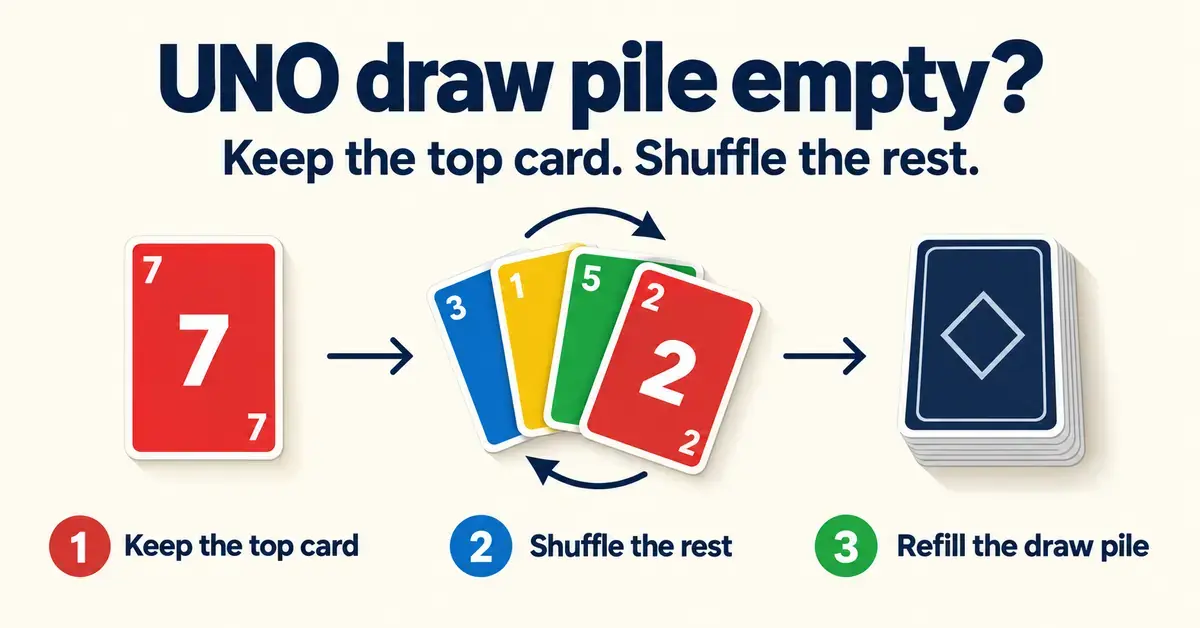
When the UNO draw pile runs out of cards mid-game, you do not stop playing: you take the discard pile, leave its current top card in place, shuffle the rest, and flip them face down to form a brand-new draw pile. This is an official Mattel rule, not a house rule, and it keeps a round going until someone finally empties their hand. Below you will find exactly how the reshuffle works, the small details most players get wrong, what to do in the rare case where even the discard pile is gone, and how the newer UNO editions handle the same situation.
Quick Answer
Short answer: When the draw pile runs out, take the discard pile, set aside its top (active) card, shuffle the rest, and flip them face down as a new draw pile. Play then continues normally.
- Keep the current top card in place — it is still the card to match.
- Shuffle only the cards beneath it.
- Nothing is scored and no cards change hands; it is just a refill.
- This is an official Mattel rule, not a house rule.
- You can reshuffle as many times as a hand needs.
The short answer: shuffle the discard pile into a new draw pile
The draw pile is simply refilled from the discard pile — nothing is scored and no cards leave anyone’s hand. The moment the face-down draw pile is empty and a player needs to draw, you pause, take the pile of cards that have already been played, and recycle them. The single card currently showing on top of the discard pile stays where it is, because it is still the card everyone has to match. Every card underneath it gets shuffled together and placed face down as the fresh draw pile, and the player who needed a card draws from it. Play then continues in the same direction as if nothing happened.
Because UNO is designed to be played until a hand is won, this recycling can happen more than once in a long round. There is no limit on how many times you may reshuffle; you simply keep refilling the draw pile from the discards whenever it empties.
Why the draw pile runs out in the first place
The draw pile empties because players keep taking cards from it without those cards coming back quickly enough. A standard deck has 108 cards (newer decks have 112). After dealing seven cards to each player, the rest become the draw pile. Every time someone cannot match the top card — or chooses not to play — they pull from that pile, and Draw Two and Wild Draw Four cards force opponents to take two or four more at a time. For a full breakdown of the deck, see our guide to how many cards are in an UNO deck.
With a big group, players holding large hands, or lots of draw-penalty cards flying around, the face-down pile can drain surprisingly fast — sometimes before anyone is close to winning. That is exactly the scenario the reshuffle rule is built for.
How to reshuffle the draw pile, step by step
Reshuffling takes only a few seconds and the key is to protect the active top card. Follow these steps the moment the draw pile is empty and someone has to draw:
- Stop and confirm the draw pile is truly empty. You only reshuffle when there are no face-down cards left to take.
- Lift off the top card of the discard pile — the one currently showing — and set it aside. This card still dictates the colour, number or symbol that must be matched.
- Gather every other card in the discard pile and shuffle them thoroughly.
- Place the shuffled cards face down in the middle to become the new draw pile.
- Return the card you set aside face up next to the new pile, and let the player who needed a card draw. Play carries on normally.
Do you shuffle the top card back in?
No — the current top card stays out of the shuffle. If you mixed it in, there would be no active card to match and the game would stall. Keeping it face up means the next player always has a clear target to play on.
Do Wild cards keep their colour when reshuffled?
A Wild card loses its “chosen colour” once it goes back into the draw pile. The colour a player named only matters while that Wild is the active top card. As soon as it is covered by another card — or shuffled back into the deck — it becomes an ordinary Wild again, ready to be played and recoloured by whoever draws and plays it next. The only colour that matters after a reshuffle is the one shown on the top card you kept out.
What the official Mattel rules say
The official rule is short and clear. Mattel’s UNO instruction sheet states: “If no player is out of cards by the time the DRAW pile is depleted, the deck is reshuffled and play continues.” In practice “the deck” means the discard pile, because those are the only cards available to recycle — the newer rule wording spells out that you shuffle the discard pile (apart from the active top card) to create the new draw pile. Either way, the outcome is identical: the played cards become the next draw pile. For the full turn sequence this fits into, see the official rules of how to play UNO.
One related official detail trips people up: if you draw a card because you had nothing to play, you may play that drawn card immediately if it matches, but you may not then play a second card from your hand. Reshuffling does not change this — you still draw just one card unless an action card forces more.
What if the discard pile runs out too?
In the rare case where both the draw pile and the discard pile are empty, the official rules do not spell out a fix, so you handle it as a stalemate. This happens only when nearly every card is locked in players’ hands — for example in a large group where everyone has been forced to draw heavily. There is nothing left to reshuffle, so the standard, fair solutions are:
- Any player who cannot draw simply forfeits the draw and play passes on. If you cannot take a required card because none exist, you skip that part of the turn.
- End the hand and score it. Some groups agree in advance that if the table deadlocks, the round ends immediately and points are tallied from the cards still in hand (the player with the fewest points, or fewest cards, is treated as the winner of that hand).
Because this is not covered by Mattel, agree on your approach before the game so there is no argument. It is extremely unlikely in a normal two-to-four-player game and is mostly a concern for very large tables.
Does reshuffling affect scoring?
Reshuffling the draw pile has no effect on scoring whatsoever — it is purely a way to keep cards available. Points are only counted when a player goes out by playing their last card; the winner then scores the value of every card left in opponents’ hands. Recycling the discard pile mid-hand does not add, remove or change any points.
Scoring only becomes relevant to an empty-pile situation in the stalemate case above, where a deadlocked hand is ended early and tallied. The standard values still apply: number cards count their face value, Draw Two, Reverse and Skip are 20 points each, and Wild and Wild Draw Four are 50 points each. See our full guide to UNO scoring rules for a worked example and the race to 500.
How different UNO editions handle an empty draw pile
Every mainstream UNO game refills from the cards already played, but the mechanics differ by edition. The reshuffle matters most in editions where you draw a lot — such as UNO No Mercy, where you draw until you get a playable card, so the pile drains quickly — and in UNO Attack, where a button-press launcher replaces the draw pile entirely. The table below summarises how each one copes when cards run low.
UNO Editions Compared
| Edition | How you draw | When the pile (or launcher) empties |
|---|---|---|
| Classic UNO | Draw one card from the face-down pile | Shuffle the discard pile (minus the top card) into a new draw pile |
| UNO No Mercy | Draw until you get a playable card, so the pile drains fast | Same reshuffle rule — the discards become the new draw pile |
| UNO Flip | Draw from the double-sided pile with the active side up | Reshuffle the discard pile into a new draw pile, active side still up |
| UNO Attack | Press the launcher instead of drawing | Shuffle the discard pile and reload it into the launcher |
| DOS | Draw to keep cards in hand from the draw pile | Shuffle the discards to rebuild the draw pile |
In short, the principle never changes: the cards that have been played are shuffled and put back into circulation, whether that means a new face-down pile or a reloaded launcher.
Common mistakes when the draw pile runs out
The most common error is shuffling the active top card back into the deck, which leaves no card to match. Watch out for these frequent slip-ups:
- Mixing in the top card. Always set the current top card aside first; only the cards beneath it are shuffled.
- Reshuffling too early. Only recycle when the draw pile is completely empty and a player actually needs to draw — not when it merely looks low.
- Forgetting a Wild’s colour resets. A reshuffled Wild is a blank slate again; the only binding colour is the one on the kept top card.
- Drawing extra cards after a reshuffle. You still take just one card when you draw by choice; the refill does not entitle you to more.
- Calling the hand a draw automatically. A single empty draw pile is never a tie — you reshuffle and continue. Only a genuine double-empty deadlock needs a house decision.
If you have more rules questions like this one, our UNO FAQ collects quick answers to the edge cases players argue about most.
Sources
Frequently Asked Questions (FAQ)
What happens when the UNO draw pile runs out?
You reshuffle. Take the discard pile, leave its current top card in place, shuffle the remaining cards, and set them face down as a new draw pile. The player who needed a card draws from it and play continues as normal.
Do you shuffle the top card back into the new draw pile?
No. The card currently showing on the discard pile stays face up because it is still the card to match. Only the cards beneath it are shuffled to form the new draw pile.
What if both the draw pile and the discard pile run out?
This is a rare deadlock not covered by the official rules. The usual fix is to let any player who cannot draw simply pass, or to agree in advance that the hand ends and is scored from the cards still in players’ hands.
Is reshuffling the discard pile an official UNO rule?
Yes. Mattel’s official instructions say that if no one is out of cards when the draw pile is depleted, the cards are reshuffled and play continues. It is a standard rule, not a house variation.
Does a Wild card keep its chosen colour when it is reshuffled?
No. A Wild’s named colour only matters while it is the active top card. Once it is shuffled back into the draw pile it becomes an ordinary Wild again, and the next player to play it chooses a fresh colour.
