
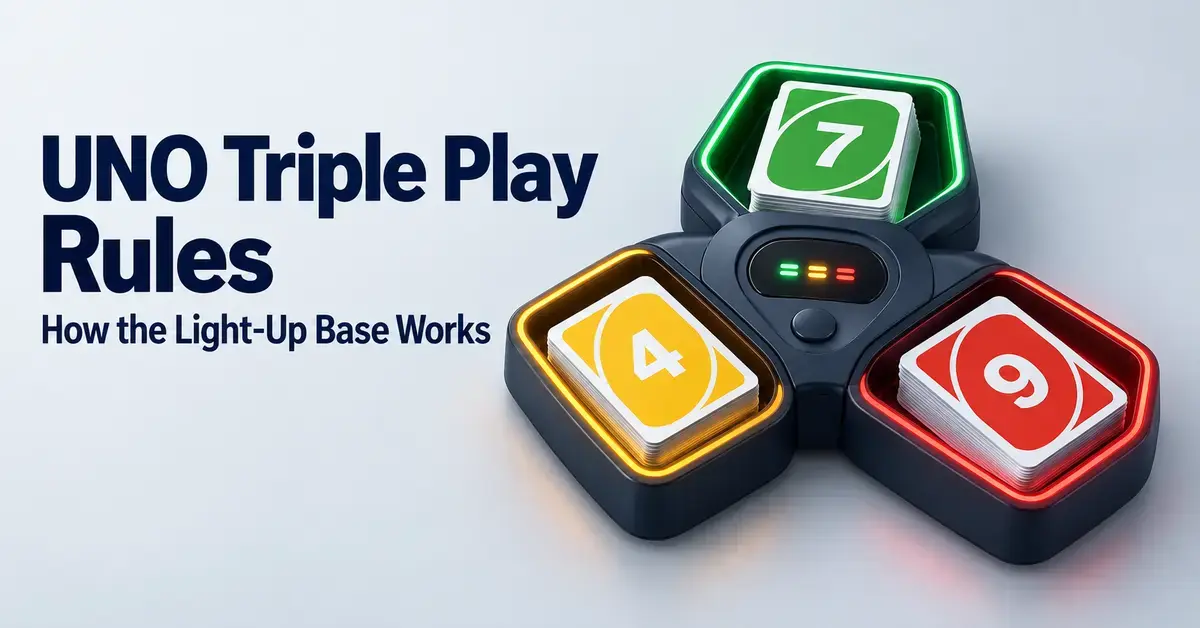
UNO Triple Play is the electronic edition of UNO built around a battery-powered base with three discard piles instead of one, plus lights and sounds that tell you where you may play. The twist is simple to grasp but changes the game: you can only discard onto a pile the unit has lit up, and if you feed any pile too often it “overloads” and forces you to draw penalty cards. This guide explains the light-up base, the slot mechanic, the overload penalty and the three special cards you won’t find in the classic deck — all checked against Mattel’s official instruction sheet.
Quick Facts
| Publisher | Mattel |
|---|---|
| Official product page | shop.mattel.com (GXV87) |
| Model number | GXV87 (also sold as HCC21) |
| Contents | 112 cards + 1 electronic Triple Play unit |
| Players | 2–6 |
| Recommended age | 7+ |
| Game modes | Regular Mode & Timer Mode |
| Batteries | 3 AA alkaline (not included) |
| Released | Around 2020 |
What is UNO Triple Play?
UNO Triple Play is a Mattel UNO variant (model GXV87) that keeps the familiar goal of being first to shed every card, but replaces the single discard pile with an electronic unit holding three of them. Launched around 2020, it plays like classic UNO at heart: you match the top card by colour, number or symbol. What is new is that the unit decides which piles are open on each turn and tracks how full each one is, adding a light-and-sound layer of luck and pressure. It is designed for 2 to 6 players, ages 7 and up.
What comes in the box?
Every UNO Triple Play set includes 112 cards and one electronic Triple Play unit. The unit needs 3 AA alkaline batteries, which are not included. The 112 cards break down like this:
- 76 number cards — 19 in each colour (blue, green, red, yellow): one 0 and two each of 1 through 9.
- 24 action cards — 8 Skip, 8 Reverse and 8 Discard Two of the Same Color (two of each per colour).
- 12 Wild cards — 4 Wild, 4 Wild Clear and 4 Wild Give Away.
Notice what is missing: UNO Triple Play has no Draw Two and no Wild Draw Four. The overload system does the job those punishment cards do in the standard deck, so they are left out entirely.
How the light-up base and three discard slots work
The heart of UNO Triple Play is the electronic base, which controls three discard piles and lights them to show where you may play. You can never play to a dark pile — only a lit one.
Which slots light up each turn
At the start of each turn the unit lights one, two or all three discard piles, and the mix changes constantly. One turn every pile may be open; the next, only a single pile might be lit. You must play a matching card onto one of the currently lit piles, which is what makes the game less predictable than ordinary UNO — the card you were saving is only useful if its pile is open.
Rotating the lights to the next player
After you play, press the pile straight down like a button until you hear a beep. That registers your card and rotates the lights, setting up which piles are open for the next player. If you cannot play, you draw and — if the new card still doesn’t fit — you press down on any lit pile anyway to pass the lights along. Nothing advances until a pile is pressed, so the base keeps turn order tidy.
Playing a turn, step by step
Setup is quick: switch the unit on, place it in the middle, deal 7 cards to each player, and set the rest face down as the draw pile. Turn one number card face up into each of the three discard spaces to start them (start piles with number cards only). Then press the yellow “GO” button and play in turns:
- Look at which piles are lit. You may only play onto a lit pile.
- Play one card that matches the top card of a lit pile by colour, number or symbol. Action and Wild cards trigger their effects.
- Press that pile down until it beeps to rotate the lights.
- If you have no playable card for a lit pile, draw one card from the draw pile. Play it if it now fits; if not, press any lit pile to pass the turn.
- You may choose to draw instead of playing even when you hold a playable card. If you draw and don’t play, press a lit pile to move on.
These action cards behave just as they do in the base game — you can read the full breakdown of UNO action cards such as Skip and Reverse if you want the standard rules in detail.
The overload penalty: the capture-pile mechanic
Each discard pile has a counter light that fills up as cards land on it, and overloading a pile is how UNO Triple Play punishes players. The light climbs from green (safe) to yellow (caution) to red (close to overload), so a red pile is a warning to play elsewhere if you can.
When a pile takes one card too many, it overloads: the unit plays an overload tone and flashes a number in the centre display. The player who caused the overload must draw that many cards from the draw pile — anywhere between 1 and 4 cards. After drawing, press “GO” to continue with the next player.
One rule catches people out: if you play your very last card onto a pile that overloads, you do not win. You must draw the indicated cards and keep playing. So dumping your final card onto a red pile is a real gamble.
The special cards in UNO Triple Play
UNO Triple Play uses the usual Skip, Reverse and Wild, but adds three cards built specifically for the electronic base. Action cards may be played on action cards of the same type or the same colour; Wild cards may be played on any card on any lit pile.
Action cards
- Skip — the next player loses their turn.
- Reverse — reverses the direction of play (clockwise becomes counter-clockwise and vice versa).
- Discard Two of the Same Color — lets you shed two cards at once. Play this card together with another card of the same colour: the Discard Two card goes on the bottom, the other card face up on top. If the top card is an action card, the next player must take that action. You may also play the Discard Two card on its own.
Wild cards
- Wild — can be played on any lit pile. Unusually, the player who lays the Wild does not choose the colour. Instead, the next player to play on that pile sets the colour by the card they lay down.
- Wild Clear — resets a stressed pile. Lay it down and hold the pile pressed for about two seconds until the counter light returns to green, effectively emptying the overload meter for that pile.
- Wild Give Away — your escape hatch. If the pile overloads when you play this card, you take the penalty cards from the draw pile but hand them out to other players however you like, instead of keeping them. If the pile does not overload, your turn simply ends.
Special Cards at a Glance
| Card | Type | What it does | Points |
|---|---|---|---|
| Skip | Action | Next player misses their turn | 20 |
| Reverse | Action | Reverses the direction of play | 20 |
| Discard Two of the Same Color | Action | Play two same-colour cards together | 20 |
| Wild | Wild | Next player on that pile sets the colour | 50 |
| Wild Clear | Wild | Hold the pile ~2 seconds to reset its counter to green | 50 |
| Wild Give Away | Wild | If the pile overloads, hand the penalty cards to other players | 50 |
Regular Mode versus Timer Mode
UNO Triple Play offers two ways to play, set by a small switch on the bottom of the unit. Regular Mode is the standard game described above, with no clock. Timer Mode plays identically but gives you only 7 seconds to play a card, counted down on the centre display. If the timer runs out on your turn, you must draw 6 cards — a steep penalty that makes Timer Mode noticeably more frantic and better suited to older or more confident players.
Calling “UNO” and winning
Calling UNO works just like the classic game. The moment you are down to a single card, you must shout “UNO” to warn the table. If another player catches you and calls “UNO” before you do — and before the next player starts their turn — you must draw 2 cards as a penalty.
You win a hand the instant you play your final card successfully, as long as that play does not overload a pile. Then you reshuffle and play again.
Keeping score (optional)
Scoring is optional in UNO Triple Play and follows the familiar UNO system. When someone empties their hand, they collect points for every card still held by their opponents:
- Number cards (0–9): face value.
- Action cards (Skip, Reverse, Discard Two of the Same Color): 20 points each.
- Wild cards (Wild, Wild Clear, Wild Give Away): 50 points each.
Keep a running tally from hand to hand; the first player to reach 500 points wins the match.
How UNO Triple Play differs from classic UNO
If you already know standard UNO, these are the changes that matter most:
| Feature | Classic UNO | UNO Triple Play |
|---|---|---|
| Discard piles | One | Three, controlled by an electronic base |
| Where you can play | The single pile | Only piles the unit lights up |
| Main penalty | Draw Two / Wild Draw Four cards | Overload counter (draw 1–4 cards) |
| Draw Two card | Yes | No |
| Wild Draw Four | Yes | No |
| Unique cards | — | Discard Two of the Same Color, Wild Clear, Wild Give Away |
| Who picks the Wild colour | The player of the Wild | The next player on that pile |
| Batteries | None | 3 AA alkaline (not included) |
It sits alongside many other editions in the range — you can compare it with the rest in our overview of UNO versions and editions.
Common mistakes to avoid
Most Triple Play errors come from treating it like standard UNO. Watch for these:
- Playing to a dark pile. Only lit piles are legal. Check the lights before you reach for a card.
- Ignoring the counter colour. Dropping a card on a red pile risks the overload penalty. Spread your plays across piles when you can.
- Trying to go out on a red pile. If your last card overloads the pile, you don’t win — you draw and keep playing. Finish on a safer pile.
- Choosing a colour on a Wild. In Triple Play the next player sets the colour, not you, so don’t announce one.
- Forgetting to press the pile. The lights only rotate when a pile is pressed until it beeps; skipping that stalls the turn.
- Not calling “UNO.” The catch penalty still applies — say it on your one-card turn.
Who is UNO Triple Play for?
UNO Triple Play suits families and groups who enjoy the base game but want extra unpredictability and a tactile, noisy gadget at the table. The lights and sounds make it appealing for children 7 and up, while Timer Mode gives older players a faster challenge. Because the base runs on batteries and the electronic unit is bulkier than a card box, it is less travel-friendly than a plain deck, and players who prefer pure strategy may miss the control that Draw Two and Wild Draw Four give in standard play. If you like inventing your own twists, many of the classic UNO house rules are harder to bolt on here because the unit governs the flow.
Sources
Frequently Asked Questions (FAQ)
How many cards are in UNO Triple Play?
There are 112 cards plus one electronic unit. That includes 76 number cards, 24 action cards (Skip, Reverse and Discard Two of the Same Color) and 12 Wild cards (Wild, Wild Clear and Wild Give Away).
How does the overload penalty work?
Each pile has a counter light that rises from green to yellow to red as cards pile up. When a pile takes one card too many it overloads, and the unit flashes a number — between 1 and 4 — that the responsible player must draw from the draw pile.
Does UNO Triple Play have Draw Two or Wild Draw Four cards?
No. UNO Triple Play leaves out both Draw Two and Wild Draw Four. The overload system replaces them as the game’s main way of forcing players to draw extra cards.
Can you win by playing your last card on any pile?
Only if that pile does not overload. If your final card causes an overload, you do not go out — you must draw the penalty cards shown and keep playing, so aim for a green or yellow pile to finish.
How many players can play UNO Triple Play?
UNO Triple Play is built for 2 to 6 players and recommended for ages 7 and up. A hand usually takes about 10 to 15 minutes.
