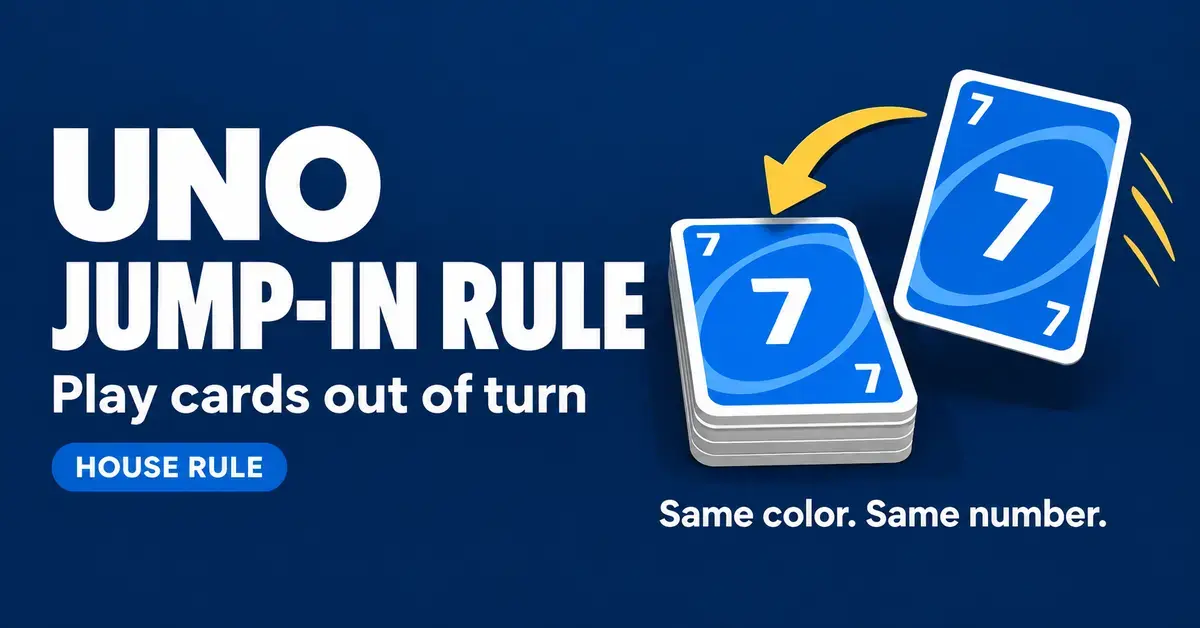
The UNO jump-in rule lets you play a card out of turn the moment you hold an exact copy of the card on top of the discard pile. If the top card is a Blue 7 and you also have a Blue 7, you can slap it down immediately — even if it is not your turn — and play then jumps to you. It is one of the most popular unofficial ways to speed up the game, but it is a house rule in classic UNO, not part of Mattel’s standard rulebook. This guide explains exactly how jump-in works, what counts as a valid card, whose turn comes next, and how to settle the arguments it tends to start.
Key Points
- What it is: jump-in lets you play a card out of turn when you hold an exact copy of the top discard — same colour and same number/symbol.
- Official status: a house rule in classic UNO (not in Mattel’s standard rulebook), but a built-in mode in UNO Party! and a toggle in the UNO app.
- Turn order: after a jump-in, play resumes from you in the normal direction; players in between are skipped for that lap.
- Exact match only: a Blue 7 can jump in on a Blue 7 — a Red 7 or Blue 5 cannot.
- Action cards yes, Wilds no: a matching Skip, Reverse or Draw Two can jump in; colourless Wilds cannot.
- Agree first: settle speed ties, penalties and Wild handling before you deal to avoid disputes.
What is the UNO jump-in rule?
The jump-in rule allows any player to play a card out of turn if that card is an exact duplicate of the card currently on top of the discard pile. “Exact duplicate” means the same colour and the same number or symbol — not just a matching colour or a matching number. You do not have to wait for your turn: the instant a matching card lands on the pile, anyone holding its twin can jump in and play it.
When you jump in, play continues from you as if it had just been your turn. Everyone sitting between the previous player and you is skipped for that cycle. Because it rewards quick reactions and thins your hand fast, jump-in is a favourite among groups who find standard turn-by-turn UNO too slow. It sits alongside other popular optional tweaks in most collections of UNO house rules.
Is jump-in an official UNO rule or a house rule?
In classic UNO, jump-in is a house rule only — it is not printed in Mattel’s standard instruction sheet, where turn order is strictly one player at a time. There is nothing in the basic rulebook that lets you play out of turn, so if you want to use jump-in with a normal UNO deck, everyone at the table has to agree to it before the game starts.
That said, jump-in is no longer purely unofficial everywhere. Mattel made it a built-in mode in UNO Party! (released 2023), where playing a number card that matches both the colour and the number of the top card out of turn is written into the official rules. The digital UNO game (mobile and console) also offers “Jump-In” as a toggle you can switch on in custom or house-rule matches. So the honest answer is: house rule in standard UNO, official option in certain UNO products.
Jump-In Across UNO Versions
| UNO version | Is jump-in built in? | Notes |
|---|---|---|
| Classic UNO (standard deck) | No — house rule | Not in the printed rulebook; add it only by table agreement. |
| UNO Party! (2023) | Yes — official mode | Playing a matching number card out of turn is written into the rules. |
| UNO app / video game | Optional toggle | “Jump-In” can be switched on in custom or house-rule matches. |
| UNO Flip! and themed decks | No — house rule | Same house-rule status as classic UNO unless the pack states otherwise. |
What counts as a valid jump-in card?
Only an exact duplicate qualifies — the card you jump in with must match the top card in both colour and number/symbol. This is the single most important detail, and the one that causes the most confusion at the table.
- Valid: the top card is a Blue 7 and you play another Blue 7.
- Not valid: the top card is a Blue 7 and you play a Red 7 (right number, wrong colour).
- Not valid: the top card is a Blue 7 and you play a Blue 5 (right colour, wrong number).
The normal UNO matching rule — where you can follow a card by matching either its colour or its number — does not apply to jump-in. A jump-in has to be a true twin of the card on the pile. You also have to be quick: the window closes the moment the next card is played on top, whether that is the regular player taking their turn or someone else jumping in first.
Whose turn is it after a jump-in?
After a jump-in, play continues from the player who jumped in, moving in the current direction of play. In other words, once your duplicate is on the pile it becomes “your turn”, and the person to your left (in normal clockwise play) goes next. Anyone who was sitting between the previous player and the jumper simply loses their go for that lap — they are effectively skipped.
This is exactly why jump-in changes the pace of the game so much: turns can leapfrog around the table, and a well-timed jump-in can cut several opponents out of a rotation while you offload a card.
Can you jump in with action cards and Wild cards?
Action cards can be jumped in, but Wild cards generally cannot. Here is how each type is usually handled at tables that allow jump-in.
Action cards (Skip, Reverse, Draw Two)
You can jump in with a coloured action card if it is identical in colour and symbol. If a Blue Skip is on the pile, a player holding another Blue Skip can jump in with it, and the card’s effect fires as normal from the new position — so the next player after the jumper gets skipped. The same works for a matching Reverse or Draw Two. Because these cards keep their effect, a jumped-in Draw Two or Skip can be a powerful surprise.
Wild and Wild Draw Four cards
Standard Wild and Wild Draw Four cards cannot be used to jump in, because they have no fixed colour to match. Jump-in requires an exact colour-and-symbol match, and a Wild is colourless, so there is nothing for a second Wild to “duplicate” under the strict version of the rule. Some casual tables allow jumping a Wild onto a Wild anyway — that is a table-by-table call, and one worth agreeing on in advance so nobody is caught out.
How to play with the jump-in rule
Adding jump-in to a normal UNO game takes no extra equipment — just a shared agreement. Here is a simple way to start.
- Agree before you deal. Confirm that jump-in is on, and decide the finer points: are action-card jump-ins allowed, and can Wilds be jumped?
- Set a fairness rule for speed. Because jump-in rewards fast hands, decide up front how you will judge who played first if two people react at once (see the disputes section below).
- Watch the pile, not just your turn. Keep an eye on every card played — your chance to jump in can come at any moment.
- Play one card at a time. If you hold two matching cards, you still play them singly. Put one down, then reach back for the second — which gives someone else a chance to jump in ahead of you.
- Call “UNO” as normal. The one-card-left warning still applies, and jump-in makes it easy to drop to a single card quickly.
If you enjoy speeding the game up like this, it pairs well with the other fast-play tweaks covered in these fun UNO variations.
Common jump-in disputes (and how to settle them)
Jump-in causes more arguments than almost any other house rule, because it turns a calm turn-based game into a reflex contest. Settle these points before play, not mid-argument.
Who played first?
The most common dispute is two players slapping down the same duplicate at nearly the same instant. There is no official tiebreaker, so agree on one in advance: the card that physically touches the pile first wins, or the first player to clearly say the card out loud wins. A neutral “card down beats card called” rule keeps things simple.
Was it a true exact match?
Players often try to jump in on colour alone or number alone. Re-read the rule at the table: the jump-in card must match both colour and number/symbol, or it is not legal and goes back into the hand (some groups add a draw-one penalty for a mistaken jump-in).
Did the window close?
A jump-in is only valid before the next card lands. If the regular player has already played, the moment has passed. Decide whether a jump-in that arrives a split second late is simply void, or void with a small penalty.
Damaged or bent cards
Fast slapping can bend or mark cards, which then become recognisable in future hands. Agree to play jump-in gently — a placed card counts the same as a slammed one — to keep the deck fair.
Fairness for slower players
Jump-in structurally favours quick reactors and can leave younger or newer players out. If your group is mixed, consider limiting jump-in to number cards only, or dropping it entirely for beginner games.
Common mistakes to avoid
- Treating a colour or number match as enough. Only exact duplicates (both colour and symbol) can jump in.
- Trying to jump in with a Wild. Wilds have no colour, so under the standard rule they cannot jump in.
- Playing two matching cards at once. Even a genuine pair must be played one at a time, leaving a jump-in window between them.
- Forgetting the turn shifts to you. After you jump in, play resumes from your seat — be ready for it to be the next player’s turn, not a return to the original order.
- Not agreeing the rules first. The biggest mistake is starting without settling action cards, Wilds, ties and penalties. Nail these down before the deal.
Who is the jump-in rule best for?
Jump-in suits fast, experienced groups who want a quicker, more chaotic game. Its upsides are obvious: rounds finish faster, everyone stays alert because a chance to play can come at any second, and clever timing rewards attentive players. It also makes large groups more engaging, since you are not always waiting for a long turn order to reach you.
The downsides are just as real. Jump-in rewards reflexes over strategy, disadvantages players who need longer to find a card, and reliably sparks who-went-first disputes. For young children, casual family games, or anyone new to UNO, standard turn order is usually the friendlier choice. A good rule of thumb: keep jump-in if your table is quick and competitive, and drop it if anyone at the table is young or still learning.
Sources
Frequently Asked Questions (FAQ)
Is the jump-in rule official in UNO?
In standard UNO it is a house rule and is not in Mattel’s basic rulebook, so all players must agree to use it. It is, however, a built-in official mode in UNO Party! and a toggle in the digital UNO game.
What cards can you jump in with?
Only an exact duplicate of the top card — the same colour and the same number or symbol. A Blue 7 can jump in on a Blue 7, but a Red 7 or a Blue 5 cannot. Coloured action cards like a matching Skip or Draw Two can also be jumped in.
Whose turn is it after someone jumps in?
Play continues from the player who jumped in, moving in the current direction. Anyone sitting between the previous player and the jumper is skipped for that lap.
Can you jump in with a Wild card?
Under the standard rule, no. Wild and Wild Draw Four cards have no fixed colour, so there is no exact colour match to jump in on. Some casual groups allow Wild-on-Wild jump-ins by agreement, but it is not the default.
What happens if two players jump in at the same time?
There is no official tiebreaker, so agree on one before you play — for example, the card that touches the pile first wins, or the first player to say the card out loud wins. Keeping a clear rule ready prevents most jump-in arguments.
