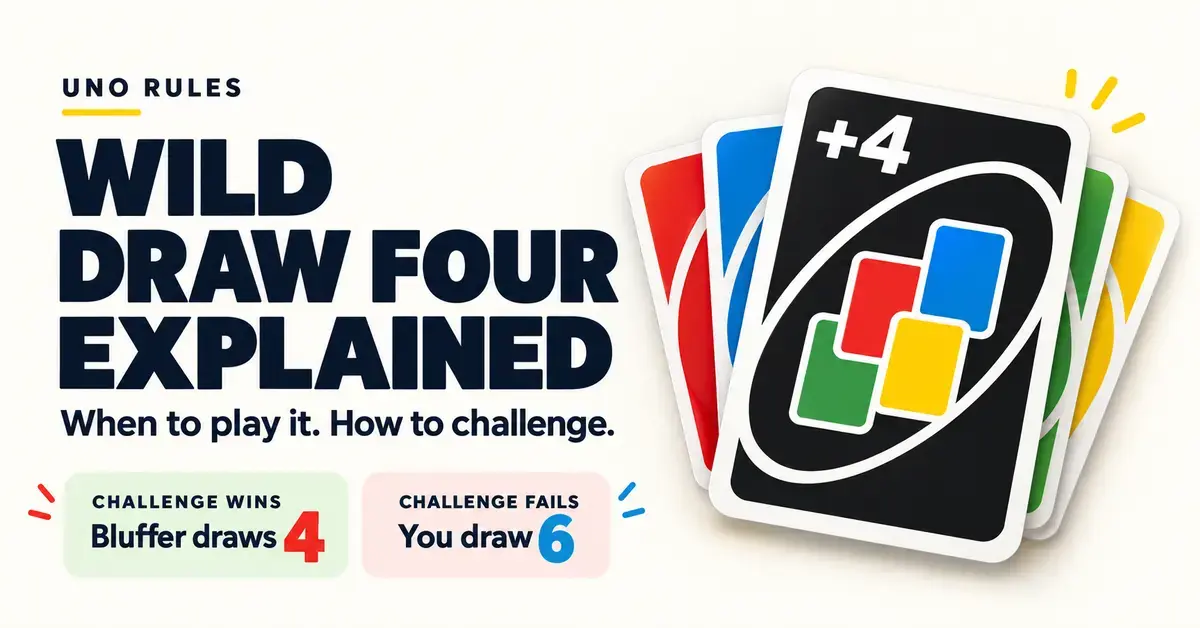
The Wild Draw Four (also written +4) is the most powerful card in UNO: it forces the next player to draw four cards, skips their turn, and lets you change the colour in play. But it also comes with the game’s strictest condition and its only formal challenge system. This guide explains exactly when you are allowed to play a Wild Draw Four, why bluffing with it is part of official UNO, and how the challenge works — including who draws how many cards when a challenge succeeds or fails. Every rule below matches Mattel’s official UNO instructions.
Key Points
- Play condition: allowed only when you hold no card matching the colour on the discard pile.
- Colour only: matching numbers or symbols in other colours do not block the +4.
- The bluff: playing it illegally is legal until you are challenged — hands are hidden.
- Who challenges: only the player being forced to draw, and only before their turn begins.
- Successful challenge: the bluffer draws 4 instead of you.
- Failed challenge: you draw 6 (4 + 2) and lose your turn.
- Value: 50 points — the highest-scoring card, tied with the regular Wild.
What Is the UNO Wild Draw Four Card?
The Wild Draw Four is a wild card with an added penalty: the next player draws four cards and loses their turn, and the person who played it chooses the colour that play continues in. A standard 108-card UNO deck contains four Wild Draw Four cards, each showing four coloured segments and a large “+4” symbol.
It differs from the ordinary Wild card in two ways. First, a plain Wild lets you change the colour but carries no draw penalty. Second, the Wild Draw Four is the only card in UNO with a legal restriction on when you may play it. That restriction is the source of almost every argument at the table, so it is worth understanding precisely. If you are still learning the basics, our full guide on how to play UNO walks through setup, turn order and winning a hand.
When Can You Play a Wild Draw Four?
You may play a Wild Draw Four only when you have no card in your hand that matches the colour of the card on top of the discard pile. This is the single most misunderstood rule in UNO. It is a colour-only restriction — the numbers and symbols on your other cards do not matter.
The “No Matching Colour” Rule Explained
Officially, a Wild Draw Four is a card of last resort. If the top of the discard pile is a red card, and you are holding any red card at all, you are not supposed to play a Wild Draw Four. You are expected to play the red card instead (or a regular Wild, or another legal card). Only when you are completely out of the current colour does the Wild Draw Four become a legal play.
What Counts as a Match (and What Doesn’t)
The restriction looks only at colour, not at number or action type. This trips up new players constantly, so here is the distinction:
- Blocks a legal Wild Draw Four: holding any card of the current colour — a matching-colour number card, Skip, Reverse, Draw Two or the coloured symbol on the pile.
- Does NOT block it: holding a card that matches the number or action symbol in a different colour. For example, if a red 7 is on top and your only “matches” are a blue 7 and a green Skip, you have no red card — so playing a Wild Draw Four is completely legal.
- Never a factor: a regular Wild card in your hand does not count as a colour match and never makes a Wild Draw Four illegal.
In short: matching-colour cards block the +4; matching numbers or symbols of another colour do not. Understanding this is what makes the bluff — and the challenge — possible. For a refresher on how Skip, Reverse and Draw Two behave, see our breakdown of UNO action cards.
What Is the Wild Draw Four Bluff?
The Wild Draw Four bluff is playing the card illegally — while you actually hold a matching-colour card — and hoping no one challenges you. Because every player’s hand is hidden, the restriction cannot be enforced automatically. Nobody at the table can see whether you genuinely had no matching colour, so the rule relies entirely on the honour system backed up by the challenge.
This makes bluffing a built-in, official part of UNO rather than cheating. Mattel’s rules explicitly anticipate that players will sometimes play a Wild Draw Four when they were not allowed to, which is exactly why the challenge mechanic exists. A well-timed bluff can dump your highest-penalty card, change the colour to one that suits you, and hit an opponent with four cards — all in a single turn. The risk is that if you are caught, the penalty lands on you instead.
Can You Challenge a Draw 4 in UNO?
Yes. When someone plays a Wild Draw Four against you, you can challenge it before you draw, forcing them to prove the card was played legally. The challenge is the only official way to punish an illegal Wild Draw Four, and it can flip the penalty back onto the player who tried to bluff you.
How to Challenge a Wild Draw Four
Only the player directly targeted — the one who would otherwise draw four cards — may issue the challenge. To challenge, you accuse the player of having a card that matched the colour of the discard pile at the moment they played the +4. The challenged player must then privately show you their hand so you can check whether they were holding a matching colour. Other players do not get to see the hand.
Successful Challenge: The Bluffer Draws 4
If the challenge succeeds — their hand contains a card matching the colour that was in play — the bluff is caught. The player who played the Wild Draw Four must draw the four cards instead of you, and you take your turn as normal. In other words, the penalty rebounds onto the person who tried to cheat the rule.
Failed Challenge: The Challenger Draws 6
If the challenge fails — their hand shows no matching-colour card, so the +4 was legal — you pay a higher price. The challenger must draw six cards (the original four plus two more as a penalty) and still loses their turn. That two-card surcharge is what makes a challenge a real gamble rather than a free guess.
When Must You Challenge?
You have to challenge immediately, before you take any part of your turn. Once you draw from the deck, play a card, or otherwise begin your turn, the Wild Draw Four is accepted and the chance to challenge is gone. So decide the moment the +4 hits the table — hesitation counts as acceptance.
Wild Draw Four vs Wild Card
| Feature | Wild Draw Four (+4) | Wild Card |
|---|---|---|
| Changes colour | Yes | Yes |
| Draw penalty for next player | 4 cards | None |
| Next player skipped | Yes | No |
| Play restriction | Only with no matching colour | Playable any time |
| Can be challenged | Yes | No |
| Point value | 50 | 50 |
| Copies in a 108-card deck | 4 | 4 |
Special Situations You Should Know
A few edge cases around the Wild Draw Four come up often enough to deserve their own rulings.
Wild Draw Four as the First Card
If a Wild Draw Four is turned up as the very first card of the game, it is returned to the deck, the deck is reshuffled, and a new starting card is flipped. Mattel considers the card too powerful to open a hand with. This is different from a plain Wild turning up first, in which case the first player simply chooses the starting colour.
Can You Play a Wild Draw Four as Your Last Card?
Yes, you can win the game by playing a Wild Draw Four as your final card, provided the play is legal (you had no matching colour). Just remember to call “UNO” when you are down to one card, exactly as with any other card. The next player still draws four, but the hand ends because you are out of cards.
Can You Stack a +4 on a +4 or +2?
No. Under official rules there is no stacking: when a Wild Draw Four is played you must draw four and forfeit your turn — you cannot dodge it by playing another Draw card. Mattel confirmed this directly in 2019, stating that a +4 cannot be answered with a +2 to pass a larger penalty along. Stacking exists only as a popular house rule; if that is how your group plays, read our guide to UNO stacking rules to keep everyone consistent.
How Many Points Is a Wild Draw Four Worth?
A Wild Draw Four is worth 50 points in UNO scoring, tying it with the regular Wild card as the highest-value card in the deck. When a player goes out, every opponent’s remaining cards are tallied and added to the winner’s score. For reference, number cards score their face value (0–9) and coloured action cards (Skip, Reverse, Draw Two) score 20 points each. Because a Wild Draw Four carries such a heavy 50-point cost, getting stuck holding one at the end of a hand is expensive — another reason players try to unload it, sometimes with a risky bluff.
Common Mistakes With the Wild Draw Four
Most Wild Draw Four disputes come down to a handful of repeat errors. Avoiding them keeps games fair and fast:
- Thinking a matching number blocks the card. Only a matching colour restricts you. A blue 5 in your hand does not stop you playing a Wild Draw Four on a red 5.
- Believing you can “never” bluff. Playing a Wild Draw Four illegally is allowed by the rules; it is only penalised if you are successfully challenged.
- Letting anyone challenge. Only the player being forced to draw may challenge, and only before they start their turn.
- Forgetting the six-card penalty. A failed challenge costs the challenger six cards, not four — challenge only when you are reasonably confident.
- Stacking by default. Stacking a +2 or +4 to escape the penalty is a house rule, not official play; agree on it before the game starts.
- Skipping the private reveal. A proper challenge requires the accused to show their hand to the challenger only — not to leave it to a verbal claim.
Who Should Use the Challenge Rule?
The challenge rewards players who pay attention to what colours opponents have been forced to draw or play. If someone changes the colour with a +4 right after failing to follow the previous colour, a challenge is often worth the risk. Casual and family games sometimes skip challenges entirely to keep things simple, which is fine — just make sure everyone agrees, because dropping the challenge effectively legalises unlimited bluffing.
Sources
Frequently Asked Questions (FAQ)
Can you play a Wild Draw Four at any time in UNO?
No. Officially you may play it only when you have no card matching the colour on top of the discard pile. Matching numbers or action symbols in other colours do not prevent you from playing it, but any card of the current colour does.
What happens if I challenge a Draw 4 and I am right?
If your challenge succeeds, the player who played the Wild Draw Four illegally must draw the four cards instead of you, and you then take your turn normally. The penalty rebounds onto the bluffer.
What happens if I challenge a Draw 4 and I am wrong?
If the challenge fails because the card was played legally, you must draw six cards — the original four plus a two-card penalty — and you still lose your turn. That extra cost is the risk of challenging.
Is bluffing with a Wild Draw Four cheating?
No. Because hands are hidden, playing a Wild Draw Four when you actually hold a matching colour is a legitimate bluff built into the rules. It is only punished if another player successfully challenges you.
How many points is a Wild Draw Four worth?
A Wild Draw Four is worth 50 points, tying with the regular Wild card as the highest-scoring card in UNO. Those points are counted against whoever is still holding the card when another player goes out.
