
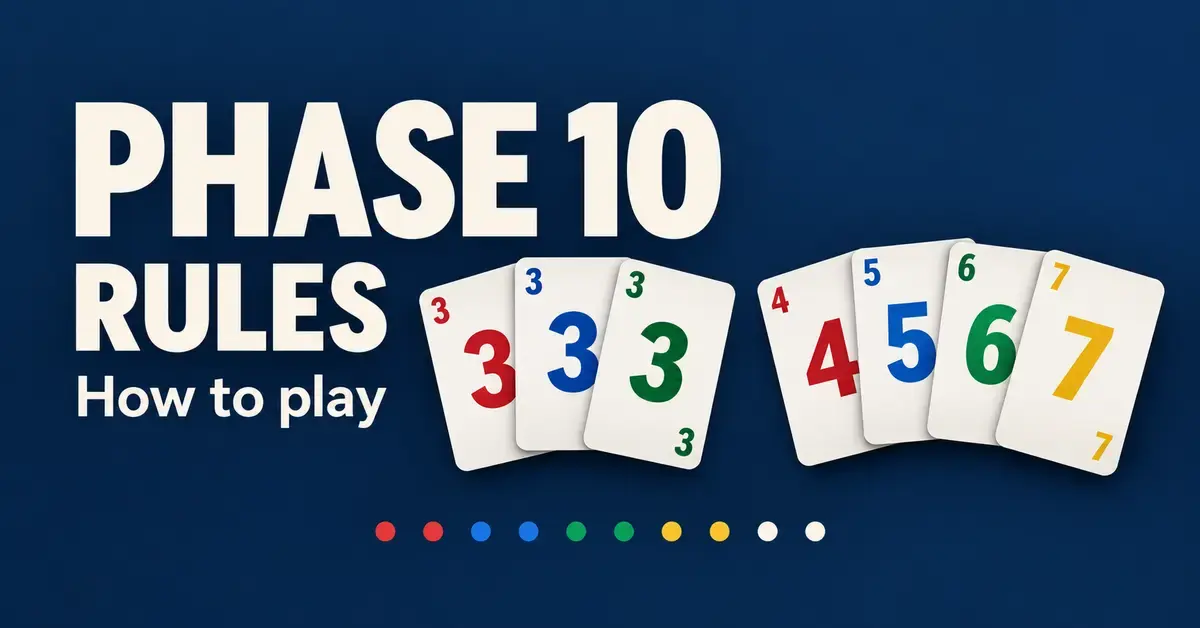
Phase 10 is a rummy-style card game in which you race to be the first player to complete ten set card combinations, called phases, in a fixed order. It is published by Mattel — the same company behind UNO — but it is its own game with its own 108-card deck, not an UNO edition. This guide explains the official Phase 10 rules step by step: the deck, how to set up, how a turn works, what each of the ten phases requires, how Skip and Wild cards behave, how scoring works and how you win.
Quick Facts
| Game type | Rummy-style card game |
|---|---|
| Designer | Kenneth Johnson (1982) |
| Publisher | Mattel (makers of UNO; acquired 2010) |
| Players | 2–6 |
| Age | 7+ |
| Deck | 108 cards (96 numbered, 8 Wild, 4 Skip) |
| Cards dealt | 10 to each player |
| Objective | Be the first to complete all 10 phases, in order |
What is Phase 10?
Phase 10 is a card game for 2 to 6 players, aged 7 and up, where everyone works through the same ten phases and the first person to finish Phase 10 wins. A phase is a required combination of cards — for example two sets of three cards, or a run of seven cards in sequence — that you must build in your hand and lay on the table before you can move on.
The game was created by Kenneth Johnson in 1982 and was sold for decades by Fundex Games. Mattel acquired the rights in December 2010, which is why Phase 10 now sits in the same family as UNO. Despite the shared publisher, the two games play very differently: UNO is about shedding cards by matching colour or number, while Phase 10 is a collect-and-build game closer to classic rummy. If you are weighing it against other decks, our guide to card games like UNO places Phase 10 alongside six other options.
What is in the Phase 10 deck?
A standard Phase 10 deck contains 108 cards. You never shuffle it into an ordinary playing-card deck — the mix of numbers and special cards is built for the game. The breakdown is:
- 96 number cards — the numbers 1 to 12 in four colours (red, blue, yellow and green), with two of each number in each colour.
- 8 Wild cards — each one can stand in for any number and any colour.
- 4 Skip cards — each one forces another player to lose their turn.
Colour only matters for one phase (seven cards of a single colour). For every other phase, what counts is the number on the card, not its colour.
How do you set up a game of Phase 10?
Setup takes under a minute once the deck is shuffled. Follow these steps:
- Choose a dealer. The dealer shuffles and deals 10 cards face down to each player, one at a time.
- Players keep their 10 cards hidden and do not rearrange them into phases until play begins.
- Place the rest of the deck face down in the middle as the draw pile.
- Turn the top card of the draw pile face up next to it to start the discard pile.
- The player to the dealer’s left goes first; play passes clockwise.
Everyone starts on Phase 1 and works upward. The deal of 10 cards stays the same for every hand of the game.
How does a turn work?
A turn in Phase 10 is always the same three actions, in order:
- Draw one card — take either the top card of the draw pile or the top card of the discard pile.
- Play, if you can — if you now hold a complete version of your current phase, you may lay it face up on the table. You can only lay down a phase on your turn, and only the phase you are currently on.
- Discard one card — place any one card from your hand face up on the discard pile to end your turn.
If the draw pile runs out, shuffle the discard pile (except its top card) to form a fresh draw pile. You do not have to lay down a phase the moment you complete it, but you can only complete it once per hand, so most players lay it down as soon as they can.
What counts as a set, a run or a colour group?
Three building blocks make up every phase, and knowing them is the key to the whole game:
- Set — two or more cards of the same number, in any colours. Three red-blue-yellow 7s is a set of three.
- Run — four or more cards in consecutive numerical order, in any colours. 4-5-6-7 is a run of four.
- Colour group — cards that are all the same colour, used only in Phase 8, where the numbers do not matter.
What are the 10 phases?
The ten phases must be completed in the exact order shown below — you cannot skip ahead or swap the order. Each entry lists what you must collect and lay down. Note that a “set of 3” means three cards sharing a number, while a “run of 4” means four cards in sequence.
The 10 Phases
| Phase | What you must lay down | Cards needed |
|---|---|---|
| 1 | 2 sets of 3 | 6 |
| 2 | 1 set of 3 + 1 run of 4 | 7 |
| 3 | 1 set of 4 + 1 run of 4 | 8 |
| 4 | 1 run of 7 | 7 |
| 5 | 1 run of 8 | 8 |
| 6 | 1 run of 9 | 9 |
| 7 | 2 sets of 4 | 8 |
| 8 | 7 cards of one colour | 7 |
| 9 | 1 set of 5 + 1 set of 2 | 7 |
| 10 | 1 set of 5 + 1 set of 3 | 8 |
The middle phases (the long runs in Phases 4 to 6) and the two-set finishers (Phases 9 and 10) are where most hands are won or lost, because they need many specific cards and lean heavily on Wild cards.
How do Skip and Wild cards work?
Skip and Wild cards are the only special cards in the deck, and they do very different jobs.
Skip cards
A Skip card makes another player lose their next turn. You cannot use a Skip card inside a phase — it is purely an attack. To use one, discard it and name the player who will be skipped; you may skip yourself only if no one else is left to target. You cannot pick a Skip card up from the discard pile, and by the official rules a given player can be hit by only one Skip per round of the table.
Wild cards
A Wild card can stand in for any number and any colour, so it is the most valuable card for completing a phase. You may use more than one Wild in a single phase, as long as the phase still contains at least one natural number card. Once you play a Wild into a phase on the table, it stays there for the rest of the hand — you cannot swap it out later by replacing it with the real card it represents.
What is “hitting” in Phase 10?
Hitting is how you empty your hand after you have laid down your phase. Once your own phase is on the table, on later turns you may add — or “hit” — extra cards onto any phase already laid down, whether it is yours or an opponent’s. A card you add must fit that phase: the same number for a set, the next number in sequence for a run, or the matching colour for the colour group.
You can only hit after you have completed your own phase for the hand, and only on your own turn. Hitting is the fastest way to go out, because going out ends the hand and scores zero points against you.
How do you advance and complete a phase?
You advance to the next phase only by completing your current one during a hand. When any player goes out (empties their hand), the hand ends immediately. Every player who laid down their phase that hand moves up to the next phase for the following hand; anyone who did not complete their phase must attempt the same phase again next hand.
This is the heart of Phase 10’s catch-up design: a player can fall several phases behind and still win, because being behind simply means you keep trying the same phase while others risk stalling on harder ones.
How is Phase 10 scored and how do you win?
The player who goes out first scores zero for the hand. Everyone else adds up penalty points for the cards still in their hand, and low scores are good. The values are:
- Cards 1–9: 5 points each
- Cards 10–12: 10 points each
- Skip cards: 15 points each
- Wild cards: 25 points each
Scores carry over from hand to hand. The game ends when at least one player finishes Phase 10. That player wins outright. If two or more players complete Phase 10 in the same hand, the winner is the one with the fewest total penalty points. If those players are also tied on points, they replay Phase 10 and the first to go out wins. Because Phase 10 is a points-and-phases race rather than a shedding game, the scoring works differently from the UNO scoring rules, where you play to 500.
How does Phase 10 compare with UNO, Skip-Bo and DOS?
All four games come from Mattel, but each has a distinct mechanic. The table below shows how Phase 10 fits next to its siblings.
| Game | Players | Core goal | Main mechanic |
|---|---|---|---|
| Phase 10 | 2–6 | Complete 10 phases in order | Collect sets, runs and colour groups (rummy-style) |
| UNO | 2–10 | Be first to empty your hand | Match the top card by colour or number |
| Skip-Bo | 2–6 | Empty your stock pile first | Build 1–12 sequences on centre piles |
| DOS | 2–4 | Be first to empty your hand | Match two centre piles by number |
If you enjoy the build-and-sequence feel of Phase 10, the Skip-Bo rules will feel familiar, while DOS and classic UNO are faster shedding games.
What are the most common Phase 10 mistakes?
New players tend to lose hands for a handful of avoidable reasons. Watch for these:
- Trying to skip ahead. You must finish phases in order; completing a harder phase early does not let you jump past an earlier one.
- Laying down more than your current phase. When you lay down, you put down only the phase you are on — extra cards go out later by hitting, not in the same play.
- Hoarding Wild cards. A Wild left in your hand at the end of the round costs 25 points, so unused Wilds are the most expensive cards to be caught with.
- Forgetting Skip cards cannot join a phase. They are discards only, and you cannot draw them from the discard pile.
- Racing to lay down instead of going out. Completing your phase matters, but emptying your hand (going out) is what ends the hand and scores you zero — keep hitting to clear your last cards.
Who is Phase 10 best for?
Phase 10 suits families and groups who like a longer, strategic card game with a built-in comeback mechanic. Because being behind just means repeating a phase, slower players stay in contention, which makes it friendly for mixed-age game nights from around age 7 upward. A full game of ten phases can run anywhere from 30 minutes to a couple of hours depending on the number of players, so it rewards a group that wants more than a quick round. Players who prefer short, fast-matching games may still gravitate to UNO, but anyone who likes rummy-style collecting will find Phase 10 an easy favourite.
Sources
Frequently Asked Questions (FAQ)
How many cards do you deal in Phase 10?
Deal 10 cards face down to each player, one at a time, at the start of every hand. The rest of the deck becomes the draw pile, and one card is turned face up to start the discard pile.
Do you have to complete the phases in order?
Yes. Every player works through Phases 1 to 10 in the same fixed order. You cannot skip a phase or jump ahead, even if you happen to hold the cards for a later one.
What happens if you do not finish your phase in a hand?
You stay on the same phase and attempt it again in the next hand. Only players who completed their phase during the hand advance to the next one.
Can you win Phase 10 if you are behind on phases?
Yes. The winner is the first player to complete Phase 10, regardless of how many hands it took. Falling behind only means you keep retrying the same phase, which is why the game has a strong catch-up element.
Is Phase 10 made by the same company as UNO?
Yes. Mattel, which publishes UNO, acquired the rights to Phase 10 in 2010. It remains a separate rummy-style game with its own 108-card deck rather than an edition of UNO.
