
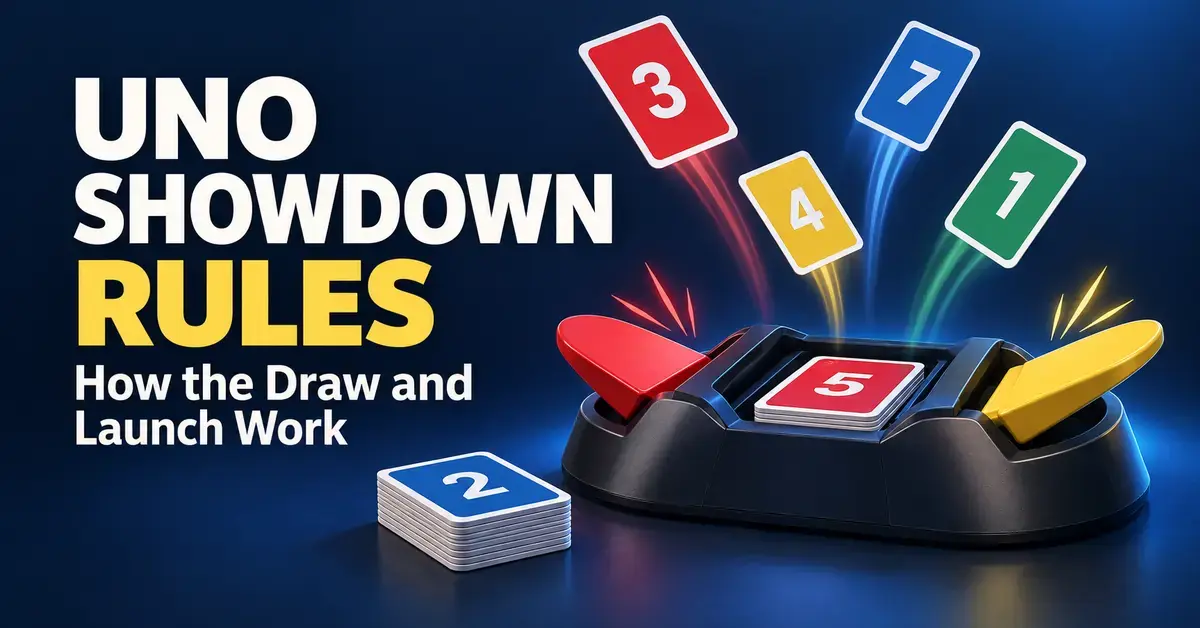
UNO Showdown is Mattel’s electronic twist on the classic card game, built around a battery-powered launcher that settles duels with a slam of a paddle. You still play UNO almost exactly as you remember — match by colour, number or symbol, and race to empty your hand — but a new set of Showdown cards pulls two players into a quick-draw “showdown” at the machine, and the loser gets a faceful of cards. This guide explains the full rules: how the deck works, how you draw, how the launcher and paddles work, what every action card does, how scoring runs to 500, and exactly how UNO Showdown differs from its cousin, UNO Attack.
Quick Facts
| Publisher | Mattel |
|---|---|
| Game type | Electronic UNO edition with a card launcher |
| Players | 2–10 |
| Age | 7 and up |
| Deck | 112 cards + Showdown unit |
| Batteries | 3 × AAA (not always included) |
| Released | 2020 |
| Object | Empty your hand; first to 500 points wins |
| Official info | Mattel product support page |
What is UNO Showdown?
UNO Showdown is an electronic edition of UNO for 2 to 10 players, aged 7 and up, released by Mattel in 2020. The core game is standard UNO, but the box adds a plastic Showdown unit — a small card launcher with two paddles — plus a handful of special cards that trigger head-to-head duels. When one of those cards is played, two players face off at the machine: a random timer counts down, and whoever hits their paddle first fires the loaded cards at their opponent, who must pick them up.
The key thing to understand is that the launcher does not replace normal drawing. In UNO Showdown you still have an ordinary draw pile and draw one card when you cannot play. The machine only comes out for showdowns. That single design choice is what separates Showdown from UNO Attack, where the launcher is the draw pile. If you already know the classic UNO rules, you know roughly 90% of UNO Showdown already.
What comes in the box
UNO Showdown contains 112 cards plus the electronic Showdown unit. The deck follows the modern 112-card UNO make-up, with the four blank-slot cards replaced by Wild Showdown cards:
- 76 number cards — in red, yellow, green and blue (one 0 and two each of 1–9 per colour).
- 8 Draw Two cards — two in each colour.
- 8 Reverse cards — two in each colour.
- 8 Skip cards — two in each colour.
- 4 Wild cards.
- 4 Wild Draw Four cards.
- 4 Wild Showdown cards.
Many of the ordinary number cards are also printed with a small Showdown symbol carrying a number from 1 to 3. Playing one of those number cards starts a showdown as well — the printed number tells you how many cards go into the launcher. The Showdown unit itself runs on 3 AAA batteries, which are not always included, so check before game night. For a full breakdown of a standard deck, see how many cards are in an UNO deck.
How to set up UNO Showdown
Setup is the same as classic UNO, with one extra step for the machine. Follow these steps:
- Insert 3 AAA batteries into the Showdown unit and place it where every player can reach it.
- Shuffle the full 112-card deck.
- Deal 7 cards to each player.
- Place the rest face down as the draw pile.
- Flip the top card over to start the discard pile. (If it is a Wild Showdown card, return it to the deck and flip another.)
- The player to the dealer’s left goes first, and play normally moves clockwise.
How a turn works: the draw side of the game
On your turn you play one card that matches the top of the discard pile by colour, number or symbol. A red 7 can be covered by any red card or by any colour 7; a Skip can be covered by another Skip or by any card of the same colour. Wild cards can be played on anything.
If you cannot — or choose not to — play a matching card, you draw one card from the draw pile. If that card can be played, you may play it immediately; if not, your turn ends and play passes on. This is the ordinary UNO draw, and it is the main way UNO Showdown differs from UNO Attack: here, drawing and the launcher are two separate systems. You only touch the machine when a showdown is triggered.
If the draw pile runs out before anyone wins, shuffle the discard pile (except the top card) to make a fresh draw pile and carry on.
What the Showdown cards do: the launch side of the game
Showdowns are the headline feature. They are triggered in two ways, and both send two players to the launcher.
Showdown number cards
Some number cards carry a Showdown symbol with a number from 1 to 3. When you play one of these, you have a showdown against the next player in turn order. The number on the symbol is how many cards get loaded into the machine for that duel. The colour and value still count for matching, so these cards double as normal plays.
The Wild Showdown card
The Wild Showdown card is the most powerful card in the game and can be played on any card. When you play it, you choose three things:
- the colour that play must continue in;
- the opponent you want to duel — any player at the table, not just the next one;
- the number of cards (1 to 3) loaded into the launcher for the showdown.
That flexibility lets you target the leader or the player with the fewest cards, which is why the Wild Showdown card is worth holding until it hurts.
Running a showdown step by step
Once a showdown is triggered, the two players carry it out like this:
- Place the Showdown unit between the two duelling players.
- Load the required number of cards (1–3) into the machine.
- Press the timer button. The unit runs a random countdown with lights and sounds.
- When the light flashes green, both players slam their paddle as fast as they can.
- Pressing a paddle releases the bar holding the cards, firing them toward the slower player.
- The player who was slower loses the showdown and must add all the launched cards to their hand.
In other words, the faster hand wins and stays lean; the slower hand pays. After the showdown, play continues in the direction set, from the player chosen by a Wild Showdown or past the next player for a Showdown number card.
Action cards and Wild cards
Apart from the showdown cards, UNO Showdown uses the standard UNO action and Wild cards. Here is what each one does:
- Skip — the next player loses their turn.
- Reverse — reverses the direction of play. With only two players it acts like a Skip, giving you another turn.
- Draw Two — the next player draws two cards from the draw pile and loses their turn.
- Wild — play it on anything and name the colour play must continue in.
- Wild Draw Four — name the next colour and make the next player draw four cards and miss their turn. Officially you should only play it when you have no card matching the current colour.
Because Draw Two and Wild Draw Four still make players draw from the pile rather than the launcher, UNO Showdown keeps the familiar feel of classic play. If you want the finer points of the +4, our guide to the UNO Wild Draw Four rules covers the bluff and challenge.
Calling “UNO” and the penalty
The UNO call works exactly as it does in the classic game. When you play your second-to-last card and are down to one card, you must shout “UNO.” If another player catches you before the next player takes their turn, you draw two cards as a penalty. For the full timing and who is allowed to catch you, see our breakdown of calling “UNO”.
Scoring and how to win
UNO Showdown is won over several rounds using standard UNO scoring. The first player to empty their hand wins the round and scores points for every card still held by the other players. Point values are:
- Number cards — face value (a 7 is worth 7 points).
- Draw Two, Reverse, Skip — 20 points each.
- Wild Showdown — 40 points each.
- Wild and Wild Draw Four — 50 points each.
Add up the value of every opponent’s leftover cards and award that total to the round winner. Keep playing rounds; the first player to reach 500 points or more wins the game. If you would rather track scores a different way, our guide to the official UNO scoring rules explains the point table and an alternative lowest-score version.
UNO Showdown vs UNO Attack: how draw and launch differ
UNO Showdown and UNO Attack both come with an electronic card launcher, which is why people mix them up. The difference is what the launcher is for. In UNO Attack the launcher replaces the draw pile entirely — when you cannot play, you press the button and it may spit out anywhere from zero to a fistful of cards at random. In UNO Showdown you draw normally from a pile, and the machine is reserved for two-player showdowns settled by paddle speed. The table below sums it up, and our full UNO Attack rules cover that game in depth.
Showdown vs UNO Attack
| Feature | UNO Showdown | UNO Attack |
|---|---|---|
| What the launcher does | Runs head-to-head showdown duels only | Replaces the draw pile entirely |
| How you draw | Draw one card from a normal paper draw pile | Press the launcher button; it fires 0–several cards at random |
| Paddles | Yes — two players slam paddles to settle a showdown | No paddles; single launch button |
| Signature cards | Showdown number cards and Wild Showdown | Hit 2, Discard All, Trade Hands, Wild Hit-Fire |
| Batteries | 3 × AAA | 3 × C |
| Players / age | 2–10, ages 7+ | 2–10, ages 7+ |
| Scoring | Standard UNO, first to 500 points | Standard UNO, first to 500 points |
UNO Showdown is one of several electronic UNO editions. If you like the gadget angle, UNO Triple Play uses three light-up discard slots instead of a launcher, and you can compare the whole family on our overview of every current UNO version.
Common mistakes to avoid
A few errors come up again and again with UNO Showdown:
- Treating the launcher like UNO Attack’s draw pile. You do not press the paddle to draw. Normal drawing uses the paper draw pile; the machine is only for showdowns.
- Slamming the paddle early. Wait for the green flash. Pressing during the countdown does not help and can cost you the duel.
- Forgetting the Wild Showdown lets you pick anyone. A regular Showdown card hits the next player, but the Wild Showdown can target any opponent — use it on the leader.
- Loading the wrong number of cards. For a Showdown number card the count is printed on the card; for a Wild Showdown you choose 1 to 3.
- Skipping the UNO call. The two-card penalty applies here just like in the classic game.
Who is UNO Showdown for?
UNO Showdown suits families and groups who enjoy a bit of physical chaos and quick reflexes on top of the usual card play. The paddle duels add tension and reward speed, so it tends to land well with kids aged 7 and up and at party tables. Players who prefer a calmer, purely strategic game, or who dislike needing batteries and a plastic unit, may be happier with classic UNO or a non-electronic edition. The game is widely sold second-hand and through various retailers; availability of new copies varies, so check current stock if you want a boxed set.
Sources
Frequently Asked Questions (FAQ)
Do you draw cards from the launcher in UNO Showdown?
No. In UNO Showdown you draw one card from an ordinary paper draw pile when you cannot play, exactly as in classic UNO. The electronic launcher is used only for showdowns, not for normal drawing. That is the opposite of UNO Attack, where the launcher replaces the draw pile.
What does a Showdown card do?
A Showdown card pits two players against each other at the launcher. Cards are loaded into the unit, a random timer counts down, and when the light turns green both players slam their paddle. The slower player loses and must take all the launched cards into their hand.
What is the Wild Showdown card?
The Wild Showdown is the game’s strongest card. It can be played on any card, and when you play it you choose the next colour, pick any opponent to duel, and set how many cards (1 to 3) are loaded into the launcher for that showdown. It is worth 40 points if left in a hand at scoring.
How many players can play UNO Showdown?
UNO Showdown is for 2 to 10 players, aged 7 and up. Although the whole table plays, each showdown is always a one-on-one duel between two players at the machine.
How do you win UNO Showdown?
You win a round by being the first to play all the cards in your hand, then score points for the cards left in your opponents’ hands. Number cards score face value, Draw Two, Reverse and Skip score 20, Wild Showdown scores 40, and Wild and Wild Draw Four score 50. The first player to reach 500 points wins the game.
