

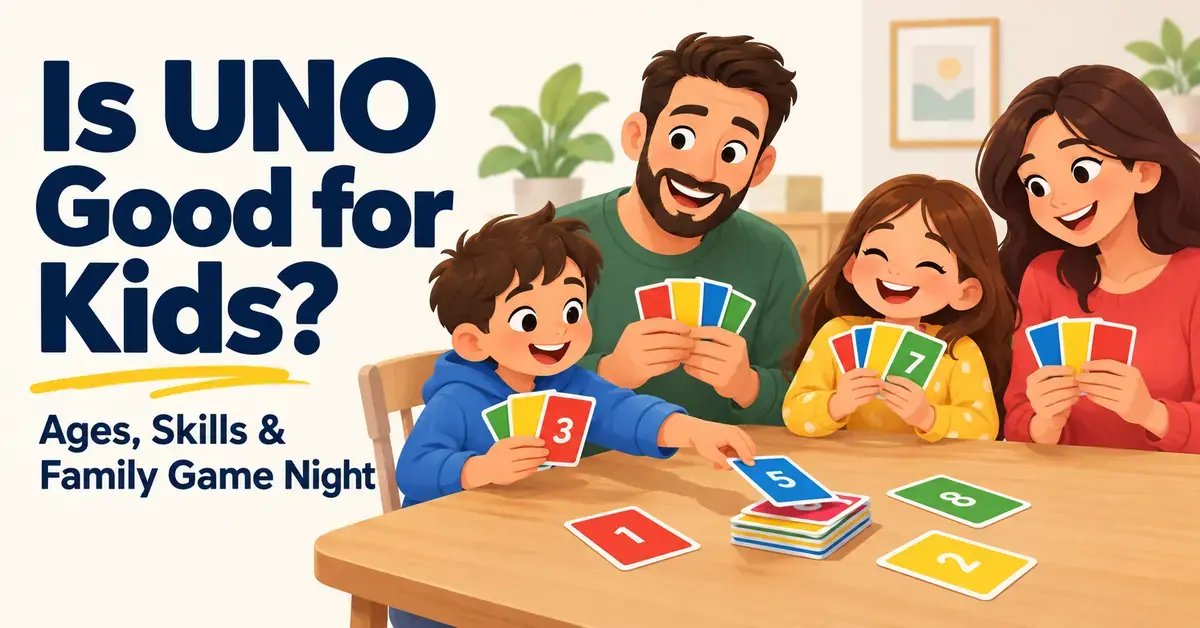
Yes, UNO is a genuinely good game for kids. The classic deck is officially made for ages 7 and up, and UNO Junior brings the same colour-and-number matching fun to children as young as 3. Beyond being easy to learn, UNO quietly builds skills that matter for young children — recognising colours and numbers, taking turns, counting and thinking a move ahead — all wrapped in a fast, social game the whole family can play together. This guide explains the right age for each version, the specific skills UNO develops, how to adapt it for very young players, and the mistakes parents most often make.
Key Points
- Classic UNO: officially for ages 7+ and 2–10 players.
- UNO Junior: officially for ages 3+ and 2–4 players, with a simplified deck and animal pictures.
- Skills built: colour and number recognition, matching, turn-taking, counting, memory and early strategy.
- Ages 5–6: often play classic UNO with adjustments (cards face-up, no penalties, action cards read aloud).
- Family game night: short rounds and a 2–10 player range suit mixed-age groups.
Which UNO for my child? Pick an age
Tap your child’s age and we will tell you which version to buy and how to adapt the rules.
Short version: UNO Junior for ages 3 to 6, classic UNO from age 7.
Is UNO good for kids? The short answer
UNO is good for kids because it teaches early learning skills through play rather than drills. A round is short, the rules are simple, and every turn asks a child to look at a card, find a match by colour or number, and wait for their turn — the exact skills preschools and early-years teachers work on. It is also affordable, portable and playable by 2 to 10 people, so it scales from a quiet game between a parent and one child to a noisy family night. The one thing to get right is matching the version to your child's age, which is where most of the confusion comes from.
What age is UNO for?
The right UNO for your child depends on their age and whether they can recognise numbers yet. Mattel, the game's maker, publishes an official minimum age on every box, and the two main choices are the classic game (ages 7+) and UNO Junior (ages 3+).
Classic UNO: ages 7 and up
The standard UNO card game is rated for 2 to 10 players, ages 7 and up. That rating exists because the full game asks children to read numbers 0–9, understand action cards such as Skip, Reverse and Draw Two, plan which card to keep, and remember to call "UNO" when they have one card left. A typical 7-year-old can handle all of this, and many 5- and 6-year-olds can play a simplified version with an adult helping. If you want the complete walkthrough, see our guide on how to play UNO using the official rules.
UNO Junior: ages 3 and up
UNO Junior is the version built for preschoolers. It is officially rated for 2 to 4 players, ages 3 and up, and uses a simplified 45-card deck. Instead of a full spread of numbers and action cards, each card pairs a bright colour with a friendly animal picture, so a child who cannot yet read numbers can still match by colour or by animal. Mattel designed it with more than one level of play, so the game can grow with your child — you start with pure matching and add rules as they are ready. Because UNO Junior does not have its own rules page on this site yet, you can see where it sits in the wider family of games in our overview of UNO versions and editions.
What about ages 5 to 6?
Children aged 5 to 6 are in the gap between the two versions, and that is normal. Many can play classic UNO with a few adjustments — playing with cards face-up at first, skipping the "call UNO" penalty, and letting an adult read the action cards aloud. Others are happier staying with UNO Junior a little longer. Neither choice is wrong; follow the child, not the number on the box.
UNO Age Guide
| Version | Recommended age | Players | Deck | Best for |
|---|---|---|---|---|
| UNO Junior | 3+ | 2–4 | 45 cards, colour + animal matching, few action cards | Preschoolers who cannot yet read numbers |
| Classic UNO | 7+ | 2–10 | 108 cards, full numbers 0–9 and all action cards | Children reading numbers and mixed-age family play |
| Classic UNO (simplified) | ~5–6 with an adult | 2–10 | Reduced deck, cards face-up, penalties dropped | Bridging the gap before the full rules |
What skills does UNO teach kids?
UNO builds several early-learning skills at once, which is why it is popular with parents and teachers alike. Because a child uses these skills on almost every turn, the practice adds up fast without feeling like schoolwork.
Colour and number recognition
Every UNO turn starts with a matching decision: does this card share the colour or the number of the card on the pile? For young children this is direct, repeated practice at naming the four colours (red, yellow, green, blue) and recognising the digits 0 to 9. The numbers are printed large and the colours are bold, which makes them easy for small eyes to read.
Turn-taking and patience
UNO only works if players wait their turn, so the game is constant practice at one of the hardest early social skills. Children learn to watch what others do, hold back until it is their go, and cope with the small frustration of a Skip or Reverse card sent their way — all useful preparation for classroom and playground life.
Counting and simple maths
There are natural chances to count throughout a game: counting the seven cards dealt at the start, counting how many cards are left in a hand, or tallying points at the end of a round. You can lean into this by asking your child to count their cards aloud, or to sort them into colour groups and count each pile.
Memory and early strategy
As children get comfortable, UNO nudges them toward light strategy — remembering which colours have been played, deciding when to hold a Wild card, and noticing when another player is close to winning. This is the same thinking our UNO strategy guide covers for adults, just at a beginner's pace. It is a gentle first taste of planning ahead.
Social and emotional skills
Finally, UNO is a shared, face-to-face game, so it builds communication, gentle competition and good sportsmanship. Winning and losing several short rounds in one sitting gives children low-stakes practice at handling both, especially with a supportive adult modelling how to lose gracefully and win kindly.
How to play UNO with young children
The trick to playing UNO with young children is to simplify first and add rules later. Start with a stripped-down game and build up as your child gains confidence — the goal at first is successful matching and turn-taking, not the full rulebook.
- Start with UNO Junior or a reduced deck. For under-7s, use UNO Junior, or remove the Wild Draw Four and Draw Two cards from a classic deck so the game is gentler.
- Play with cards face-up at first. Seeing everyone's cards lets you coach your child's choices and keeps the game moving while they learn.
- Drop the penalties early on. Skip the "forgot to say UNO" penalty and the challenge rules until your child understands the basics; add them back once matching is automatic.
- Read action cards aloud. Say "Skip — that means we jump past the next player" so the symbols become familiar.
- Keep rounds short and praise effort. Several quick rounds beat one long game; celebrate a good match, not just the win.
- Use the cards for other activities. Sorting by colour, laying numbers in order or playing simple matching games all reinforce the same skills away from a full match.
Common mistakes when playing UNO with kids
Most problems come from expecting too much too soon rather than from the game itself. Watch for these common mistakes:
- Starting with the full rules. Introducing action cards, stacking-style house rules and the UNO penalty all at once overwhelms a young child. Add complexity one layer at a time.
- Using the wrong version for the age. Handing a 3-year-old the classic deck usually ends in frustration; UNO Junior exists for exactly this reason.
- Enforcing strict scoring too early. Formal scoring to 500 points can wait — for young children, "empty your hand first" is a complete and satisfying goal.
- Letting rounds run too long. Attention fades; stop while it is still fun so your child wants to play again.
- Making it only about winning. If every game becomes a contest, the social and learning benefits shrink. Keep the tone light.
Is UNO good for family game night?
UNO is one of the best games for family game night because it works across a wide age range at the same table. With a player count of 2 to 10, grandparents, parents and children can all play the same round, and the short game length means no one is stuck for an hour. Mixed-age groups can even run a friendly handicap — younger players ignore the harder action cards while older players use the full rules. For a sense of why the game has stayed a family staple for decades, our history of UNO traces it from a 1971 invention to a worldwide classic.
UNO also travels well. A single deck fits in a bag or glovebox, needs no board or batteries, and can be set up on a plane tray, a picnic blanket or a restaurant table while you wait for food — which makes it a reliable pick for holidays and long journeys with kids.
Sources
Frequently Asked Questions (FAQ)
What age is UNO suitable for?
Classic UNO is officially rated for ages 7 and up and 2 to 10 players. For younger children, UNO Junior is made for ages 3 and up with a simplified deck, so families can start much earlier and move up to the classic game later.
Can a 4-year-old play UNO?
A 4-year-old can play UNO Junior, which is designed for ages 3 and up and lets children match by colour or animal picture before they can read numbers. The full classic game is usually too complex until around age 7, though a 4- or 5-year-old can join a simplified, cards-face-up version with adult help.
Is UNO educational?
Yes. UNO gives children repeated practice at colour and number recognition, matching, turn-taking, counting and, as they improve, simple memory and planning. Because these skills are used on nearly every turn, children practise them naturally while having fun rather than doing drills.
How many players do you need for UNO with kids?
UNO works with as few as 2 players, so a parent and one child is enough for a full game. Classic UNO supports up to 10 players and UNO Junior up to 4, which makes both good fits for family game night or small groups of children.
What is the difference between UNO and UNO Junior?
UNO Junior is a simpler, smaller version for ages 3 and up: fewer cards, animal pictures alongside the numbers, fewer action cards and 2 to 4 players. Classic UNO, for ages 7 and up, uses the full 108-card deck, all the action and Wild cards, and up to 10 players.
