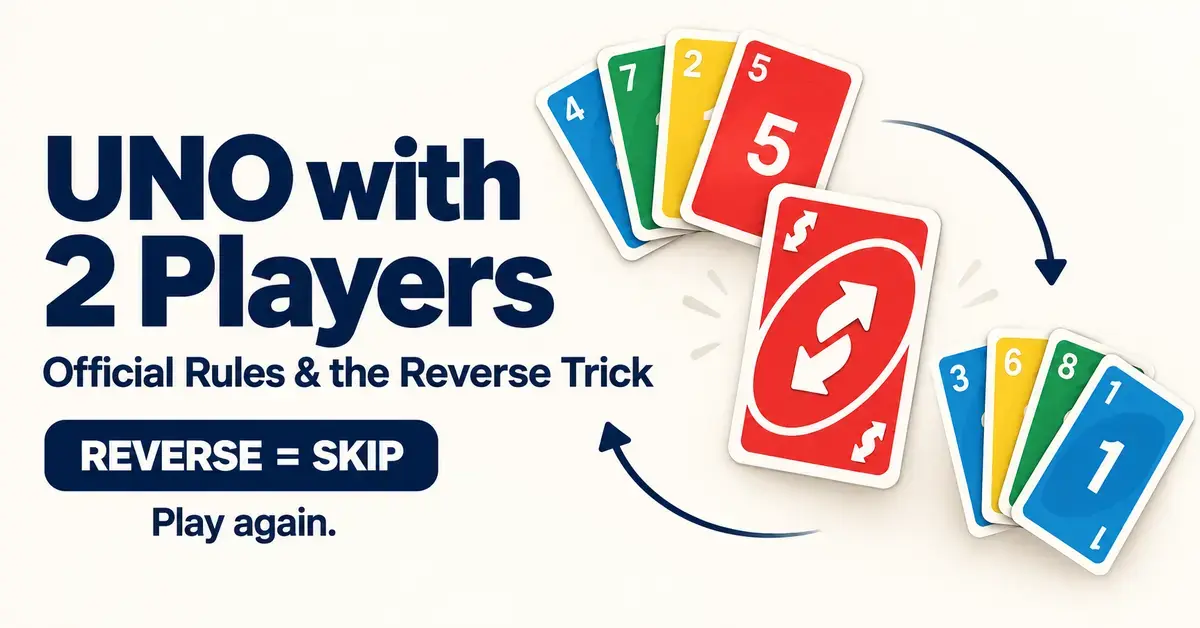
UNO is built for 2 to 10 players, and it works just as well head-to-head as it does in a big group — you only need to learn a few small rule tweaks. This guide covers the official rules for playing UNO with 2 players, including the famous “Reverse trick,” how the action cards change, how to keep score, and the mistakes that trip up most two-player games.
Key Points
- Yes, 2-player UNO is official — the game is made for 2–10 players.
- Same setup: full 108-card deck, 7 cards dealt to each player.
- Reverse = Skip: your opponent is skipped and you play again.
- Skip: your opponent loses their turn, so you take another turn.
- Draw 2 / Wild Draw 4: your opponent draws and loses their turn — play returns to you.
- Call “UNO” at one card left, exactly as in a group game.
- Scoring: the first player to reach 500 points wins the match.
Can You Play UNO with 2 Players?
Yes — you can play UNO with 2 players, and it is part of the official rules. The standard UNO instructions list the game for 2 to 10 players, and Mattel (the company that makes UNO) includes a specific set of adjustments for the two-player game. Nothing else about the deck or the goal changes: you still use the full 108-card deck, still deal 7 cards each, and still race to be the first to empty your hand.
The only real difference is how the action cards behave when there is just one other person at the table. With no third player to pass to, cards like Reverse and Skip are re-purposed so they still have a meaningful effect. That single idea is the heart of two-player UNO.
What You Need and How to Set Up a 2-Player Game
Setting up two-player UNO is identical to the group game. You need one standard UNO deck and a flat surface. Here is the setup, step by step:
- Shuffle the deck. Use the full 108-card deck: number cards 0–9 in four colours, plus Skip, Reverse, Draw Two, Wild, and Wild Draw Four cards.
- Deal 7 cards to each player. Both you and your opponent get seven cards, exactly as in a larger game.
- Start the draw pile. Place the remaining cards face down in the centre as the draw pile.
- Flip the top card. Turn over the top card of the draw pile to start the discard pile — this is the first card you match against.
If the first flipped card is an action card, it takes effect immediately (a Wild Draw Four is the exception — it is returned to the deck and a new card is flipped). For the full deal-and-play walkthrough, see our guide on how to play UNO.
The Official 2-Player Rule Changes (the “Reverse Trick”)
The official two-player rules change what three cards do: Reverse, Skip, and the two “Draw” cards. Everything else — number cards, Wild colour changes, and calling “UNO” — stays the same. Here is each change on its own.
2-Player Rule Changes
| Card | Group play (3+ players) | 2-player play |
|---|---|---|
| Reverse | Changes the direction of play | Acts like a Skip — opponent is skipped, you play again |
| Skip | Next player loses their turn | Opponent loses their turn, so you play again |
| Draw Two | Next player draws 2 and is skipped | Opponent draws 2, loses the turn, play returns to you |
| Wild Draw Four | Next player draws 4 and is skipped | Opponent draws 4, loses the turn; you pick the colour and play again |
| Wild | Choose the next colour | Same — choose the colour, then your opponent plays |
| Number cards (0–9) | Match by colour or number | Same — match by colour or number |
Reverse Works Like a Skip
In a two-player game, a Reverse card acts exactly like a Skip: your opponent loses their turn and you immediately play again. This is the “Reverse trick” that defines two-player UNO. In a group game a Reverse flips the direction of play, but with only two people there is no direction to flip, so it simply becomes a second turn for you.
Skip Lets You Play Again
Playing a Skip card skips your opponent, which means you take another turn right away. You can chain it: if your second card is another Skip or a Reverse, you keep going. A hand with several Skip and Reverse cards can let you unload a big chunk of your cards in one burst.
Draw 2 and Wild Draw 4 Make Your Opponent Draw — Then You Go Again
When you play a Draw Two, your opponent draws 2 cards and loses their turn, so play comes straight back to you. A Wild Draw Four works the same way: your opponent draws 4 cards, loses their turn, and you also choose the new colour before playing again. In two-player UNO these cards are doubly powerful — they grow your opponent’s hand and hand you a free turn at the same time.
Want a full breakdown of every special card? See our detailed guide to UNO action cards.
How a Turn Works in Two-Player UNO
On your turn you match the top card of the discard pile by colour, number, or symbol, or you play a Wild. Here is the flow:
- Look at the top discard and play a card that matches its colour, its number, or its symbol.
- If you have no playable card, draw one from the draw pile. If that card can be played, you may play it; if not, your turn ends.
- If you played a Skip, Reverse, Draw Two, or Wild Draw Four, take another turn (your opponent is skipped or made to draw).
- If you played a plain number card or a plain Wild, play passes to your opponent.
Because action cards return the turn to you, a single well-timed Skip or Draw Two can swing a two-player round very quickly.
Calling “UNO” with Two Players
You must still say “UNO” when you are down to one card, even head-to-head. If you play your second-to-last card and forget to call “UNO” before your opponent catches you, the standard penalty is to draw cards (commonly 2, or 4 in some newer editions). The rule matters just as much in a two-player game, because your single opponent is watching your hand closely and is very likely to catch a missed call.
You can also end the game on an action card. Mattel has confirmed that finishing your hand with a Skip, Reverse, Draw Two, or Wild Draw Four is allowed — the action still applies, but since you have emptied your hand you simply win the round.
How to Keep Score in a 2-Player Game
Scoring in two-player UNO uses the standard point values. When one player empties their hand, they score points based on the cards still left in the opponent’s hand:
- Number cards (0–9): face value.
- Draw Two, Reverse, and Skip: 20 points each.
- Wild and Wild Draw Four: 50 points each.
Add up the value of the loser’s remaining cards and give those points to the winner. Under official rules, the first player to reach 500 points wins the match. For a quick single game, you can simply agree that the first player to empty their hand wins the round.
Winning Strategy for Two-Player UNO
The best two-player strategy is to hold your action cards and play them in a chain rather than one at a time. Because Skip, Reverse, and the Draw cards all give you another turn, saving two or three of them lets you dump several cards in a single burst — ideally right when you are close to winning.
- Save Skips and Reverses for the finish. A back-to-back Skip and Reverse near the end can empty your hand before your opponent gets a turn.
- Time your Draw cards. Playing a Draw Two or Wild Draw Four when your opponent is close to calling “UNO” both stalls them and gives you a bonus turn.
- Watch your opponent’s colour. With only one rival, it is easy to track which colour they keep avoiding — deny it when you can.
- Do not sit on Wilds too long. A Wild is worth 50 points if you are caught holding it, so use it to escape a colour you cannot match.
Common Mistakes in Two-Player UNO
The most common mistake is forgetting that action cards give you another turn, so players pass the turn when they should keep playing. Watch out for these:
- Passing after a Skip or Reverse. In a two-player game you play again — do not hand the turn over.
- Assuming you can “stack” Draw cards. Stacking a Draw Two onto a Draw Two is a popular house rule, but it is not part of the official rules. Officially, your opponent draws and loses the turn — they cannot answer with their own Draw card.
- Playing every action card immediately. Dumping Skips one at a time wastes their chaining power; hold them for a finishing run.
- Forgetting to call “UNO.” Head-to-head, your opponent will almost always notice a missed call and make you draw.
- Thinking you cannot win on an action card. You can — ending on a Draw Four is a perfectly legal way to close out the round.
Two-Player UNO vs. Group Play
Two-player UNO is faster and more tactical than a big-group game because the turn keeps bouncing back to you and there is no unpredictable chain of players between plays. In a large group, a Draw Two hits whoever sits to your left; head-to-head it always lands on your single opponent, so action cards feel far more powerful. The trade-off is less chaos and more direct, back-and-forth play.
Sources
Frequently Asked Questions (FAQ)
Can you play UNO with just 2 players?
Yes. UNO is officially made for 2 to 10 players, and the rulebook includes specific adjustments for the two-player game. You use the same 108-card deck and deal 7 cards to each player.
What does a Reverse card do in 2-player UNO?
With two players, a Reverse works exactly like a Skip: your opponent loses their turn and you immediately play another card. There is no direction to reverse, so it becomes a second turn for you.
Do you still say “UNO” with only two players?
Yes. You must call “UNO” when you have one card left. If your opponent catches you before you say it, you draw the penalty cards, just as in a larger game.
Can you stack Draw 2 cards in a two-player game?
No, not under official rules. Stacking is a common house rule, but officially your opponent simply draws the cards and loses their turn — they cannot respond with their own Draw card.
How many cards do you start with in 2-player UNO?
Each player is dealt 7 cards, the same as in a group game. The rest form the draw pile, and the top card is flipped to start the discard pile.
