
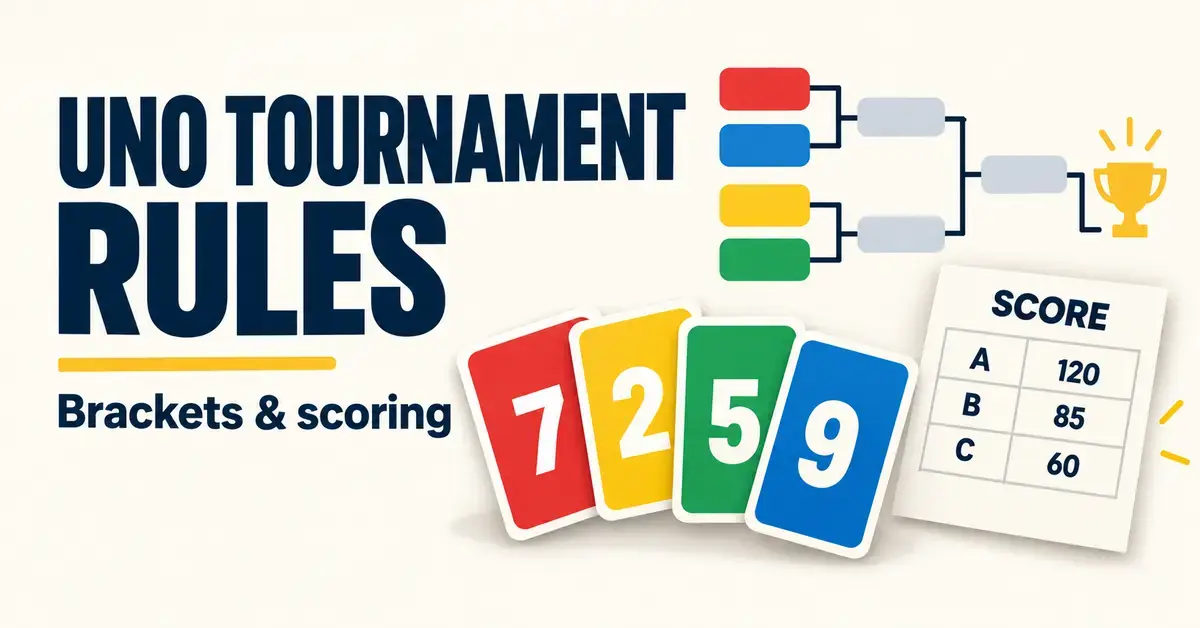
Running an UNO tournament turns a casual card game into an organized competition with a bracket, a match schedule and a running scoreboard. There is no single Mattel-sanctioned rulebook for competitive UNO, so a workable tournament ruleset combines the official UNO scoring system with the format conventions organizers have settled on: how to seat players, which bracket to use, how long each match lasts and how to decide the winner. This guide walks through every decision — from choosing a format to keeping score and avoiding the usual mistakes — so your event runs cleanly from the first deal to the final hand.
Key Points
- There is no official Mattel competitive tournament circuit — a tournament ruleset combines official UNO gameplay with organizer conventions.
- Common bracket formats: single elimination, double elimination, round robin and Swiss.
- Play solo or in teams of two (partners seated directly across from each other).
- Two scoring systems: first to 500 points, or the lowest cumulative penalty total when time is called.
- The 300-point mercy rule can end a lopsided match early.
- Agree house-rule decisions — stacking, calling UNO, finishing on an action card — before the first deal.
Are there official UNO tournament rules?
There is no official Mattel competitive tournament circuit with a fixed rulebook. Mattel publishes the core game rules — setup, turn order, the action cards and the scoring system — plus an optional Team Play mode for two-player teams, but it leaves bracket structure, match length and scheduling entirely to whoever runs the event. In practice, an “UNO tournament ruleset” therefore has two layers: the official UNO rules that govern how each hand is played, and a set of organizer decisions that turn a series of hands into a ranked competition.
That distinction matters when you write your event sheet. Anything about matching colours and numbers, action-card effects and card points is official and should not change. Anything about brackets, timing, seeding and tie-breaks is a convention you choose — so decide it in advance, write it down, and share it with every player before the first card is dealt.
What you need to run an UNO tournament
You need surprisingly little equipment — the hard part is organization, not gear. Gather the following before players arrive:
- One UNO deck per table. A standard 108-card deck handles a table of two to four players comfortably; combine two decks only if you seat very large groups at a single table.
- Tables and seating. Plan for two to four players per table. In team play, partners must sit directly across from each other so the teams alternate around the table.
- A bracket sheet or app. A printed bracket or a free online bracket generator keeps the schedule visible to everyone.
- Score sheets. One per table, with a column per player or team and a row per round, so totals are easy to verify.
- A timer. A visible clock or phone timer enforces match length and keeps rounds moving.
- A posted rules sheet. List the scoring system, the house-rule decisions and the tie-break procedure so there are no mid-game arguments.
For headcount planning and how to scale a single game up, see the guide on how many people can play UNO.
How do you choose a bracket format?
Choose the bracket format based on how many players you have and how much time you can give the event. The four formats below cover almost every UNO tournament, from a quick office lunch bracket to a full club championship.
Single elimination
In a single-elimination bracket, the loser of each match is out immediately and the winner advances. It is the fastest format and the easiest to run, but a single unlucky hand can knock out a strong player. It suits large fields and short time windows where speed matters more than fairness.
Double elimination
Double elimination gives every entrant a second chance: you must lose twice to be eliminated. The bracket splits into a winners’ bracket and a losers’ bracket, and a team dropped from the winners’ side moves to the losers’ side rather than going home. It softens the luck of a single bad hand and is the format most dedicated UNO events use, at the cost of roughly twice the matches.
Round robin
In a round robin, everyone plays everyone else and earns standings points per match (a common scheme is 2 for a win, 1 for a tie, 0 for a loss). It is the fairest way to rank players because no one is eliminated on one result, but the number of matches grows quickly, so it works best for small groups or as a group stage that feeds the top finishers into an elimination bracket.
Swiss
A Swiss format runs a fixed number of rounds and pairs players with similar records against each other each round, without eliminating anyone. It handles large fields in limited time far better than a full round robin while still producing a fair ranking, which is why game clubs favour it when dozens of players show up for an afternoon.
| Format | How it works | Best for | Luck buffer | Relative length |
|---|---|---|---|---|
| Single elimination | Lose once, you are out | Large fields, short events | Low | Shortest |
| Double elimination | Lose twice to be out (winners + losers brackets) | Serious competitive events | Medium | Medium-long |
| Round robin | Everyone plays everyone; standings points | Small groups (4–8) | High | Long |
| Swiss | Fixed rounds; pair by matching records | Large fields, fair ranking, limited time | High | Medium |
How do you seed players and build the bracket?
Seeding decides who plays whom in the first round, and the goal is to spread the strongest entrants apart so they do not meet too early. If you have no prior results, seed randomly by drawing names; if you ran a group stage first, seed by group-stage standings so the top finisher faces the weakest qualifier.
Elimination brackets work most neatly with a power-of-two field — 4, 8, 16, 32 entrants. When your count is not a power of two, give your top seeds a bye (an automatic pass through the first round) so the bracket fills correctly. For example, with 12 teams you would give the top four seeds a first-round bye and have the other eight play in, leaving eight teams for round two.
Decide early whether the event is solo or team-based. Solo brackets are simpler to seed; team play (partners of two, seated opposite) adds strategy because teammates keep the turn order flowing between them, but teammates may never reveal or hint at the cards in their hand.
How does scoring work in an UNO tournament?
Tournament scoring uses the standard UNO point values, and every organizer should post them so there is no dispute when a hand ends. When a player or team “goes out” (plays their last card), they collect points for every card still held by their opponents.
UNO Card Points Cheat Sheet
| Card | Points |
|---|---|
| Number cards (0–9) | Face value (0–9) |
| Skip | 20 |
| Reverse | 20 |
| Draw Two | 20 |
| Wild | 50 |
| Wild Draw Four | 50 |
For the full breakdown with worked examples, see the dedicated UNO scoring rules guide. In a tournament you then layer one of two scoring systems on top of those values.
First to 500 versus cumulative “lowest total wins”
First to 500 is the standard game ending: the winner of each hand banks the points from everyone else’s leftover cards, and the first player or team to reach 500 points wins the match. This is simple but can take a while, so it suits best-of formats rather than tightly timed brackets.
Cumulative “lowest total wins” flips the maths and is the more common choice for timed tournament matches. Here every player tallies the points left in their own hand at the end of each round as penalty points, you play as many rounds as the clock allows, and the player or team with the lowest accumulated total at the end wins — like golf, low score is good. It lets you fit a fixed-length match into a schedule without waiting for someone to reach a target.
Pick one system for the whole event and state it on your rules sheet. Mixing the two mid-tournament is the fastest way to confuse scorekeepers.
The 300-point mercy rule
The 300-point mercy rule ends a lopsided match early to keep the schedule on time. Under the cumulative system, if one side gains a 300-point advantage over the other during a match, the match stops immediately and the side with the lower total is declared the winner. For example, if Team A sits on 120 penalty points and Team B has climbed to 420, the 300-point gap ends the match and Team A advances. Most organizers suspend the mercy rule during championship or sudden-death hands so the final is always played out.
How long should a tournament match be?
Set a fixed match length before the event so you can build a realistic schedule. Two approaches dominate:
- Timed matches. A common standard is 45 minutes per match, playing as many rounds as fit, with the lower cumulative total winning when time is called. Championship matches often get a slightly longer cap (for example 60 minutes) so the decisive match is not rushed.
- Best-of series. Alternatively, play a best-of-three or best-of-five set of rounds, where the first side to win the majority of rounds takes the match. This ties length to results rather than the clock.
If a timed match ends in a tie, play a single sudden-death hand: the first player or team to go out and empty their hand wins the match.
Which rules should you lock down before the first deal?
Agree on the optional and house-rule decisions before play starts, because these are the points players argue about most. Write your answers on the posted rules sheet. The key decisions:
- Stacking. Officially you cannot stack a Draw Two on a Draw Two or a Draw Four on a Draw Four — see the UNO stacking rules. Most serious tournaments keep the official no-stacking rule for consistency; if you allow it, say so explicitly.
- Calling “UNO.” Enforce the official “UNO!” call rule: a player down to one card who is caught not calling UNO before the next player takes their turn draws two penalty cards. Tournaments should enforce this strictly.
- Finishing on an action card. Decide whether a player may win on a Skip, Reverse, Draw or Wild card. Officially they can; some events ban it as a house rule.
- House variants. Rules like 7-0 (swap hands), Jump-In and progressive play are fun but optional. For a straight competitive event, most organizers leave them off; see the overview of UNO house rules if you want to add any deliberately.
- Drawing. Confirm whether a player who cannot play draws one card and passes, or keeps drawing until playable. Pick one and apply it at every table.
How do you keep score and track the bracket?
Assign one scorekeeper per table and verify every total out loud at the end of each round. A clean score sheet has a column for each player or team and a row for each round, with a running total at the bottom. After each round, the scorekeeper announces the points added so both sides can confirm before the next deal.
When a match ends, record the result on the master bracket immediately and move the winner (or, in double elimination, the loser to the losers’ bracket) before starting the next match. Keeping the bracket updated in real time prevents the single most common organizational failure: losing track of who still has to play whom. Strong players will also want to brush up on how to win at UNO before competing, since tournament scoring rewards getting rid of high-value cards early.
Common mistakes when running an UNO tournament
Most tournament problems come from decisions not made in advance rather than from gameplay itself. Avoid these:
- Not agreeing house rules first. Settling whether stacking is allowed after a dispute always causes bad feeling. Decide and post everything up front.
- An awkward player count. Fields that are not a power of two need byes; skipping them breaks the bracket. Work out the byes before seeding.
- No time limit. First-to-500 matches with no clock can overrun badly and stall the whole schedule. Use timed matches or a best-of cap.
- Mixing scoring systems. Using “first to 500” at one table and “lowest total” at another makes results impossible to compare. Standardize one system.
- Loose UNO-call enforcement. If some tables enforce the penalty and others ignore it, results are not comparable. Enforce it everywhere.
- Not updating the bracket live. Record each result immediately so you always know the next match.
Who are UNO tournaments for?
UNO tournaments suit any group that wants more structure than a single casual game — family gatherings, classrooms, offices, game clubs and charity fundraisers all run them well. Solo brackets are the simplest to organize and the fairest test of an individual; team play (partners of two) adds a layer of cooperative strategy and works nicely for larger crowds. For a two-handed showdown rather than a full bracket, the two-player UNO rules cover the small adjustments to turn order. Whatever the setting, the recipe is the same: official rules for the cards, clear conventions for the event, and a visible scoreboard everyone trusts.
Sources
Frequently Asked Questions (FAQ)
Does Mattel have official UNO tournament rules?
No. Mattel publishes the core game rules and an optional two-player Team Play mode, but there is no official Mattel competitive tournament rulebook. Brackets, match length and scheduling are set by whoever runs the event, built on top of the standard UNO gameplay and scoring.
What is the best bracket for an UNO tournament?
Double elimination is the most popular choice for serious events because a single unlucky hand will not knock a player out. For large fields with limited time, Swiss works well, and small groups of four to eight get the fairest result from a round robin.
How many points win an UNO tournament match?
It depends on the scoring system you choose. In the standard game the first player or team to 500 points wins; in a timed tournament match, players usually tally the points left in their own hands each round and the lowest cumulative total wins when time is called.
What is the 300-point mercy rule?
Under cumulative scoring, if one side builds a 300-point advantage during a match, the match ends immediately and the side with the lower total wins. It keeps lopsided matches from eating the schedule and is usually suspended only during championship or sudden-death hands.
How do you handle an odd number of players?
Give your top seeds a bye — an automatic pass through the first round — so the bracket fills to the next power of two (4, 8, 16, 32). With 12 entrants, for instance, four top seeds sit out round one while the other eight play in.
