
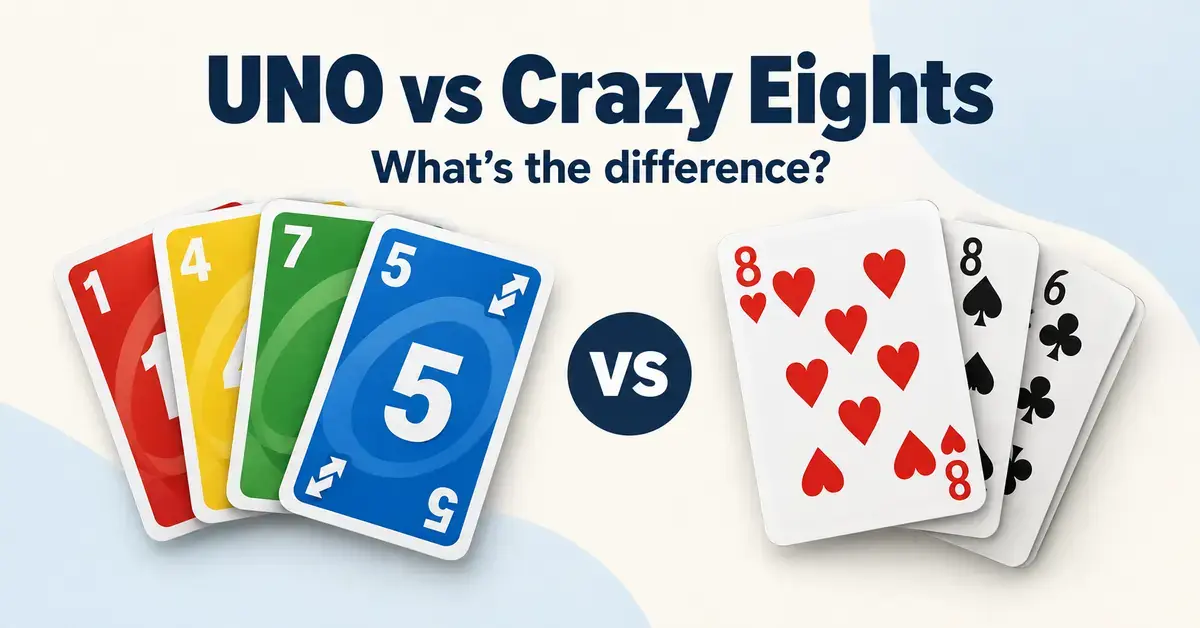
UNO and Crazy Eights are two of the most popular “shedding” card games in the world — games where you race to get rid of every card in your hand — and they are far more closely related than most players realise. In fact, UNO was invented in 1971 specifically to settle a family argument over the rules of Crazy Eights. The two games share the same core idea of matching the card on top of the pile, yet they use different decks, different wild mechanics and different scoring. This guide breaks down exactly what the two games have in common, where they split apart, and which one is the better fit for your table.
What is UNO?
UNO is a commercial card game, now owned by Mattel, played with a purpose-made 108-card deck (newer printings have 112 cards). Instead of the four suits and thirteen ranks of a normal deck, UNO uses four colours — red, yellow, green and blue — with number cards from 0 to 9 plus dedicated action cards printed right on the face: Skip, Reverse and Draw Two in each colour, along with colourless Wild and Wild Draw Four cards.
On your turn you play a card that matches the top of the discard pile by colour, number or symbol; if you cannot, you draw. When you are down to one card you must call “UNO,” and the first player to empty their hand wins the round. For the complete step-by-step rules, see our guide on how to play UNO.
What is Crazy Eights?
Crazy Eights is an older folk card game played with an ordinary 52-card deck, and it is the direct ancestor of UNO. There is no single official rulebook — it is a traditional game that spread by word of mouth, which is exactly why nearly every household plays it a little differently.
The basics are simple: play a card that matches the top discard by suit (hearts, diamonds, clubs or spades) or by rank (the number or face value). The eights are the special card — every eight is wild and lets you name the suit that the next player must follow. As in UNO, the first person to run out of cards wins. Crazy Eights is also known around the world under names such as Switch, Swedish Rummy, Mau-Mau (Germany), Pesten (the Netherlands) and Tschau Sepp (Switzerland).
How are UNO and Crazy Eights related?
UNO was created directly out of Crazy Eights. In 1971, Merle Robbins, a barber from Ohio, grew tired of the endless rules disputes that broke out whenever his family played Crazy Eights — because the game had no printed rulebook, every argument came down to “that’s not how we play it.” His fix was to design a brand-new deck that put the rules on the cards themselves, so there was nothing left to argue about.
Robbins did not really change the game — he changed the cards. He swapped the four suits for four colours, replaced ranks with the numbers 0–9, turned the “eights are wild” idea into dedicated Wild cards, and printed the special effects (Skip, Reverse, Draw Two) directly onto cards instead of relying on house rules. He named it UNO, Spanish for “one,” after the call you make on your last card. Robbins sold the rights to International Games in 1972, and the game eventually passed to Mattel, where it became one of the best-selling card games ever made. You can read the full story in our history of UNO.
UNO vs Crazy Eights Side by Side
| Feature | UNO | Crazy Eights |
|---|---|---|
| Deck | Dedicated 108-card deck (112 in newer sets) | Standard 52-card deck |
| Players | 2–10 | 2+ (about 2–5 per deck; add a second deck for more) |
| Cards dealt | 7 each | 7 each for two players; 5 each for three or more |
| Match by | Colour, number or symbol | Suit or rank |
| Wild card | Wild and Wild Draw Four | Any eight (names the next suit) |
| Action cards | Skip, Reverse, Draw Two built in | None by default (optional house rules) |
| Call on last card | Must say “UNO” or draw a penalty | No required call |
| Round winner | First to empty their hand | First to empty their hand |
| Wild card points | 50 | 50 (each eight) |
| Match target | First to 500 points | Agreed total, often 100 points |
| Origin | Invented 1971 by Merle Robbins | Traditional folk game (ancestor of UNO) |
How do the rules of UNO and Crazy Eights compare?
The rules overlap heavily because UNO grew out of Crazy Eights, but the differences are what give each game its own feel. Here is a point-by-point breakdown.
The deck
UNO uses a dedicated 108-card deck (112 in some newer sets) of four colours with numbers and action cards; you cannot play it with anything else. Crazy Eights uses a standard 52-card deck of four suits, which means you can start a game with any pack of playing cards you already own. For a full count of what is inside an UNO pack, see how many cards are in an UNO deck.
Players and the deal
Both games suit small groups. UNO officially supports 2 to 10 players and deals 7 cards to each. Crazy Eights works for 2 or more; with one deck it is comfortable for about 2 to 5 players, and larger groups simply shuffle in a second 52-card deck. The deal in Crazy Eights depends on the count: 7 cards each for two players, and 5 cards each once three or more are playing.
Matching cards
This is where the two games are almost identical. In both, you play a card that matches the top of the discard pile. In UNO you match by colour, number or symbol; in Crazy Eights you match by suit or rank. Functionally, “colour” in UNO does the same job as “suit” in Crazy Eights, and “number” does the same job as “rank.”
The wild card
Crazy Eights has one wild mechanic: any eight can be played on any card, and the player then names the suit to be followed. UNO splits that idea across two cards — the plain Wild (choose the next colour) and the Wild Draw Four (choose the colour and force the next player to draw four cards). UNO’s Wild Draw Four also carries a challenge rule that Crazy Eights has no equivalent for; see the UNO Wild Draw Four rules.
Action and penalty cards
UNO has built-in action cards — Skip, Reverse and Draw Two — that are part of the official game. Classic Crazy Eights has none of these by default; the only special card is the eight. However, because Crazy Eights is so house-rule driven, many families bolt on extra effects (for example, Queens skip a turn, Twos make the next player draw two, Aces reverse direction), which starts to resemble UNO’s action cards. The difference is that in UNO these effects are official and printed on the cards, while in Crazy Eights they are optional add-ons. Our breakdown of UNO action cards explains exactly what each one does.
Drawing when you cannot play
In UNO, if you cannot match the top card you draw one card from the pile; you may play it if it is playable, otherwise your turn ends. Crazy Eights varies by household: some play “draw one and pass,” while others make you “draw until you can play.” Always agree on the draw rule before a Crazy Eights game begins.
Calling “UNO”
UNO has a signature rule with no Crazy Eights counterpart: when you are reduced to a single card you must announce “UNO,” and if an opponent catches you staying silent you draw a penalty. Crazy Eights has no required call — some groups add a “last card” warning as a house rule, but it is not part of the traditional game.
Scoring
Both games can be played as a single round or scored over several hands, and the point values are similar in spirit. In UNO, the round winner scores the value of the cards left in everyone else’s hands — number cards at face value, Skip/Reverse/Draw Two worth 20 each, and Wild and Wild Draw Four worth 50 — and the first player to reach 500 points wins the match. Our UNO scoring rules page has a worked example.
In Crazy Eights, the cards left in losing hands are tallied each round: each eight is worth 50 points, kings, queens, jacks and tens are worth 10, aces count as 1, and all other cards score their face value. Families typically play rounds until someone crosses an agreed total such as 100 points. Because Crazy Eights has no official rulebook, whether those points count for or against players — and the exact target — is something you should settle before you start.
Key Takeaways
- Same DNA: UNO was built directly from Crazy Eights — match the top card, use a wild to change colour/suit, first to empty their hand wins.
- Deck: UNO needs its own branded deck; Crazy Eights plays with any ordinary 52-card pack.
- Wilds: Crazy Eights uses wild eights; UNO splits this into the Wild and the harsher Wild Draw Four.
- Rules certainty: UNO is standardised by Mattel; Crazy Eights has no official rulebook, so agree on the variant first.
- Best for: UNO for a settled, action-packed family game; Crazy Eights for a free, flexible game you can start anywhere.
Which game is better?
Neither game is objectively “better” — they suit different situations, so the right choice depends on what you want from game night. Here is how they compare across the things players actually care about.
For a guaranteed, consistent game
UNO wins if you want everyone reading from the same page. Because the rules are printed and standardised by Mattel, there is little to argue about, which is exactly the problem UNO was invented to solve. Crazy Eights, with its many regional variants, is more likely to spark a “that’s not how we play” debate unless you agree on the rules up front.
For playing anywhere with no special gear
Crazy Eights wins on convenience. Any ordinary 52-card deck will do, so you can play on a plane, at a cabin, or anywhere a pack of cards turns up — no need to own a specific product. UNO requires its own branded deck.
For younger children
UNO is usually easier for young kids because colours and symbols are quicker to recognise than suits and ranks, and the game is officially aimed at ages 7 and up (with UNO Junior for ages 3+). Crazy Eights requires reading a standard deck, which can be a little harder for pre-readers.
For strategic depth and chaos
UNO offers more tactical tools out of the box — stacking colours, timing a Wild Draw Four, using Skip and Reverse to control who goes next — which makes for a more swingy, chaotic game. Classic Crazy Eights is calmer and more about hand management, though house rules can add as much mayhem as you like.
For cost and availability
Crazy Eights is effectively free if you own any deck of cards, while UNO is an inexpensive but separate purchase. If you want to explore the wider family of matching games, our round-up of card games like UNO compares seven popular options side by side.
Common mistakes and misconceptions
The biggest mistake is assuming the two games share rules they do not. A few points trip players up:
- Thinking UNO has “official” stacking. Stacking a Draw Two on a Draw Two is a popular house rule, not part of official UNO — see our UNO stacking rules guide.
- Treating Crazy Eights rules as fixed. There is no single correct version. Agree on the draw rule, extra action cards and scoring before you deal.
- Expecting a “call” in Crazy Eights. The mandatory “UNO” shout belongs to UNO only; adding it to Crazy Eights is a house rule.
- Assuming eights equal Wild Draw Fours. A Crazy Eights eight only changes the suit — it does not force the next player to draw cards the way an UNO Wild Draw Four does.
- Playing UNO with a standard deck (or vice versa). The decks are not interchangeable; each game needs its own cards.
Who should play each game?
Choose UNO if you want a self-contained, standardised game with built-in action cards, bright colour matching for kids, and plenty of tactical chaos. Choose Crazy Eights if you want a flexible, no-cost game you can start with any deck, enjoy tinkering with house rules, or want to teach the “classic” version that UNO itself grew out of. Many households happily keep both: UNO for a quick, rules-settled family game, and Crazy Eights for when all you have is a spare pack of cards.
Sources
Frequently Asked Questions (FAQ)
Is UNO just Crazy Eights with different cards?
Essentially, yes — UNO was designed as a self-contained version of Crazy Eights. It keeps the same match-by-colour-or-number idea but replaces suits with colours, turns wild eights into Wild cards, and prints action cards like Skip and Reverse directly on the deck so there are no rules disputes.
Which came first, UNO or Crazy Eights?
Crazy Eights came first by decades. It is a traditional folk game that was already popular in the early 20th century, whereas UNO was invented in 1971 by Merle Robbins as a fix for the constant rule arguments that Crazy Eights caused.
Can you play Crazy Eights with an UNO deck?
Not in the standard way. Crazy Eights relies on the four suits and numbered ranks of a 52-card deck, while an UNO deck uses colours, action cards and no suits. You can improvise a shedding game with UNO cards, but it will really just be a form of UNO rather than true Crazy Eights.
Which game is easier for young children?
UNO is usually easier for young kids because matching by colour and symbol is quicker to grasp than reading suits and ranks. Classic UNO is aimed at ages 7 and up, and UNO Junior simplifies it further for ages 3 and up.
Do UNO and Crazy Eights use the same scoring?
They are similar but not identical. Both tally the cards left in losing hands, and in both the wild card is worth 50 points. UNO adds fixed values for its action cards and plays to 500 points, while Crazy Eights scores face cards at 10 and aces at 1 and usually plays to an agreed target such as 100.
