
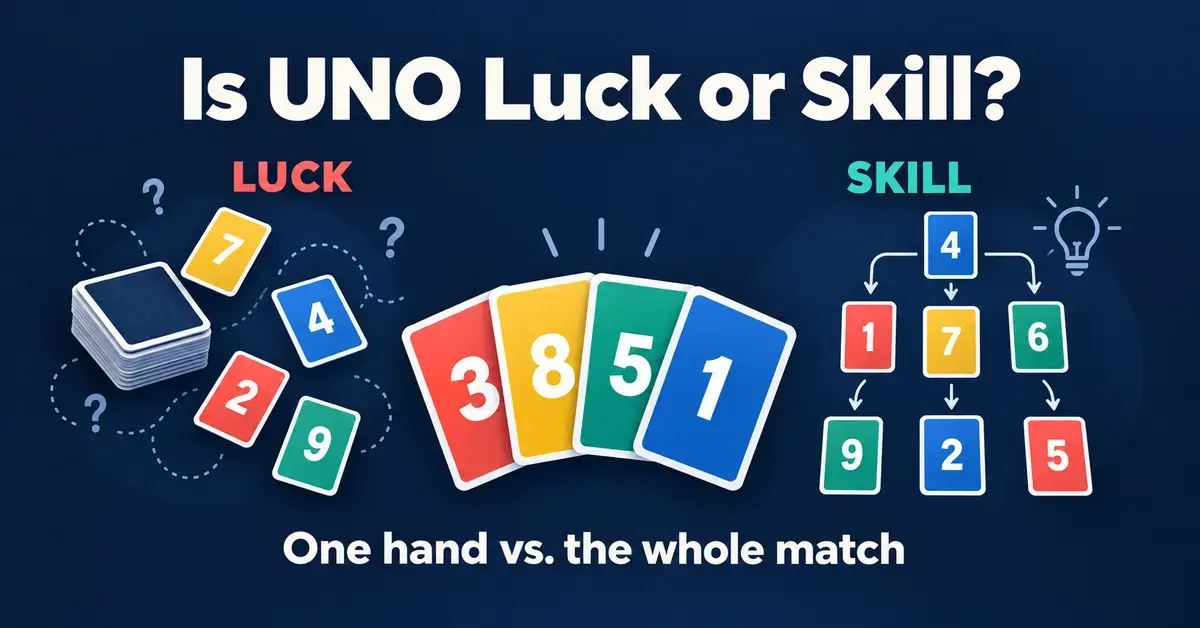
UNO is both a game of luck and a game of skill — but not in equal measure, and not on the same timescale. Any single hand is driven mostly by chance: the cards you are dealt, the order of the draw pile, and what the player before you does are all out of your control. Over a full game to 500 points, though, the better decision-maker wins far more often than random chance would predict. In short, luck decides one hand; skill decides the match. This guide breaks down exactly where each one comes from, how much weight each carries, and what you can actually control at the table.
Is UNO luck or skill? The short answer
UNO sits in the middle of the luck–skill scale, leaning toward luck in a single hand and toward skill over many hands. Unlike chess, where no hidden randomness exists, UNO deals you a random hand and forces you to draw unknown cards, so chance is baked into every round. But unlike a pure coin-flip game, UNO constantly asks you to make decisions: which card to play, which colour to choose, when to hold a Wild, and whom to target. Those decisions compound. A skilled player cannot win every hand, but they will win more hands and lose fewer points in the hands they don’t win — and that is what the 500-point format rewards.
A useful way to think about it: luck sets the range of outcomes available to you, and skill decides how well you play within that range. Great cards can carry a weak player to a single win, and a bad deal can sink a strong player on any given hand. Play long enough and the luck largely averages out, leaving skill as the deciding factor.
How luck shapes an UNO game
Luck enters UNO at three clear points, and recognising them helps you separate what you can control from what you cannot.
The deal
Each player is dealt seven random cards. A strong opening hand — a good spread of colours, a couple of Wilds, a few low numbers — is a genuine head start that no amount of skill earns. A hand stacked with one colour and high-value cards is a disadvantage you simply have to play around.
The draw pile
When you can’t match the top card, you draw blind. Whether that card rescues you or adds dead weight is pure chance. Over a hand you might draw the exact colour you needed, or you might draw five unplayable cards in a row while opponents empty their hands.
The player in front of you
UNO is a game of turn order. A Skip, Reverse, or Draw Two played by someone else can wreck a plan you had no way to foresee, and in a multiplayer game you are often hit by a Wild Draw Four aimed at the leader — who might be you. You don’t control other players’ hands, so part of every outcome is simply the luck of where you sit and what lands on you.
Where skill actually comes in
Skill in UNO is the sum of many small, repeatable decisions. None of them guarantees a win, but each one shifts the odds in your favour across a game.
Hand management
Deciding which card to play is the core skill. Shedding high-value cards (Wilds are worth 50 points, action cards 20) early protects you from a big penalty if an opponent goes out before you do. Keeping a playable card in several colours keeps your options open so you are not forced to draw. Good players think a turn or two ahead rather than just playing whatever matches.
Colour tracking and card counting
Paying attention to which colours opponents keep drawing on tells you what they are missing. If a player has been forced to draw every time green comes up, switching the colour to green with a Wild can trap them. This overlaps with the counting and tracking ideas in our advanced UNO strategy guide, and it is one of the clearest places where attention beats luck.
Bluffing and the Wild Draw Four
The Wild Draw Four is the game’s main bluffing tool because you are only supposed to play it when you have no card matching the current colour. Playing it as a bluff — and knowing when an opponent’s Draw Four can be challenged — is a skill, not a dice roll. The full mechanic is covered in our UNO Wild Draw Four rules, including what happens when a challenge succeeds or fails.
Timing and targeting the leader
Holding a Skip, Reverse, or Draw Two until the moment an opponent is about to win is a high-value play. So is steering attacks toward whoever is closest to going out. In a two-player game the skill shifts: Reverse acts like a Skip, which creates deliberate tempo plays (see our UNO rules for 2 players). Choosing when to spend your disruptive cards is where experienced players quietly pull ahead.
Key Strategies at a Glance
- Dump high-value cards early — shed Wilds (50 pts) and action cards (20 pts) before someone goes out.
- Keep a Wild in reserve for the moment you would otherwise be forced to draw.
- Watch opponents’ colours — note what they keep drawing on and switch play to that colour.
- Time your action cards — save Skip, Reverse and Draw Two to block a player about to win.
- Target the leader — aim attacks at whoever is closest to emptying their hand.
- Call “UNO” on time to avoid a self-inflicted penalty draw.
Why one hand feels like pure luck but a whole game rewards skill
The reason UNO can feel like a coin flip in the moment yet reward good players over time comes down to variance. In a single hand, the random deal and draws create a wide spread of possible outcomes, so even a weak decision can win and a strong one can lose. That short-term noise is what makes people call UNO “all luck.”
Across many hands, that noise averages out. The player who consistently sheds high cards, tracks colours, and times action cards well will convert more of their good hands into wins and lose fewer points on their bad hands. The more hands you play, the more the result reflects decision quality rather than any one lucky deal — the same reason poker is considered a skill game despite dealing random cards. UNO’s standard race to 500 points is long enough for this effect to show, which is exactly why our how to win at UNO guide can meaningfully help you win more.
How scoring tips the balance toward skill
Scoring is the mechanism that turns small skill advantages into match wins, so it deserves attention in any luck-versus-skill discussion. When a player goes out, the winner scores the point value of every card left in opponents’ hands, and the first player to 500 points wins the game.
This matters because it rewards damage control, not just winning the hand. A skilled player who gets a bad deal still tries to dump 50-point Wilds and 20-point action cards early, so that if they lose the hand they hand over fewer points. Over a game, minimising your losses on unlucky hands is just as important as winning the lucky ones — and that is a decision, not a draw. The full breakdown lives in our UNO scoring rules.
UNO Card Points Cheat Sheet
| Card | Point value |
|---|---|
| Number cards 0–9 | Face value (0–9) |
| Skip | 20 |
| Reverse | 20 |
| Draw Two | 20 |
| Wild | 50 |
| Wild Draw Four | 50 |
The winner scores the value of every card left in opponents’ hands; the first player to 500 points wins the game.
What the data says about luck versus skill in UNO
Public opinion leans toward luck, but it is divided. In a YouGov poll of 1,226 US adults conducted on 22–26 May 2020, 52% of respondents said UNO is a game of random chance rather than skill — only a slim majority. For comparison, the same survey saw strong skill consensus for chess (82%) and Scrabble (76%), and strong luck consensus for pure-chance games. UNO’s near-even split is itself telling: it reflects a game that genuinely contains both, where casual players feel the randomness of the deal while regular players notice how much their decisions change the result.
How UNO compares to other games on the luck–skill scale
Placing UNO next to familiar games shows where it really sits. It has far more decision-making than roll-and-move or pure matching games, but less than games with no hidden information.
| Game | Luck source | Skill source | Overall lean |
|---|---|---|---|
| Chess | None | Full information, deep planning | Almost all skill |
| Poker | Dealt cards | Betting, reading, bluffing over many hands | Skill over time |
| UNO | Deal and draw pile | Hand management, tracking, timing, targeting | Luck per hand, skill per game |
| Blackjack | Dealt cards | Hit/stand decisions, counting | Mixed |
| Snakes and Ladders | Dice only | None | All luck |
UNO shares DNA with other shedding and matching card games. If you enjoy weighing this balance, our roundup of card games like UNO compares several alternatives that sit at different points on the same scale.
Does the UNO version change the luck-to-skill ratio?
Yes — different UNO editions and house rules shift the balance noticeably, which is worth knowing before you judge the game as a whole.
- More luck: UNO All Wild removes colour-matching entirely and every card is wild, so the draw and the deal drive more of the result. Simplified editions aimed at young children also lean heavily on chance.
- More skill: Two-player UNO rewards tempo and card-counting because you track one opponent closely. House rules that allow stacking or the 7-0 swap add decisions, though they also add swings.
- Both at once: UNO No Mercy piles on brutal draw cards and mandatory stacking, which raises the luck swings and the skill ceiling simultaneously — you can be buried fast, but good timing matters more because the penalties are so large.
Because classic UNO is only one member of a large family, the ratio you experience depends on which edition is on the table. Our overview of every UNO version lays out how each one plays.
Common mistakes that let luck beat you
Most players who feel UNO is “just luck” are leaving skill on the table. These are the recurring mistakes that hand control back to chance:
- Hoarding Wilds too long. Saving a Wild for the perfect moment that never comes means you eat 50 points if someone goes out first. Spend them before the hand gets dangerous.
- Ignoring opponents’ colours. If you don’t watch what others draw on, you miss easy chances to switch to a colour they can’t play.
- Playing the obvious card every turn. Dumping whatever matches, with no plan for your next two turns, forfeits the hand-management edge entirely.
- Forgetting to call “UNO.” Getting caught with one card and no call costs you a penalty draw — a self-inflicted loss that has nothing to do with the deal.
- Attacking the wrong player. Spending a Draw Two on someone with a full hand instead of the player about to win wastes your best disruption.
- Chasing a bad hand. When you’re clearly behind, failing to dump high-value cards means a larger point loss when the hand ends.
If you want a structured way to fix these, start with our UNO tips for beginners and build from there.
Sources
Frequently Asked Questions (FAQ)
Is UNO more luck or more skill?
It depends on the timescale. A single hand is mostly luck because of the random deal and draw pile, but a full game to 500 points rewards skill, since good decisions compound across many hands and the luck averages out.
Can you win UNO with pure strategy?
No. Strategy greatly improves your odds, but you cannot overcome a genuinely terrible deal and draw in a single hand. Skill wins you more hands over time; it cannot guarantee any one hand.
Why does UNO feel so random?
Because short-term variance is high. The deal, the draws, and other players’ action cards create wide swings in any single hand, so even good decisions can lose and poor ones can win in the moment.
Which UNO skills matter most?
Hand management (shedding high-value cards early), tracking opponents’ colours, timing your Skip, Reverse and Draw Two cards, and knowing when to play or challenge a Wild Draw Four. These decisions decide close games.
Is UNO a game of chance legally or for gambling?
UNO is sold and played as a family card game, not a gambling product. While it contains an element of chance, the standard game involves no betting or money, so it is treated as casual entertainment rather than a game of chance in the gambling sense.
