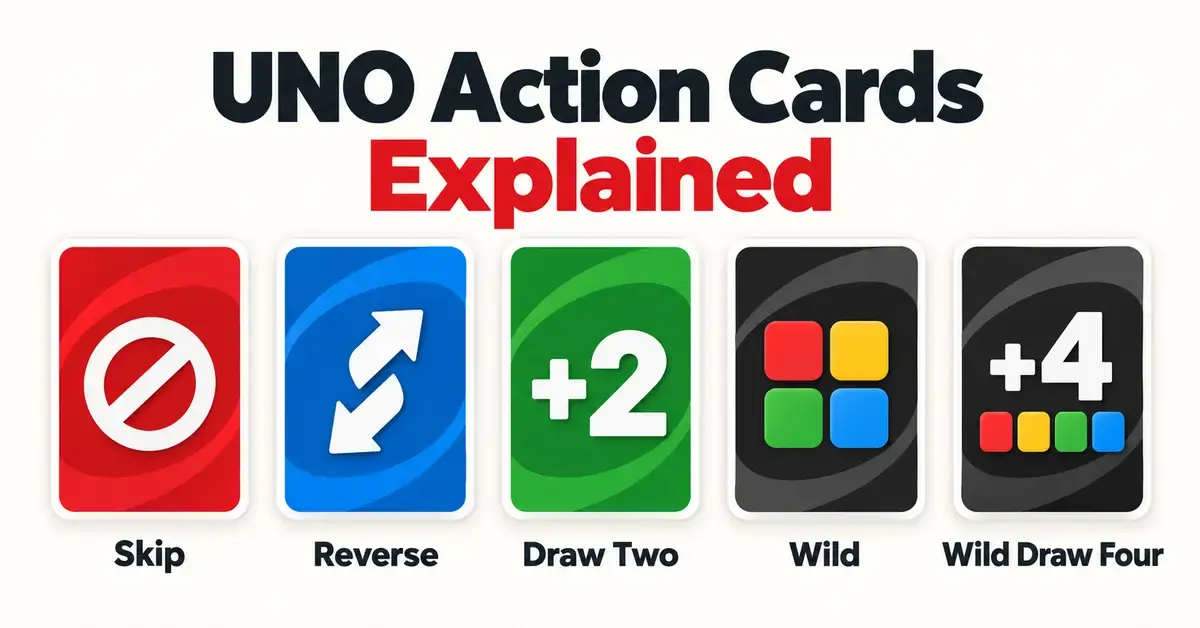
UNO action cards are the coloured symbol cards — Skip, Reverse and Draw Two — plus the black Wild and Wild Draw Four cards that change what happens on your turn instead of simply matching a number. Knowing exactly what each one does, when you are allowed to play it and how many points it is worth is the difference between a smooth game and a rules argument at the table. This guide explains every action and wild card in a standard UNO deck, with a quick meaning table, the official rules from Mattel, and the edge cases that trip people up — like why Reverse behaves like Skip when only two people are playing.
Key Points
- A standard UNO deck has 108 cards; 24 are coloured action cards (Skip, Reverse, Draw Two) and 8 are black wild cards (Wild, Wild Draw Four).
- Coloured action cards can only be played on a matching colour or on the same type of action card.
- Wild and Wild Draw Four can be played on any colour, and you choose the next colour.
- Wild Draw Four is only legal when you have no card of the current colour in hand.
- Official Mattel rules do not allow stacking +2 or +4 cards — that is a house rule.
- Each coloured action card scores 20 points; each wild card scores 50 points.
What are UNO action cards?
Action cards are the cards that do something to the game rather than just matching a colour or number. Most cards in an UNO deck are ordinary number cards (0 to 9) in four colours — red, yellow, green and blue — and you play them by matching either the colour or the number on top of the discard pile. Action cards work the same way for matching, but each one also triggers an effect: it can skip a player, reverse the turn order, force the next player to draw cards, or let you change the colour in play.
There are two families of action cards. Coloured action cards — Skip, Reverse and Draw Two — belong to one of the four colours and are printed with a symbol instead of a number. Wild cards — Wild and Wild Draw Four — are black, belong to no colour, and can be played on top of any card. If you are still learning the basics of turns, matching and calling “UNO”, start with our full guide on how to play UNO and use this page as the reference for what each special card does.
UNO action cards at a glance
The table below summarises every action and wild card in a standard 108-card deck: its symbol, its effect, how many are in the deck, and how much it scores at the end of a round. Each section further down explains the card in detail, including the situations where it behaves differently.
UNO Action Cards at a Glance
| Card | Symbol / marking | What it does | In a deck | Points |
|---|---|---|---|---|
| Skip | Circle with a diagonal line | Next player loses their turn | 8 (2 per colour) | 20 |
| Reverse | Two curved arrows | Reverses the direction of play (acts as Skip with two players) | 8 (2 per colour) | 20 |
| Draw Two (+2) | “+2” | Next player draws 2 cards and is skipped | 8 (2 per colour) | 20 |
| Wild | Four-colour circle | You choose the next colour of play | 4 | 50 |
| Wild Draw Four (+4) | Four-colour design with “+4” | You choose the colour; next player draws 4 and is skipped | 4 | 50 |
How many action cards are in an UNO deck?
A standard UNO deck has 108 cards, and 32 of them are action or wild cards. The rest — 76 cards — are number cards. The action-card total breaks down like this: eight Skip cards, eight Reverse cards and eight Draw Two cards (two of each in every colour), plus four Wild cards and four Wild Draw Four cards. Because the wilds have no colour, there are only four of each rather than one per colour.
Knowing these counts helps with strategy: with only two of any coloured action card in each colour, a Skip or Draw Two you have already seen is unlikely to reappear soon. For the complete card-by-card breakdown of the deck, see our guide on how many cards are in UNO. Note that decks made since 2015 sometimes ship as 112 cards, adding one Wild Shuffle Hands card and three blank customisable Wild cards, but the classic 108-card composition is the standard for the rules described here.
The Skip card: what it means
The Skip card makes the next player lose their turn. When you play it, the player who would normally go next is jumped over entirely, and play moves on to the person after them. The card shows a circle with a diagonal line through it (the universal “no entry” symbol) in one of the four colours.
You can only play a Skip on a card of the matching colour or on another Skip card. So a red Skip can be played on any red card, or on a Skip of any other colour. Once it lands, its colour becomes the active colour that the next player (the one who was not skipped) has to match. In a two-player game, playing a Skip means your opponent misses their turn and you play again immediately.
The Reverse card: what it means
The Reverse card changes the direction of play. If the turn order is currently running clockwise, it flips to anticlockwise, and vice versa. The card is marked with two curved arrows pointing in opposite directions. Like the other coloured action cards, it can only be played on a matching colour or on another Reverse card, and its colour becomes the colour to match.
Reverse is more tactical than it looks. In a three-or-more-player game it can hand the turn straight back to the player who just went, protect you from an opponent who is about to win, or set up your own next turn. It is worth 20 points if it is left in someone’s hand at the end of a round.
Reverse in a two-player game
In a two-player game, the Reverse card acts exactly like a Skip card. Because there are only two of you, reversing direction sends the turn back to you — the same result as skipping your single opponent — so you take another turn immediately. This is part of the official rules, although some modern instruction sheets leave it out, which is why it confuses. Treat two-player Reverse as “play again” and you will be following the rules correctly.
The Draw Two (+2) card: what it means
The Draw Two card forces the next player to draw two cards and lose their turn. It is printed with “+2” in one of the four colours. When you play it, the next player picks up two cards from the draw pile and is then skipped, so play continues with the person after them. In a two-player game, that means your opponent draws two, and you go again.
A Draw Two can only be played on a matching colour or on another Draw Two card. If a red Draw Two is on top, you can respond with any red card or with another Draw Two of any colour — but as the next section explains, responding with another Draw Two does not pass the penalty along under the official rules.
Can you stack Draw Two and Draw Four cards?
No — stacking is not part of the official UNO rules. In 2019, Mattel publicly confirmed that you cannot play a +2 on a +2 (or a +4 on a +4) to push a growing penalty onto the next player. Under the official rules, when a Draw Two is played, the next player simply draws two cards and misses their turn; they do not get to answer it with another Draw Two. The same applies to Wild Draw Four.
Stacking is a hugely popular house rule, and plenty of groups enjoy it, but it is a house rule rather than an official one. If you play with stacking, agree on it before the game starts so nobody is surprised.
The Wild card: what it means
The Wild card lets you choose the colour that play continues in. It is black, carries no colour of its own, and shows a four-colour circle. Because it belongs to no colour, you can play a Wild on top of any card at any time — even when you have another playable card in your hand. After playing it you name any colour (red, yellow, green or blue), and the next player must match that colour or play another Wild.
The Wild is one of the most flexible cards in the deck. It lets you switch to a colour you hold a lot of, or steer away from a colour an opponent seems to be collecting. It is worth 50 points if left in a hand at the end of a round, so it is valuable to play rather than hold.
The Wild Draw Four (+4) card: what it means
The Wild Draw Four is the most powerful card in the deck: you choose the next colour, and the next player must draw four cards and lose their turn. Like the plain Wild, it is black and can change the colour to anything you like. It shows a four-colour design with “+4” on it.
There is one important restriction. Officially, you may only play a Wild Draw Four when you have no card in your hand that matches the current colour (matching numbers or other action cards do not count — only the colour). This keeps the strongest card in the game from being used too freely, and it is the source of the game’s most argued-about rule, the challenge. For the full challenge procedure, penalties and worked examples, see our dedicated guide to the UNO Wild Draw Four rules.
The Wild Draw Four challenge rule
The challenge rule lets the next player question whether a Wild Draw Four was played legally. If you suspect the person who played it actually held a card of the current colour, you can challenge before drawing your four cards. The player who used the card must then privately show you their hand. If they were bluffing — they did have a matching colour — they draw the four cards instead of you. If they were honest — they had no matching colour — the challenge fails, and you draw six cards (the original four plus two more) and still miss your turn. Because the penalty for a wrong guess is steep, only challenge when you have a good reason to.
What happens when an action card is the first card flipped?
At the start of a round, the dealer turns up the top card of the draw pile to begin the discard pile, and that first card can be an action card. Classic UNO rules give each one a specific effect on the opening turn:
- Skip: the first player (to the dealer’s left) is skipped, and play moves on.
- Reverse: the direction reverses, so the dealer effectively plays first and play proceeds to the right.
- Draw Two: the first player draws two cards and is skipped.
- Wild: the first player chooses the colour to start play.
- Wild Draw Four: it is returned to the deck, and a new card is turned up in its place.
Newer rule sheets simplify this: if the first card flipped is any action or wild card, it is set aside, and another card is turned up until a number card appears. Both approaches are valid — just agree on which one your group uses before dealing.
How much are action cards worth in scoring?
Action cards carry high point values, which matters if you play to a score. Each coloured action card — Skip, Reverse and Draw Two — is worth 20 points, and each Wild and Wild Draw Four is worth 50 points. Number cards are worth their face value (a 7 is 7 points, a 0 is 0). When a player goes out, the round winner scores the total value of the cards still held by everyone else, so being caught with a Wild or two at the end is expensive. For the full scoring method and how to play to 500 points, see our guide to the UNO scoring rules.
Common mistakes with UNO action cards
Even experienced players get these wrong. Watching for them keeps games fair and quick:
- Assuming +2 and +4 stack. Under official rules, they do not. Passing the penalty on with another draw card is a house rule, not the printed rule.
- Forgetting Reverse equals Skip with two players. Playing Reverse against a single opponent means you go again, not that nothing happens.
- Playing Wild Draw Four when you hold the current colour. Officially it is only legal with no matching colour, and a successful challenge makes you draw the cards yourself.
- Matching a Draw Two to a number. A coloured action card can only be played on its own colour or on the same type of action card — not on a matching number.
- Playing an action card on your last card without calling UNO. Going down to one card still requires the UNO call, action card or not, or you may be penalised.
Sources
Frequently Asked Questions (FAQ)
What are the action cards in UNO?
The action cards are Skip, Reverse and Draw Two (the coloured symbol cards), plus the two black wild cards, Wild and Wild Draw Four. Each changes the flow of play — skipping a player, reversing direction, forcing draws or changing the colour — rather than just matching a number.
Does the Reverse card act as a Skip in a two-player game?
Yes. With only two players, reversing the direction sends the turn straight back to you, which is the same outcome as skipping your opponent. You play again immediately. This is part of the official rules.
Can you stack Draw Two or Wild Draw Four cards?
Not under the official rules. Mattel confirmed in 2019 that you cannot answer a +2 with another +2, or a +4 with a +4, to pass on a bigger penalty. Stacking is a common house rule, so agree on it before you start if you want to use it.
Can you play a Wild card whenever you want?
You can play a plain Wild card at any time, even if you hold a card that matches the pile. The Wild Draw Four is different: officially you may only play it when you have no card of the current colour in your hand.
How many points are UNO action cards worth?
Each coloured action card — Skip, Reverse and Draw Two — is worth 20 points. Each Wild and Wild Draw Four is worth 50 points. These values count against whoever is still holding the cards when another player goes out.
