
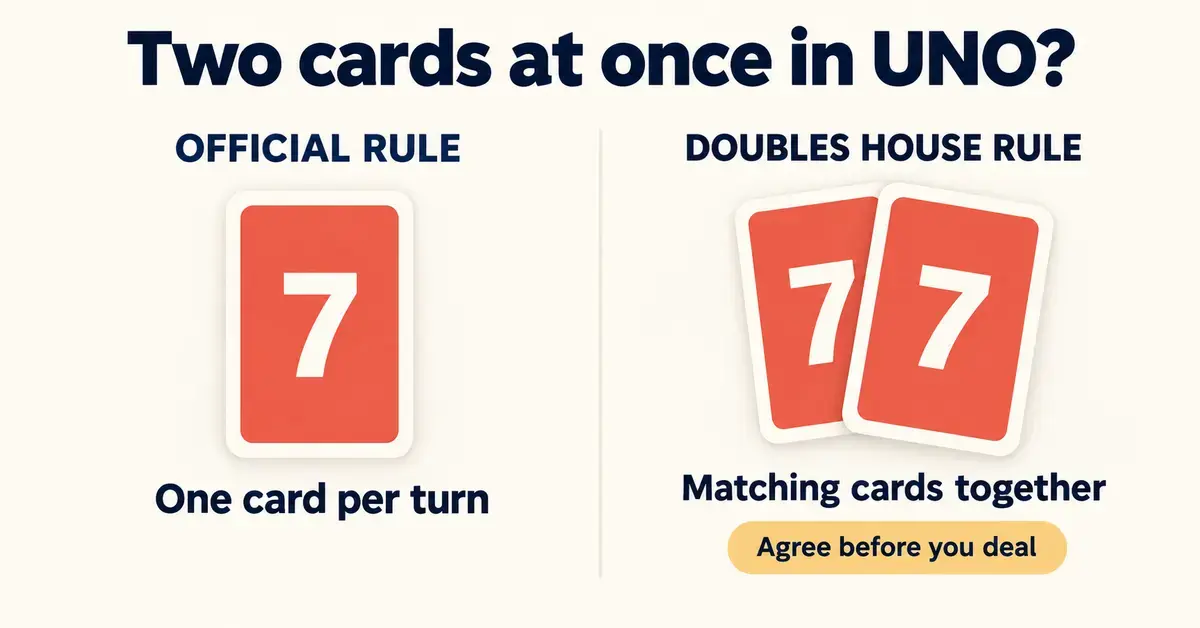
No — under the official UNO rules you cannot play two cards at once. Each player puts down a single card on their turn, full stop. Playing two (or more) cards together is a popular house rule, usually called “doubles,” and it is not part of Mattel’s printed rulebook. This guide gives you the official verdict in plain terms, shows exactly how the doubles house rule works, explains how it differs from stacking and jump-in (two moves people often confuse with it), and offers simple ways to agree on it fairly before you deal.
Key Points
- Official rule: No — UNO is a one-card-per-turn game, so you cannot legally play two cards at once.
- Doubles: A popular house rule that lets you play two or more matching cards together. It is unofficial — agree on it before you deal.
- Not stacking: Stacking piles Draw 2 / Draw 4 penalty cards as a reaction; doubles plays matching cards on your own turn.
- Not jump-in: Jump-in plays an exact duplicate out of turn; doubles happens during your normal turn.
- Mattel’s position: The makers of UNO have confirmed only one card is played per turn in the standard game.
The official verdict: one card per turn
Officially, you may play only one card on your turn. Mattel’s printed UNO instructions describe a turn as matching the top card of the discard pile by colour, number or symbol and putting down that single card. There is no rule anywhere in the standard game that lets you lay down two matching cards together, combine numbers, or empty two cards from your hand in one go.
This single-card limit is the same rule that makes several “everybody does it” moves unofficial. If you are following the official UNO rules, a turn is: play one legal card, or draw one card if you cannot (and play that drawn card if it matches). Nothing in that sequence involves a second card from your hand.
So if someone at your table asks, “Can I drop both my red 7s at once?” the by-the-book answer is no. You would play one red 7 this turn and keep the other for later. The only way two cards leave your hand together is if everyone has agreed to a house rule first.
What “playing two cards at once” actually means
“Playing two cards at once” usually points to one specific house rule: doubles. Before explaining it, it helps to separate three different moves that all get lumped together, because the official answer is different for each and mixing them up causes most table arguments.
- Doubles — playing two or more identical cards from your hand on your own turn. This is the move this article is about.
- Stacking — responding to a Draw 2 or Draw 4 played against you by adding your own Draw card on top, so the penalty grows and passes on. This happens as a reaction, not on a free turn.
- Jump-in — playing an exact duplicate of the top card out of turn, interrupting the normal order of play.
All three are house rules; none appears in the official rulebook. The rest of this guide focuses on doubles, then shows clearly where the other two differ.
How the doubles house rule works
The doubles house rule lets you play more than one matching card in a single turn. Groups play it in two main ways, and it is worth deciding which version you mean before the first hand, because they change the game by very different amounts.
Version 1: true doubles (same colour and number)
In the strictest version, you may only play cards that are completely identical — same colour and same number. If the top card is a green 4 and you hold two green 4s, you lay both down together and your turn ends on the second one. The next player then has to match the green 4 showing on top. This is the tidiest form of the rule because the cards you combine would each have been legal on their own.
Version 2: matching numbers of any colour
A looser, very common version lets you play any cards that share the same number, regardless of colour. If the top card is a blue 7, you could play a blue 7 and then slap down a red 7 and a yellow 7 on top of it in the same turn. Here the colour can change mid-turn, so the card left showing on top (the yellow 7 in that example) sets the colour the next player must follow. This empties hands much faster and is the version most people picture when they say “doubles.”
What about action and Wild cards?
Action cards are where doubles gets messy, so agree on this up front. Some tables allow two identical action cards — for example, two red Skips — and apply the effect twice (two Skips in a row). Others restrict doubles to number cards only, because stacking two Draw 2s together overlaps with the separate rule on stacking Draw 2 and Draw 4 cards and can snowball quickly. The safest default is to limit doubles to plain number cards and handle Draw cards under their own house rule, if you use one at all.
Why Mattel limits you to one card
Mattel keeps UNO to one card per turn to protect the game’s pace and tension. The whole point of UNO is managing a shrinking hand under pressure; letting players dump matching cards in bulk would end rounds in a flash and reduce the skill of choosing which card to play and when.
The makers of UNO have become unusually public about these distinctions. In May 2019, the official UNO account clarified that you cannot pile Draw 2 and Draw 4 penalty cards on top of each other — a ruling that surprised millions of players who had done it for years. The same spirit applies to doubles: just because a move is popular and feels natural does not make it official. Mattel’s position is consistent — one card leaves your hand per turn unless a specific edition or an agreed house rule says otherwise.
Doubles vs stacking vs jump-in
Doubles, stacking and jump-in are three separate house rules, and knowing which one is on the table prevents most disputes. The quick way to tell them apart: doubles happens on your own turn with matching cards, stacking is a reaction to a Draw card played at you, and jump-in breaks turn order entirely.
Doubles vs Stacking vs Jump-In
| Move | What you do | When it happens | Official UNO rule? |
|---|---|---|---|
| Standard play | Put down one card matching colour, number or symbol | On your turn | Yes |
| Doubles | Play two or more matching cards together | On your turn | No — house rule |
| Stacking | Add a Draw 2 / Draw 4 on top of one played against you | Reacting to a Draw card | No — house rule |
| Jump-in | Play an exact duplicate of the top card | Out of turn | No — house rule |
Jump-in is its own well-known variant: if you hold an exact copy of the card just played, you can play it immediately even if it is not your turn, and play then resumes from you. If your group likes fast, interrupt-driven games, read the dedicated guide to the UNO jump-in rule before mixing it with doubles, because the two can clash over who plays next.
How to use the doubles rule fairly
Agree on the doubles rule before you deal, and write down the version you are using if the group is new to it. Because doubles is unofficial, there is no referee to settle a mid-game disagreement, so a 20-second chat up front saves a lot of friction. Cover these points:
- Which version? Identical cards only (same colour and number) or any matching number across colours.
- Action cards? Number cards only, or are two identical Skips, Reverses or Draw 2s allowed — and do their effects apply twice?
- Calling UNO. Decide when the UNO call applies. If doubles drops you to one card, you still have to call it; see the rule on calling UNO for the timing and penalty.
- Scoring. Doubles does not change card values — the winner still totals the cards left in everyone else’s hands, so review how UNO scoring works if you play to 500 points.
Doubles sits alongside a whole family of optional twists. If your group enjoys bending the rules, the roundup of fun UNO variations and the full list of UNO house rules are good places to find others that pair well with it.
Common mistakes with the doubles rule
Most doubles arguments come from not settling the details first. Watch for these in particular:
- Assuming it is official. Doubles is a house rule. Playing it in a tournament, an app, or with strangers who expect standard rules will cause disputes.
- Confusing doubles with stacking. Playing two of your own Draw 2s on your turn is doubles; adding a Draw 2 on top of one played against you is stacking. They are different moves with different house rules.
- Forgetting which card ends on top. In the any-colour version, the last card you lay sets the colour for the next player — players often forget this and the next turn gets challenged.
- Not deciding on action-card doubles. Two Skips, two Reverses or two Draw 2s can swing a round hard; if you have not agreed whether their effects double, expect a dispute the first time it happens.
- Missing the UNO call. Dropping two cards can take you from three cards to one in a single turn — it is easy to forget to call UNO when your hand shrinks that fast.
Is the doubles rule worth playing?
Doubles is worth trying if your group wants faster, higher-energy rounds, but skip it if you prefer the tension of the standard game. It is purely a matter of taste, since the rule is optional. Weigh the trade-offs:
- Pros: rounds end faster, big matching hands feel rewarding, and it adds a small layer of planning (holding pairs for a big turn).
- Cons: it shortens games, can make luck matter more than skill, and — because it is unofficial — only works when everyone agrees.
If you want the game to last and reward careful card management, the standard one-card-per-turn rule is the better choice. If you want a quick, chaotic family round, doubles delivers that in a few minutes.
Sources
Frequently Asked Questions (FAQ)
Can you officially play two cards at once in UNO?
No. The official Mattel rules allow one card per turn. You play a single card that matches the top of the discard pile by colour, number or symbol, or draw one card if you cannot. Playing two cards together is only possible as an agreed house rule.
What is the doubles rule in UNO?
Doubles is a house rule that lets you play two or more matching cards in the same turn — either cards that are completely identical, or any cards sharing the same number. It speeds up the game but is not part of the official rulebook, so the table must agree to it first.
Is playing doubles the same as stacking?
No. Doubles means playing matching cards on your own turn. Stacking means responding to a Draw 2 or Draw 4 played against you by adding another Draw card on top so the penalty grows. Both are house rules, but they are different moves and are decided separately.
Can you play two Draw 2 cards at the same time?
Only under a house rule. Officially you cannot. Some groups allow two identical Draw 2s as doubles and make the next player draw four, but others keep doubles to number cards to avoid overlap with stacking. Agree on this before you start.
Which card counts when you play doubles of different colours?
The last card you lay down is the one that counts. In the version that allows any matching number, the final card on top sets the colour the next player must match, even if you changed colours during your turn.
